
News arrives today the way it so often does: fragmented, already interpreted, already contested before it has even been properly read. A statement by Roberto Vannacci, a former Italian Army general and political figure known for his controversial public remarks on gender, identity, and civil rights, and then the word “femicide.” It is not only politics that reacts to it. It is language itself that seems to be put on trial.
And yet, before positions, before polemics, before statements, there remains a slower, almost uncomfortable question: what do words do when we use them? They do not simply describe the world. They organize it. They make it speakable. And, in a very real sense, they make it possible.
Consider the ancient Greek word δημοκρατία: from δῆμος (dêmos, “people”) and κράτος (krátos, “power”), it literally forms the idea of “power of the people.” A word that already contains a promise within it: that political authority does not belong to one, but to a collective of citizens. Even if its historical reality has always been far more contradictory than its etymology suggests, it remains one of those rare terms in which language and political imagination so clearly overlap.
“Femicide” is a much more recent word, but it works in a similar way: it does not merely describe an event, but attempts to name a structure. It refers to the killing of a woman not as an isolated act, but as the possible—and recurring—outcome of a system of relations in which gender becomes a form of hierarchy. In this sense, the term moves away from news reporting and toward sociology, but also toward collective awareness.
In Italian legal language, femicide has become a specific criminal offense under legislation approved in 2025. However, the term is still widely used in public debate and in the social sciences in a broader sense, because it does not only describe a single crime, but points to a recurring pattern of gender-based violence, relationships of control, and structural power imbalances.
There is a subtle tension at the heart of it all. On one hand, the word risks becoming a slogan; on the other, it tries to hold together a reality that would otherwise dissolve into isolated incidents. Each time it is used, it does not only say what happened. It also says how we choose to see it. And, above all, whether we are willing to recognize that what we call a “single case” may in fact be part of something larger—still incomplete, still difficult to fully acknowledge.
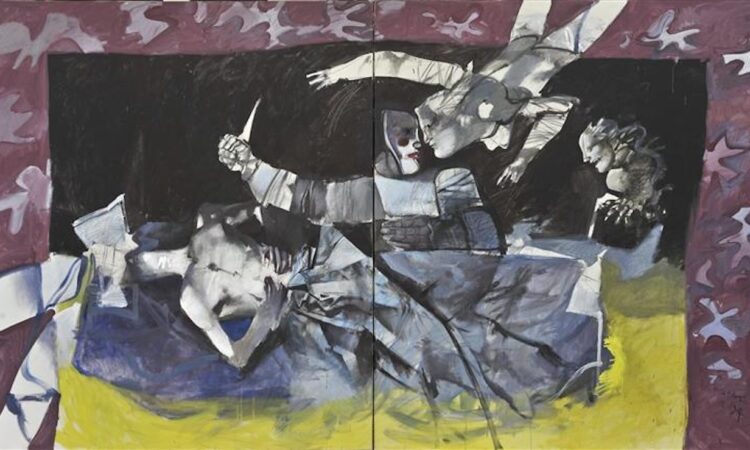
(Cover photo: The Murder by Dimitris Mytaras, public domain)
❤️ Support Florence Daily News
If you liked this article, please consider supporting Florence Daily News.
We are an independent news site, free from paywalls and intrusive ads, committed to providing clear and reliable reporting on Florence and Tuscany for everyone.
Your support — whether a one-time gift or a regular contribution — helps us stay independent and keep telling the stories that matter.
Donate securely via Stripe below.
Make a one-time donation
Make a monthly donation
Make a yearly donation
Choose an amount
Or enter a custom amount
Your contribution is appreciated.
Your contribution is appreciated.
Your contribution is appreciated.

Eirini Lavrentiadou is an actress and singer, born in Thessaloniki in 1992. She lives in Florence, where she trained at the city’s Theatre Academy and the Fiesole School of Music. She has performed in classical Greek and European plays, worked with international directors and companies, and appeared in concerts ranging from opera to jazz. She contributes to Florence Daily News as a writer.
Discover more from Florence Daily News
Subscribe to get the latest posts sent to your email.