
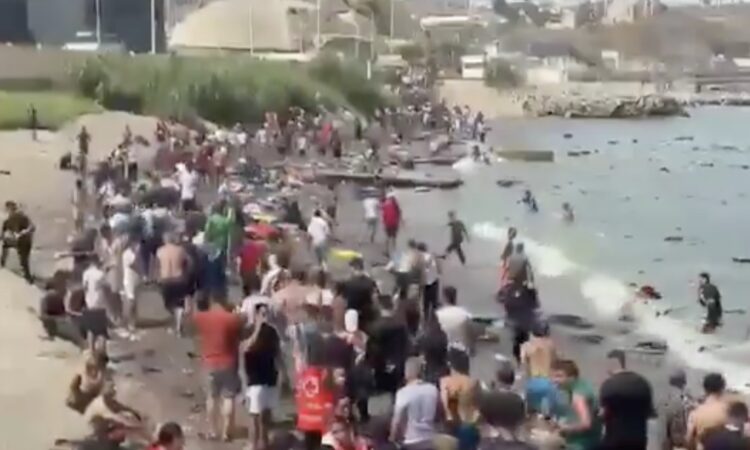
Ceuta is a geographical anomaly. It is officially part of Spain, yet it sits on the northern coast of Africa, surrounded by Morocco. For decades, it has been one of the European Union’s few land borders with Africa—and one of the continent’s most enduring symbols of migratory pressure.
In recent days, thousands of migrants crossed the border in an attempt to reach European territory. Images of crowded camps, overwhelmed security forces, and a frontier suddenly unable to contain the flow spread across the world.
Italy’s response came almost immediately. Even before the issue had begun its journey through European institutions, Prime Minister Giorgia Meloni took to social media, describing the scenes as “shocking” and calling for the European Union to respond forcefully against Spain.
Whether such a measure could ever become reality is, in some ways, beside the point. The rules governing the Schengen Area are not rewritten through a social-media post. They require legal procedures, assessments by the European Commission, and negotiations among member states. The more interesting question is not whether the proposal could succeed. It is why it was announced in that way.
For decades, politics followed a familiar sequence. First came the decisions, then the official documents, and finally the press conferences. Governments spoke after they had governed.
Today, that order appears to have been reversed.
One possible explanation lies not in Brussels but in Rome. Italy’s right governs while also competing with itself. Matteo Salvini continues to dominate the politics of immediate reaction on immigration. Roberto Vannacci, using even more confrontational language, exerts constant pressure on the same electorate, challenging Brothers of Italy for ownership of the country’s most hard-line positions.
There is no need to speculate about Meloni’s intentions to observe a broader political reality: in the age of algorithms, those who speak first often get to define what an event means. Whoever establishes the narrative first forces everyone else to respond within it.
This is how the logic of social media enters government. It changes not only how leaders communicate, but when they choose to communicate. Politics no longer waits for institutions to produce decisions. It moves first, seeking to occupy the public’s emotional attention before the institutional process has even begun.
Perhaps this is the deepest transformation of democracy in the digital age. Governments no longer simply use social media. Increasingly, they govern according to its tempo.
❤️ Support Florence Daily News
If you liked this article, please consider supporting Florence Daily News.
We are an independent news site, free from paywalls and intrusive ads, committed to providing clear and reliable reporting on Florence and Tuscany for everyone.
Your support — whether a one-time gift or a regular contribution — helps us stay independent and keep telling the stories that matter.
Donate securely via Stripe below.
Make a one-time donation
Make a monthly donation
Make a yearly donation
Choose an amount
Or enter a custom amount
Your contribution is appreciated.
Your contribution is appreciated.
Your contribution is appreciated.

Eirini Lavrentiadou is an actress and singer, born in Thessaloniki in 1992. She lives in Florence, where she trained at the city’s Theatre Academy and the Fiesole School of Music. She has performed in classical Greek and European plays, worked with international directors and companies, and appeared in concerts ranging from opera to jazz. She contributes to Florence Daily News as a writer.
Discover more from Florence Daily News
Subscribe to get the latest posts sent to your email.