
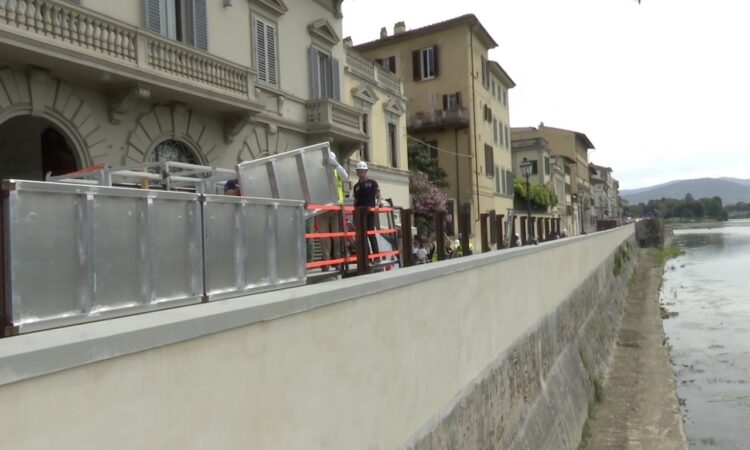
Florence has carried out the first operational test of a new system of removable flood barriers designed to protect the city from major flooding of the Arno River.
The test took place on Lungarno delle Grazie, near Ponte Vecchio, where civil protection teams assembled several sections of the metal barriers. The project forms part of a wider programme of hydraulic defence works funded through Italy’s National Recovery and Resilience Plan (PNRR), with an investment of €15 million along both banks of the Arno between Nave a Rovezzano and Ponte Santa Trinita.
Tuscany regional president Eugenio Giani attended the exercise and joined civil protection workers in assembling some of the barrier modules.
Protection until expansion basins are completed
Regional authorities said the barriers will provide additional protection for Florence while work continues on three major flood-control basins upstream at Pizziconi, Prulli and Restone in the Valdarno area.
According to the Tuscany Region, once those projects are completed, the combination of expansion basins and removable barriers will provide an additional safety margin of around 50 centimetres above the water levels expected during a flood event with a statistical return period of 200 years.
The works are intended to improve the capacity of the urban section of the Arno to handle floodwaters. Officials estimate that the river’s flow capacity through Florence will increase from approximately 3,200 cubic metres per second to around 3,500 cubic metres per second.
That represents a further improvement on the post-1966 flood interventions, which had already increased the river’s capacity from about 2,500 to 3,200 cubic metres per second.
Installed only during emergencies
The barriers are not permanent structures. The metal components will be stored at a regional warehouse in the Mantignano area of Florence and deployed only when needed.
Installation is planned during civil protection exercises and when orange or red weather alerts are issued for the Arno. Regional authorities said the system is designed to be activated rapidly based on river monitoring data and flood forecasts.
Testing activities on Lungarno delle Grazie are expected to continue until June 29.
A city shaped by the memory of 1966
The project is part of Florence’s long-term effort to reduce flood risk after the devastating Arno flood of November 4, 1966, one of the worst natural disasters in the city’s modern history. The flood killed dozens of people across Tuscany and caused extensive damage to homes, businesses, churches, libraries and works of art.
Regional officials describe the new barriers as another element in a broader flood-defence strategy that includes river engineering works, expansion basins and increasingly sophisticated forecasting and monitoring systems.
❤️ Support Florence Daily News
If you liked this article, please consider supporting Florence Daily News.
We are an independent news site, free from paywalls and intrusive ads, committed to providing clear and reliable reporting on Florence and Tuscany for everyone.
Your support — whether a one-time gift or a regular contribution — helps us stay independent and keep telling the stories that matter.
Donate securely via Stripe below.
Make a one-time donation
Make a monthly donation
Make a yearly donation
Choose an amount
Or enter a custom amount
Your contribution is appreciated.
Your contribution is appreciated.
Your contribution is appreciated.
Discover more from Florence Daily News
Subscribe to get the latest posts sent to your email.