
Almost everyone knows that feeling, even if not everyone recalls it immediately.
It is night. You are driving home after a dinner, a visit to relatives, a day at the beach. The car is wrapped in darkness, and the only light comes from the headlights sliding across the asphalt. Then something changes. A wrong sentence. An argument. A resentment resurfacing. The father at the wheel stiffens. He accelerates.
No one says anything, but everyone notices.
The curves become sharper. The overtaking more abrupt. The engine rises in pitch. In the back seat, the children fall silent. They look out of the window or fix their gaze on the seat in front of them. The fear is not only in the speed, but in the sudden recognition that the person driving is no longer driving only the car.
The French writer Neige Sinno has used this image to speak about power. But the metaphor seems to go beyond her conclusion.
Because the dominant feeling of the present may not be fear. It may be powerlessness.
We live in an era in which, within a few hours, one can travel across the world without moving from a room. A war. A fire. A climate conference. A distant political decision. Images arrive without hierarchy, all at the same distance.
Never before has it been possible to see so much.
Never before has it been possible to influence so little.
For most of history, what one feared roughly coincided with what one could act upon. The world was smaller, but not entirely separate from action. A farmer, a craftsman, a merchant: the distance between problem and intervention was shorter.
Today that link has been broken.
We can be involved in almost everything. But we can directly intervene in very little.
A distant war alters the price of energy. A decision made elsewhere affects work, healthcare, savings. A remote climatic event reflects itself in harvests, insurance, migration. Everything is connected, and precisely because of this, everything seems to concern us.
But being concerned does not mean being able to act.
From this arises a form of experience that is difficult to name. It is not simply anxiety. It is not simply information. It is the experience of witnessing something from which one is excluded while it unfolds.
To see. To understand. To react inwardly. And to have no access to the wheel.
We might call it a combination of hyper-awareness and under-power.
But perhaps the issue is not only how much we know. It is how we know it.
Collective problems arrive in individual form. One after another. On a phone screen, in the silence of a room, before falling asleep. And they are processed that way: alone, as if it were up to a single mind to solve them. This is where part of contemporary powerlessness arises. Not because power is absent, but because it is experienced in the wrong form.
Real change rarely belongs to the isolated individual. It belongs to collective forms: movements, institutions, diffuse pressures, slow accumulations. But these forms are difficult to perceive while living inside everyday life. One lives alone what exists only together with others.
Perhaps the paradox of the present is this: we are more connected than ever, and yet more alone in the way we process what happens. We receive the same news, but not in the same space. We share the same events, but not the same response.
Perhaps the question is not whether we know more. Nor whether we do more. Many already know enough. Many already do what they can.
The question is another: where does what we know go when it does not find a place in which to become something shared?
In the back seat there is not only fear of speed. There is also the feeling that no one, alone, can change the direction of the road.
And yet, unlike childhood, we are no longer forced to stay there.
But it is not at all clear what it means, for adults, to realize that the car keeps speeding forward without the problem being only who holds the wheel.
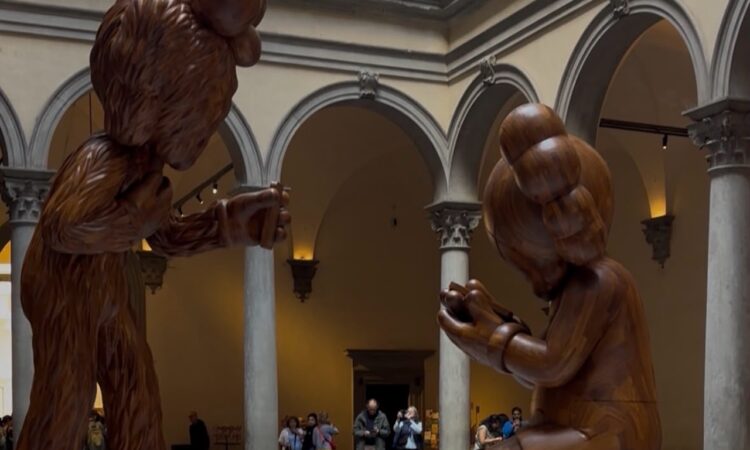
(Cover photo: The message by Kaws, Palazzo Strozzi, 2025)
❤️ Support Florence Daily News
If you liked this article, please consider supporting Florence Daily News.
We are an independent news site, free from paywalls and intrusive ads, committed to providing clear and reliable reporting on Florence and Tuscany for everyone.
Your support — whether a one-time gift or a regular contribution — helps us stay independent and keep telling the stories that matter.
Donate securely via Stripe below.
Make a one-time donation
Make a monthly donation
Make a yearly donation
Choose an amount
Or enter a custom amount
Your contribution is appreciated.
Your contribution is appreciated.
Your contribution is appreciated.

Eirini Lavrentiadou is an actress and singer, born in Thessaloniki in 1992. She lives in Florence, where she trained at the city’s Theatre Academy and the Fiesole School of Music. She has performed in classical Greek and European plays, worked with international directors and companies, and appeared in concerts ranging from opera to jazz. She contributes to Florence Daily News as a writer.
Discover more from Florence Daily News
Subscribe to get the latest posts sent to your email.