
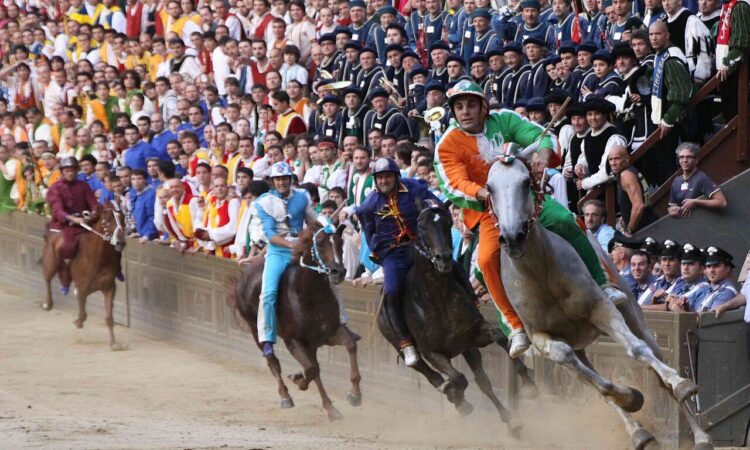
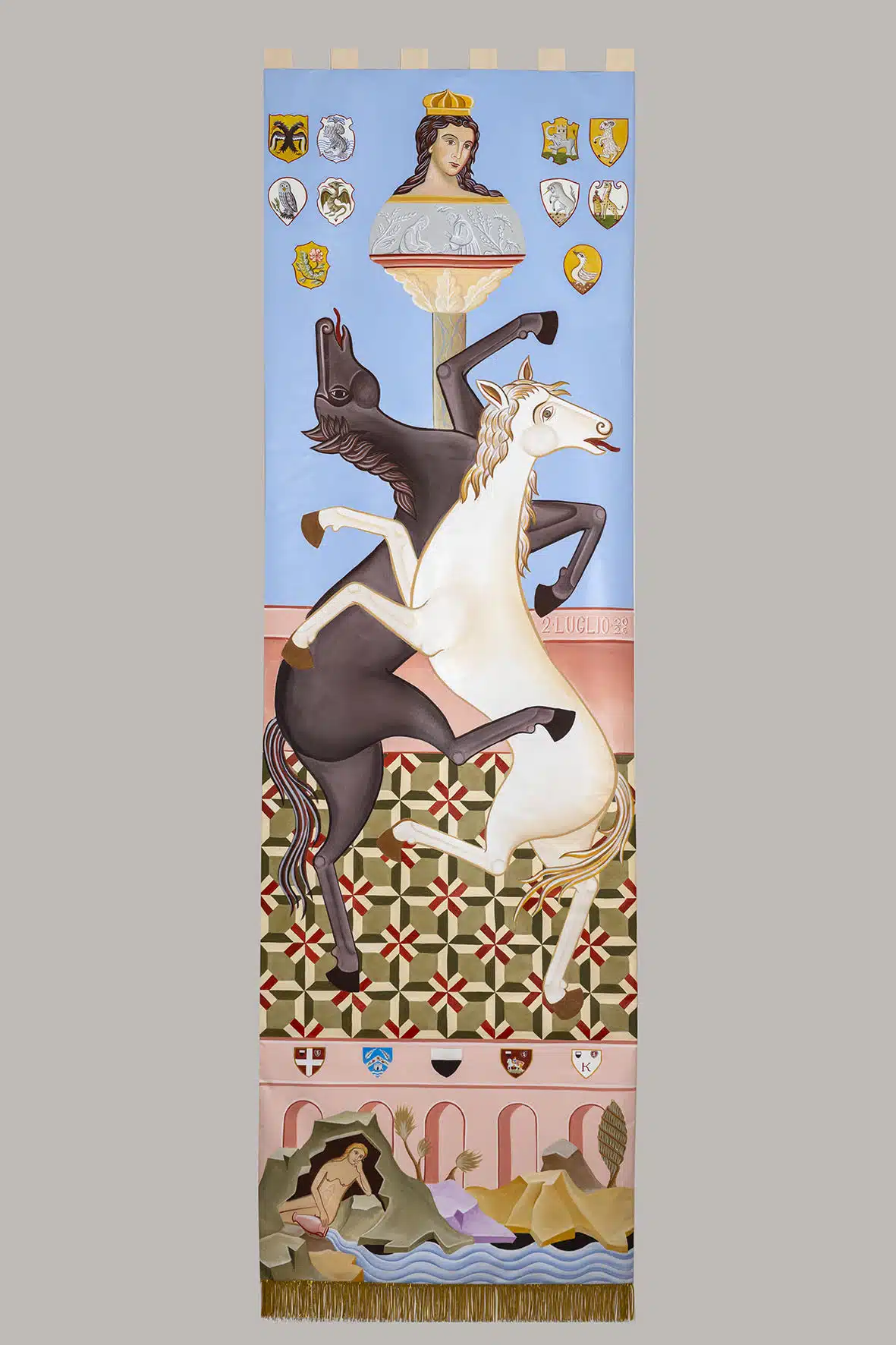
With just days to go before the Palio of July 2, Siena has unveiled the Drappellone, the painted silk banner that will be awarded to the winning contrada in the city’s historic horse race. This year’s banner was created by Trentino artist Ismaele Nones and, alongside the traditional dedication to the Madonna of Provenzano, references the 800th anniversary of the death of Saint Francis of Assisi.
The presentation of the Drappellone is one of the most anticipated moments leading up to the Palio. While the race itself lasts little more than a minute, it is the culmination of centuries of history, intense neighbourhood rivalries and civic traditions that remain central to life in Siena.
More than a horse race
Held twice a year in Siena’s shell-shaped Piazza del Campo, the Palio is one of Italy’s oldest and most distinctive public events. The race takes place on July 2, dedicated to the Madonna of Provenzano, and on August 16, dedicated to the Assumption of Mary.
Ten horses and riders compete in each race, representing ten of Siena’s seventeen contrade, or historic city districts. The participating contrade change according to a rotation system and previous results.
For residents, the Palio is far more than a sporting contest. Each contrada functions as a social and cultural community with its own museum, traditions, colours, symbols and headquarters. Many Sienese identify strongly with their district throughout their lives.
The importance of the Drappellone
Although the winning horse receives widespread attention, the real prize is the Drappellone — often called the Cencio by locals. The banner is commissioned from a different artist for each race and typically combines religious themes, references to Siena’s history and contemporary artistic interpretations.
This year’s work by Nones includes symbols linked to the city, such as the Balzana — Siena’s black-and-white coat of arms — as well as references to the legend of the city’s origins and to Saint Francis. The artist also drew inspiration from the so-called “Little Testament of Siena”, a brief text dictated by Francis during a stay in the city in 1226.
After the race, the Drappellone is carried in celebration to the winning contrada, where it becomes part of the district’s historical collection.
A tradition watched around the world
The Palio attracts thousands of visitors from Italy and abroad every year. In the days leading up to the race, Siena hosts historical processions, religious ceremonies, horse trials and neighbourhood dinners that bring together residents and visitors.
While the event is deeply rooted in local identity, it has become one of Tuscany’s best-known cultural traditions internationally, offering a glimpse into a form of civic life that has survived for centuries.
Practical information
The next Palio will take place on 2 July 2026 in Piazza del Campo, the main square in Siena, about 75 kilometres south of Florence.
Access to the centre of the square is free but limited by capacity, while balconies, windows and reserved seating areas are generally booked well in advance. Visitors are advised to arrive several hours before the race, as large crowds gather throughout the day.
The race itself lasts only a few laps around the square, but the celebrations and ceremonies surrounding it continue long after the winning contrada crosses the finish line.
Update – 2 July, 2026
The Palio has been postponed until Friday 3 July after heavy rain left the temporary tuff track in Piazza del Campo unsafe for racing. The final morning trial, known as the provaccia, was also cancelled because of the condition of the track. Siena’s municipal authorities delayed the decision until early afternoon in the hope that weather conditions would improve, but ultimately opted to postpone the race as a precaution. The programme is expected to resume on Friday, weather permitting.
(Cover photo Roberto Vicario via Wikipedia)
❤️ Support Florence Daily News
If you liked this article, please consider supporting Florence Daily News.
We are an independent news site, free from paywalls and intrusive ads, committed to providing clear and reliable reporting on Florence and Tuscany for everyone.
Your support — whether a one-time gift or a regular contribution — helps us stay independent and keep telling the stories that matter.
Donate securely via Stripe below.
Make a one-time donation
Make a monthly donation
Make a yearly donation
Choose an amount
Or enter a custom amount
Your contribution is appreciated.
Your contribution is appreciated.
Your contribution is appreciated.
Discover more from Florence Daily News
Subscribe to get the latest posts sent to your email.