
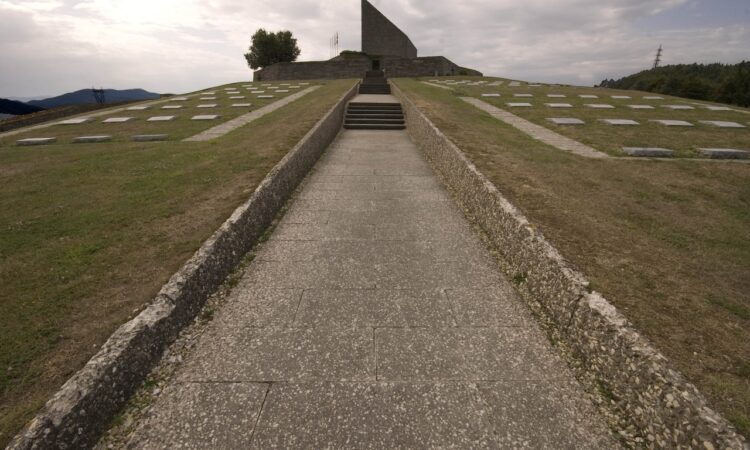
High in the Apennines between Florence and Bologna, a long stone wall winds around a hillside covered with thousands of graves. This is the German Military Cemetery at the Futa Pass, one of Tuscany’s most striking and less widely known places connected with the history of the Second World War.
For more than twenty years, the cemetery has also provided the setting for theatre performances by the company ArchivioZeta, which has used drama and literature to explore war, violence, memory and European history.
That experience is now due to end. The Volksbund Deutsche Kriegsgräberfürsorge, the German War Graves Commission responsible for the site, has decided to conclude the theatrical activities at the cemetery in 2026, citing the particular nature of military cemeteries and sensitivity towards the families of those buried there.
The decision has prompted Tuscany’s regional government to seek talks with German representatives and the organisations involved. Regional culture councillor has written to the German Embassy, and a meeting with Germany’s honorary consul in Florence is expected at the end of August.
Italy’s largest German war cemetery
The scale and history of the Futa cemetery help explain why the question of how the site should be used is particularly sensitive.
Located at an altitude of 952 metres near Firenzuola, around 40 kilometres north of Florence, the cemetery contains the remains of 30,776 German war dead, making it the largest German military cemetery in Italy. It was inaugurated on June 28, 1969.
Many of those buried there died during the fighting around the Gothic Line, the major German defensive system that crossed the Apennines during the final phase of the Second World War in Italy. The Futa Pass was one of its strategically important sectors.
The soldiers buried at the cemetery did not all die at the pass itself. After the war, the Volksbund collected remains from battlefield graves and municipal cemeteries across ten provinces, including Florence, Bologna, Pistoia, Lucca, Pisa and Ravenna, bringing them together at the Futa site.
The cemetery therefore became not simply a burial ground connected with a single battle, but a vast repository of the German military dead from a large part of central and northern Italy.
A cemetery built into the landscape
The Futa cemetery is also remarkable for its architecture.
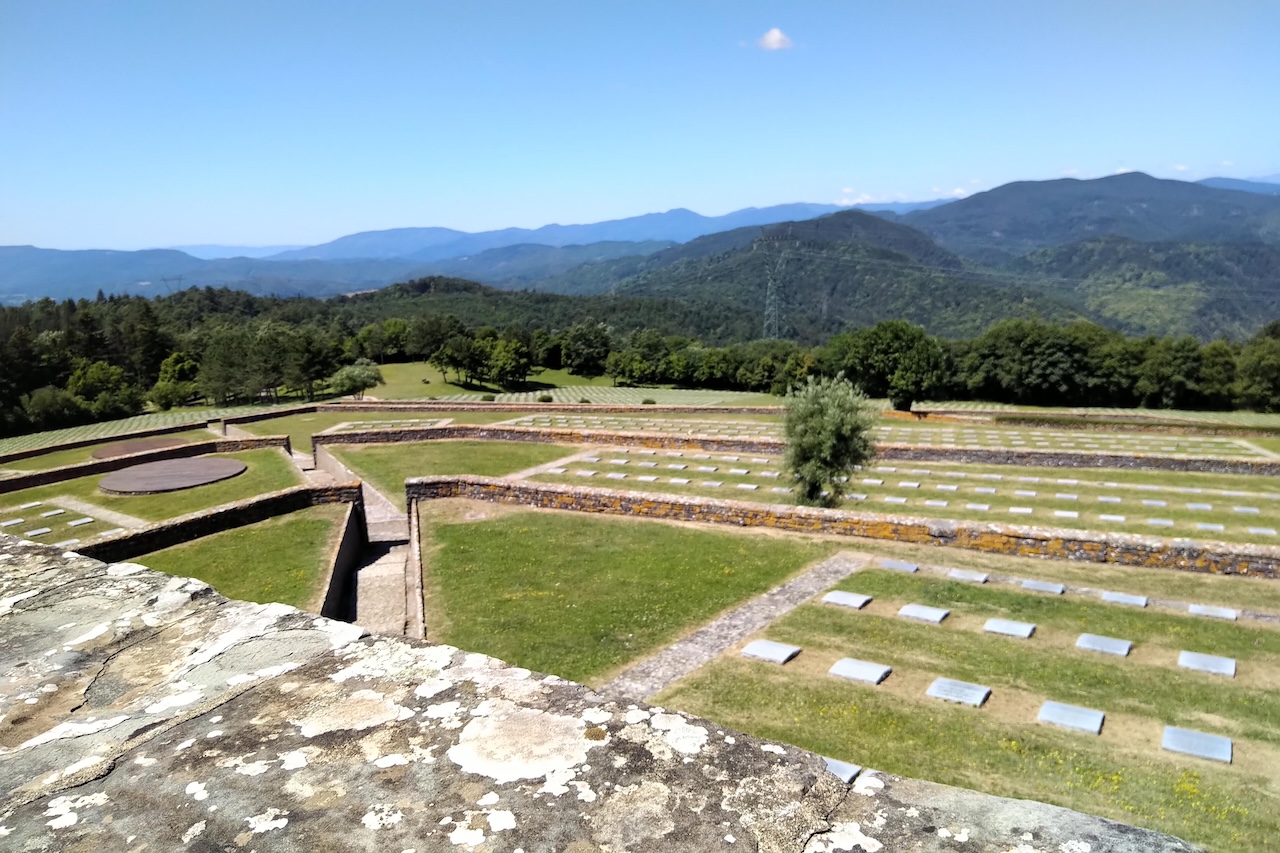
Rather than creating a conventional monumental military cemetery, German architect Dieter Oesterlen designed a structure that follows the contours of the Apennine hillside. A stone wall approximately two kilometres long climbs gradually around the mountain in a spiral, enclosing terraces containing the graves.
The cemetery is divided into 72 burial sections, while the spiral eventually reaches a memorial area and crypt. A communal grave nearby contains the remains of 397 German soldiers. The design deliberately prevents visitors from seeing the entire cemetery from a single point: the landscape and the graves reveal themselves gradually while walking through the site.
Its austere architecture, surrounded by the mountains where some of the final battles of the Italian campaign were fought, has made the Futa a distinctive place of remembrance rather than a celebration of military history.
More than twenty years of theatre and memory
It was within this setting that ArchivioZeta began staging performances in 2003. Even the Volksbund has documented the company’s long presence at the memorial, describing the Futa site as the setting for its work since that year.
The performances developed around the relationship between theatre, history and memory rather than conventional entertainment. Over the years, the cemetery itself became part of the theatrical experience: audiences encountered texts about conflict and human responsibility in a landscape containing the physical evidence of war.
The Volksbund has now decided that this chapter should close, while Tuscan institutions are asking whether a form of cultural activity compatible with the cemetery’s primary function might still be possible.
A first contact has already taken place between ArchivioZeta and the German Embassy, according to the Tuscany Region, and the planned meeting at the end of August will provide another opportunity to discuss the future.
Whatever the outcome, the debate draws attention to an unusual place less than an hour from Florence: a hillside where more than 30,000 individual stories of the Second World War are preserved, and where for more than two decades theatre has attempted to transform remembrance into a contemporary reflection on Europe’s past.
(Cover photo: Vignaccia76 via Wikimedia)
❤️ Support Florence Daily News
If you liked this article, please consider supporting Florence Daily News.
We are an independent news site, free from paywalls and intrusive ads, committed to providing clear and reliable reporting on Florence and Tuscany for everyone.
Your support — whether a one-time gift or a regular contribution — helps us stay independent and keep telling the stories that matter.
Donate securely via Stripe below.
Make a one-time donation
Make a monthly donation
Make a yearly donation
Choose an amount
Or enter a custom amount
Your contribution is appreciated.
Your contribution is appreciated.
Your contribution is appreciated.
Discover more from Florence Daily News
Subscribe to get the latest posts sent to your email.