
The restoration of Giotto’s frescoes in the Bardi Chapel at the Basilica of Santa Croce is approaching completion after a project that has combined conservation, scientific research and art historical study. The intervention, led by the Opificio delle Pietre Dure (OPD), Italy’s leading state conservation institute, began in 2022 and is now entering its final stages. Conservators are currently carrying out the final finishing work ahead of the chapel’s official reopening, scheduled for September 2026.
The fresco cycle, depicting scenes from the life of St Francis, is considered one of the masterpieces of Giotto’s mature period. Painted in the early 14th century for the influential Bardi banking family, the decoration covers roughly 180 square metres and illustrates six key episodes from the life of the founder of the Franciscan order.
A project years in the making
The restoration builds on a major diagnostic campaign carried out by the Opificio delle Pietre Dure in 2010 with support from the Getty Foundation. That research used advanced non-invasive technologies to study Giotto’s painting techniques and assess the condition of both the Bardi Chapel and the neighbouring Peruzzi Chapel. The findings helped lay the groundwork for a long-term conservation strategy.
The current project was formally developed in 2018 through an agreement involving the Opera di Santa Croce, the Opificio delle Pietre Dure and the Association for the Restoration of Italy’s Artistic Heritage (ARPAI). Work continued despite delays caused by the pandemic and has benefited from significant support from Fondazione CR Firenze. The overall investment exceeds €1 million.
Revealing centuries of history
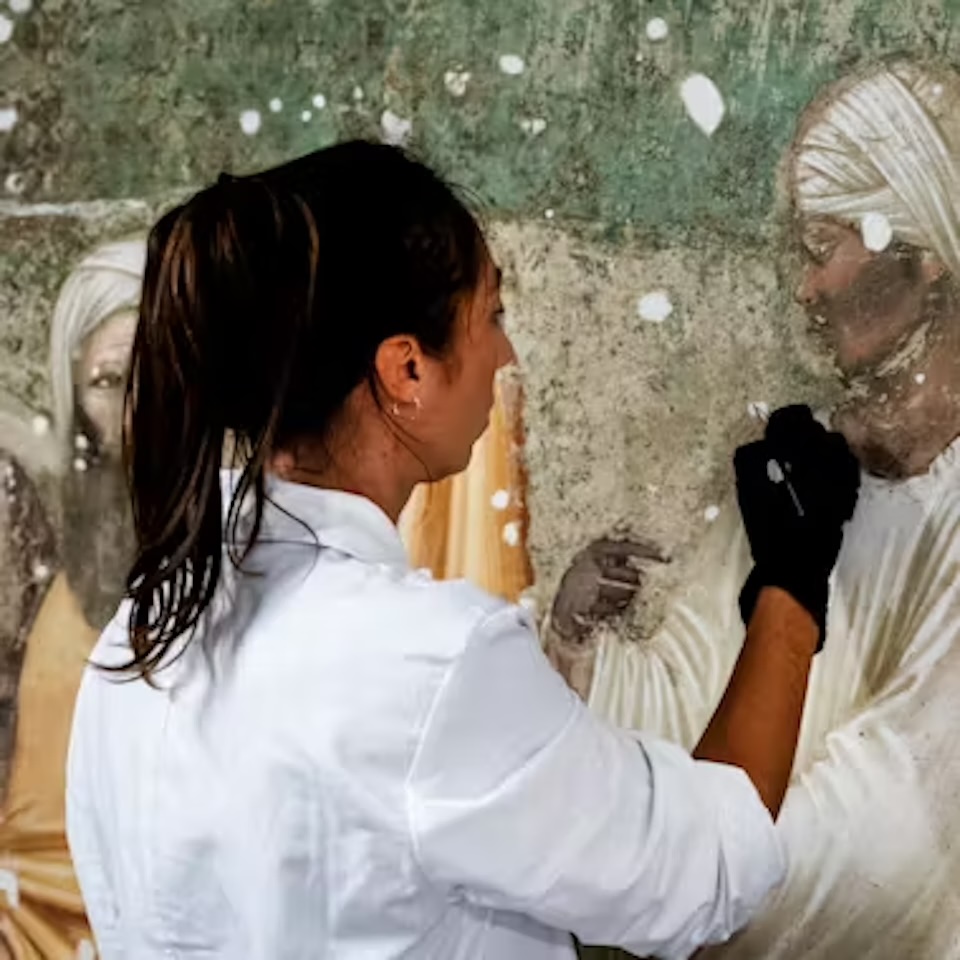
The chapel has undergone a complex conservation history. The frescoes were covered with limewash, probably during the first half of the 18th century, and remained largely hidden until the mid-19th century. Their rediscovery between 1852 and 1853 led to extensive restoration work, but also caused damage through the mechanical removal of the whitewash and the loss of some painted areas.
A second major intervention took place in 1957–58 under superintendent Ugo Procacci and restorer Leonetto Tintori. Their work removed many 19th-century repaintings in an effort to recover what Tintori described as the authentic remains of Giotto’s original painting.
The current restoration has allowed conservators to reassess these earlier interventions while addressing long-standing structural and conservation issues.
New discoveries through science
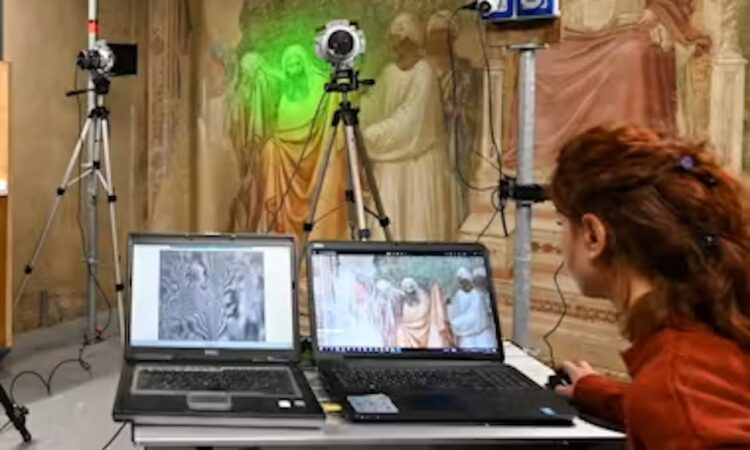
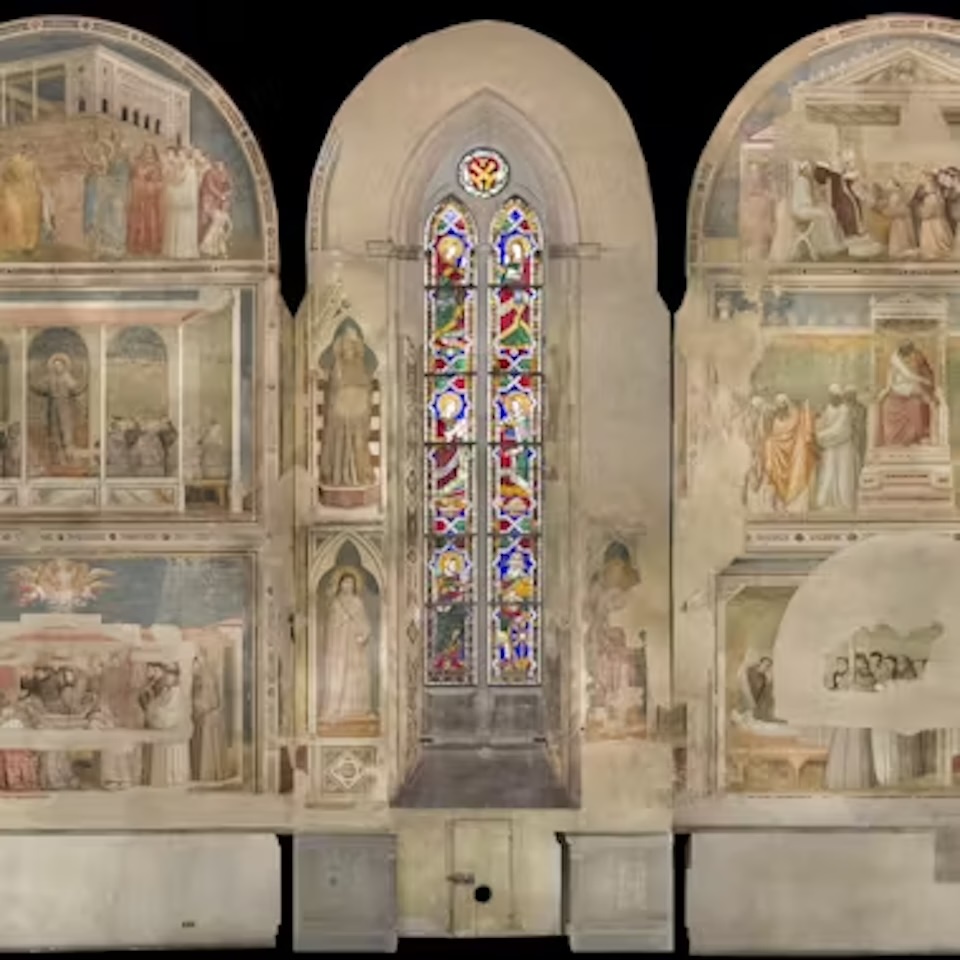
Before restoration began, specialists carried out an extensive programme of documentation and analysis. High-resolution photography, ultraviolet imaging, laser scanning, thermal imaging and georadar surveys were used to map the condition of the chapel and identify hidden structural features. A three-dimensional digital model of the entire chapel was also created.
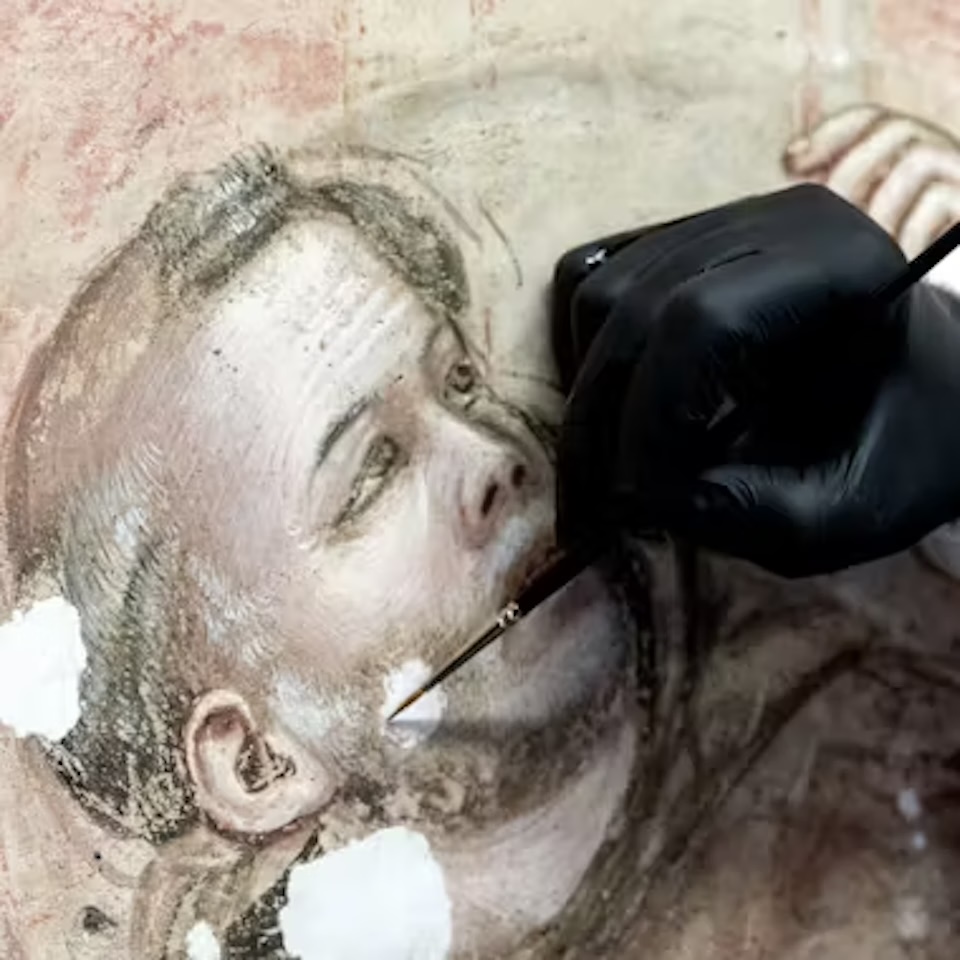
The cleaning campaign has revealed details that had long been obscured, including remarkably well-preserved faces painted entirely in fresco. Conservators have also replaced older restoration materials with more compatible lime-based mortars and removed previous fills that were considered unsuitable.
As the cleaning phase reaches completion, experts are evaluating how best to present the surviving paintings while respecting the many losses and gaps that have accumulated over centuries.
Following Giotto at work
One of the most significant outcomes of the project has been the opportunity to study Giotto’s working methods at close range.
Evidence preserved in the plaster has helped researchers reconstruct the original scaffolding used during the painting campaign. Thermal imaging revealed the locations of scaffold holes, making it possible to understand the sequence in which the chapel was decorated. Conservators also identified traces of preparatory drawings, known as sinopie, and evidence of colour tests carried out before dry painting was applied.
Analysis of pigments confirmed Giotto’s use of natural earth colours alongside materials such as azurite, lead white and cinnabar. The investigation has also shed light on the artist’s combination of fresco and a secco techniques, providing valuable information about workshop practices in early 14th-century Florence.
A landmark for Giotto studies
The restoration is being supported by a scientific committee that includes some of Italy’s leading experts on Giotto and conservation. Their work is helping shape decisions about how to balance historical authenticity, previous restorations and the readability of one of the most important narrative cycles in Western art.
Located beside the high altar of Santa Croce, the Bardi Chapel has long been regarded as one of the key monuments of Florentine painting. As restoration work nears completion, visitors and scholars alike will soon be able to see the frescoes with renewed clarity, while benefiting from a deeper understanding of how the paintings were created, altered and preserved over more than seven centuries.
❤️ Support Florence Daily News
If you liked this article, please consider supporting Florence Daily News.
We are an independent news site, free from paywalls and intrusive ads, committed to providing clear and reliable reporting on Florence and Tuscany for everyone.
Your support — whether a one-time gift or a regular contribution — helps us stay independent and keep telling the stories that matter.
Donate securely via Stripe below.
Make a one-time donation
Make a monthly donation
Make a yearly donation
Choose an amount
Or enter a custom amount
Your contribution is appreciated.
Your contribution is appreciated.
Your contribution is appreciated.
Discover more from Florence Daily News
Subscribe to get the latest posts sent to your email.