
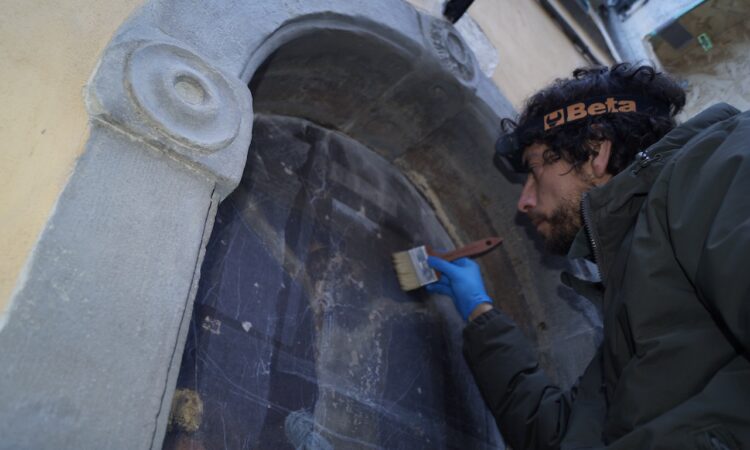
A small but historically significant tabernacle in Florence’s Santa Croce district has been restored and returned to public view following a conservation project supported by Friends of Florence and promoted by the Committee for the Restoration and Decoration of Tabernacles of the Friends of Florentine Museums and Monuments.
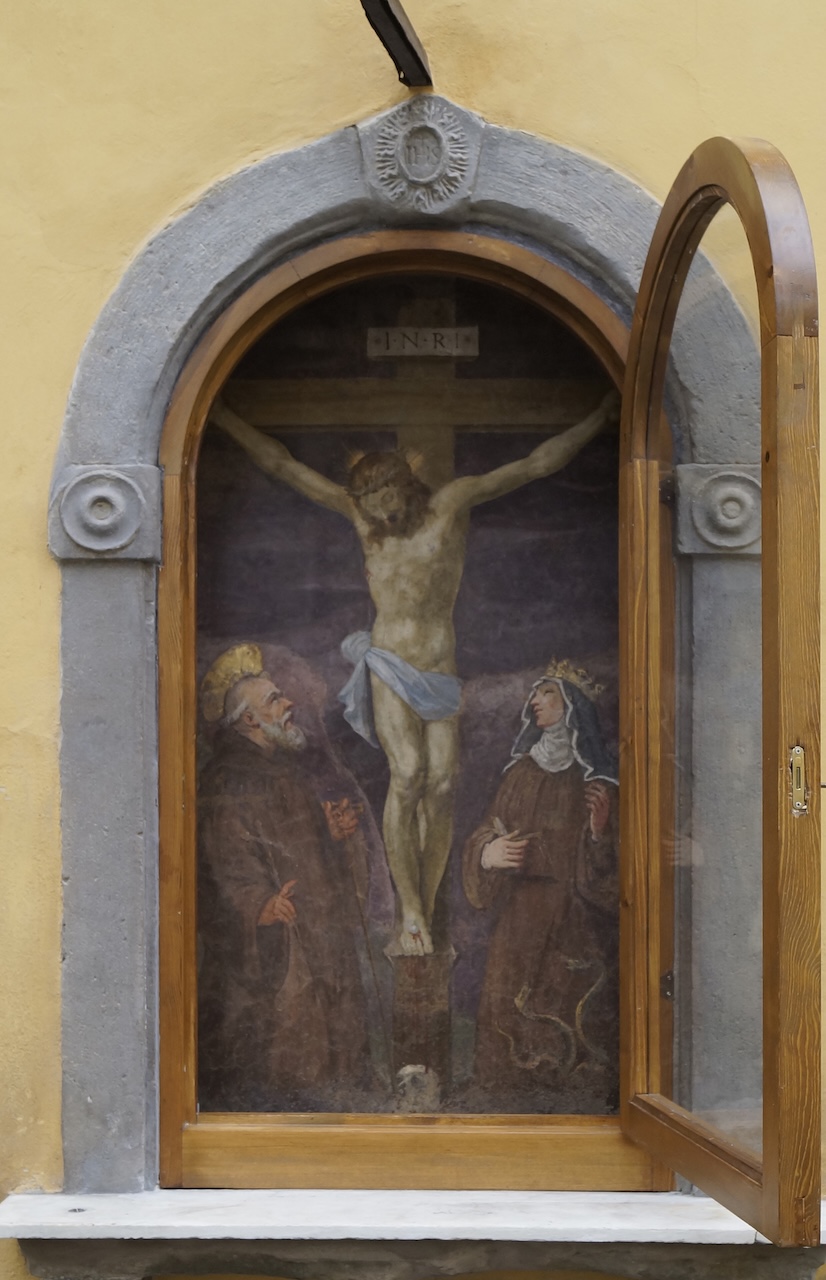
The tabernacle, located on Via dell’Agnolo near Florence’s ring roads, contains a fresco depicting the Crucifixion with Saint Anthony Abbot and Saint Verdiana. The work is attributed to a late 16th-century Florentine painter believed to be connected to the school of Andrea del Sarto. The restoration was carried out by conservator Bartolomeo Ciccone under the supervision of the Soprintendenza Archeologia, Belle Arti e Paesaggio, the state authority responsible for protecting cultural heritage in Florence and the surrounding area.
The intervention is part of a broader effort to preserve Florence’s network of street tabernacles — small devotional shrines embedded into façades across the historic centre and residential neighbourhoods. These structures, long associated with everyday religious life in the city, are considered an important element of Florence’s urban identity and collective memory.
A restoration focused on both preservation and visibility
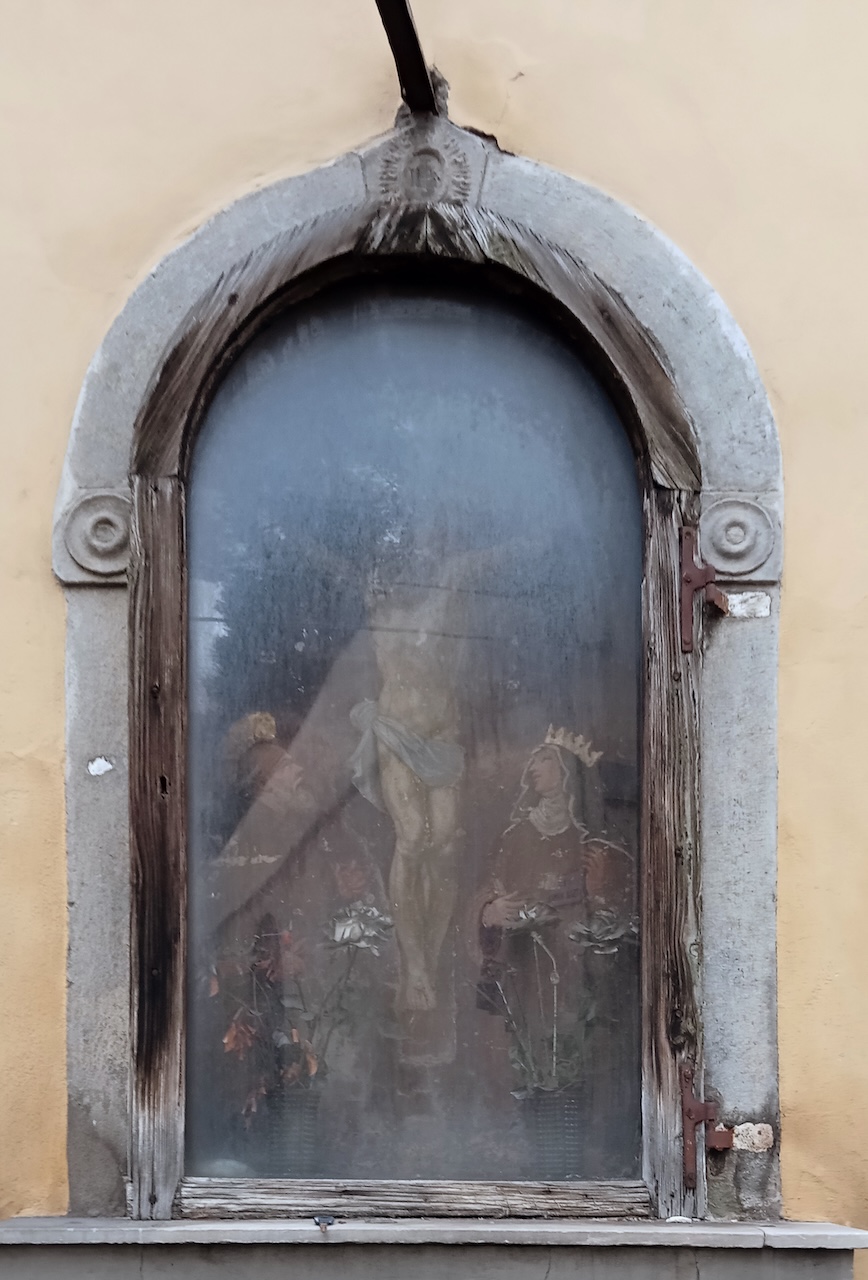
According to the restoration report, the fresco was in poor condition before work began. Conservators found detached paint layers, altered surface coatings, repainting, deteriorated plaster and an inadequate protective structure that exposed the painting to humidity and weather damage.
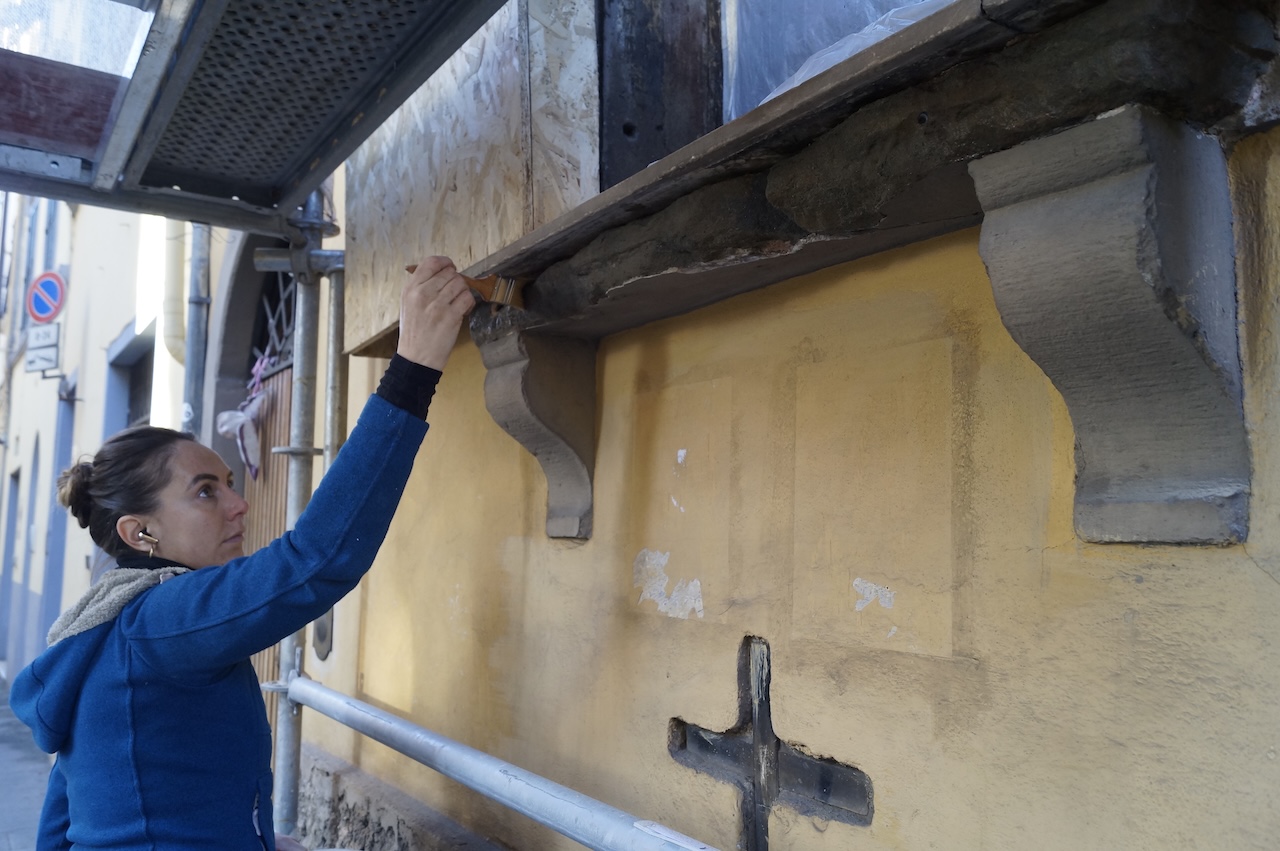
The restoration began with diagnostic investigations using visible and ultraviolet light. Conservators then stabilised the painted surface, cleaned deposits and removed incongruous additions. The stone elements surrounding the shrine were also restored, including the pietra serena architectural frame and the marble Golgotha beneath the painting.
One of the most visible additions is a new protective wooden and glass door fitted with extra-clear anti-shatter glass designed to protect the fresco while still allowing ventilation necessary for the wall painting’s conservation.
The restoration work was carried out by Bartolomeo Ciccone with the collaboration of Elena Grassano. A new protective structure was produced by Falegnameria Bulli.
Friends of Florence and the protection of Florence’s “diffuse heritage”
The project was funded by Friends of Florence, the non-profit foundation based in the United States that supports the conservation of Florentine cultural heritage. The organisation has increasingly focused not only on major monuments and museums but also on what Italians often call patrimonio diffuso — smaller artworks and historic elements dispersed throughout the urban landscape.
Friends of Florence president Simonetta Brandolini d’Adda said the restoration helped recover a work deeply connected to the history, spirituality and daily life of the neighbourhood. She also highlighted the foundation’s ongoing collaboration with the Committee for the Restoration and Decoration of Tabernacles and noted that this was the tenth tabernacle restoration supported by the Friends of Florence chapter involved in the initiative.
In recent years, Friends of Florence has expanded its support for tabernacle conservation projects across the city, including both major restorations and routine maintenance initiatives carried out with local organisations such as the Fondazione Angeli del Bello.
A link to the history of Santa Verdiana and Sant’Ambrogio
The fresco depicts Christ on the cross flanked by Saint Anthony Abbot and Saint Verdiana kneeling in adoration. Art historians believe the presence of Saint Verdiana reflects the historical connection between the area and the nearby Vallombrosan monastery of Santa Verdiana, founded at the end of the 14th century near today’s Sant’Ambrogio district.
According to the historical-artistic report prepared for the restoration, the tabernacle may originally have been commissioned by the Vallombrosan nuns who owned the building where the shrine is located.
The study also links the imagery of Saint Anthony Abbot to the life of Saint Verdiana, who lived between the 12th and 13th centuries in Castelfiorentino, southwest of Florence. Religious tradition says she spent decades in seclusion near an oratory dedicated to Saint Anthony Abbot while caring for plague sufferers.
More than 1,200 tabernacles across Florence
The restoration also draws attention to the wider network of tabernacles scattered throughout Florence. According to the Committee for the Restoration and Decoration of Tabernacles, the city still preserves more than 1,200 of these devotional structures.
The committee, founded in 1991 within the Friends of Florentine Museums and Monuments association, works with cultural institutions, restorers and private supporters to finance conservation projects that often fall outside traditional museum restoration programmes.
Recent initiatives have also introduced digital tools, including geolocation projects and QR-code systems that allow residents and visitors to access historical information about individual tabernacles directly from smartphones, turning parts of Florence into what organisers describe as an open-air and interactive museum.
❤️ Support Florence Daily News
If you liked this article, please consider supporting Florence Daily News.
We are an independent news site, free from paywalls and intrusive ads, committed to providing clear and reliable reporting on Florence and Tuscany for everyone.
Your support — whether a one-time gift or a regular contribution — helps us stay independent and keep telling the stories that matter.
Donate securely via Stripe below.
Make a one-time donation
Make a monthly donation
Make a yearly donation
Choose an amount
Or enter a custom amount
Your contribution is appreciated.
Your contribution is appreciated.
Your contribution is appreciated.
Discover more from Florence Daily News
Subscribe to get the latest posts sent to your email.