
From 27 February to 1 March 2026, the Palazzo dei Congressi in Florence will once again host tourismA – the Archaeology and Cultural Tourism Fair organised by the magazine Archeologia Viva. Now in its 12th edition, the event brings together scholars, institutions, museum professionals and the general public for three days dedicated to archaeological research and heritage promotion. The access is free.
Florence will serve as a national meeting point for recent discoveries, exhibitions, films, educational workshops and round tables, with a programme that spans from Etruscan civilisation to the use of artificial intelligence in archaeology.
The Urna del Bottarone, restored 60 years after the flood
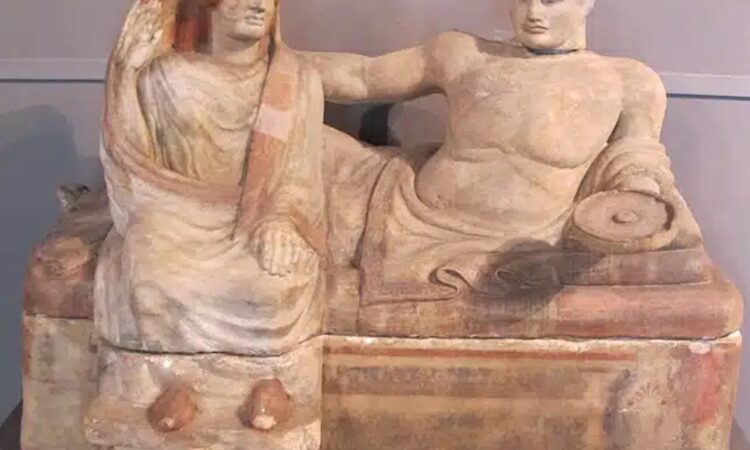
For the first time, tourismA will host an original archaeological artefact. The Urna del Bottarone, an Etruscan alabaster funerary urn dating from 425–380 BC, will be presented to the public after a recent restoration.
The urn, one of the masterpieces of the Museo Archeologico Nazionale di Firenze, was severely damaged during the 1966 flood of Florence. Sixty years later, a restoration supported by the Swiss Federal Office of Culture and carried out in collaboration with the museum has brought back the brightness and original colours of the carved scene depicting a couple of spouses embracing.
The preview exhibition, titled The Colours of Alabaster. The Restoration of the Urna del Bottarone Sixty Years after the Flood of Florence, will be open throughout the fair.
On 28 February at 11 a.m. (Sala Verde), the museum’s director Daniele Federico Maras will present recent conservation projects and new display layouts at the museum.
Guests and public events
Among the expected speakers are historian Luciano Canfora, geologist Mario Tozzi, writer and documentary-maker Cristoforo Gorno, historian Franco Cardini and popular science communicator Alberto Angela, who serves as patron of the event.
On 1 March at 4 p.m., Alberto Angela will present his latest book, Cesare. La conquista dell’eternità, in a public meeting at the fair.
According to Tuscany’s regional president Eugenio Giani, archaeology offers tools to reinterpret the past in light of new discoveries and remains a discipline in constant evolution. He also highlighted tourismA as a place where museums, research centres and cultural institutions meet to exchange experiences and develop new projects.
From the Etruscans to Ukraine
The programme opens with the conference “Progetto Etruschi verso il futuro”, focusing on strategies to promote and enhance the heritage of the Etruscan civilisation, a key cultural identity in Tuscany.
An international perspective will be offered by the meeting “Heritage under the bombs in Ukraine”. Florentine archaeologist Chiara Dezzi Bardeschi, head of the UNESCO office in Ukraine, will discuss measures adopted to protect cultural heritage during the ongoing conflict. The event will include excerpts from a Rai Cultura documentary marking the 80th anniversary of UNESCO.
Other thematic sections include:
- Archeovino – La strana coppia, a dialogue between archaeologists and wine producers on the relationship between vineyards and archaeological sites, with case studies from Pompeii, the island of Elba, San Gimignano and the Palatine Hill in Rome.
- Archeolog-IA, dedicated to the role of artificial intelligence in archaeological research and heritage conservation.
- Archeo-Divertimento, a hands-on area where children and adults can simulate excavations, create mosaics and experiment with ancient techniques.
Special workshops for children aged 6 to 11 will focus on Etruscan art and restoration, including guided visits to the Urna del Bottarone.
New discoveries in Piazza Beccaria
On the morning of Saturday 28 February, Italy’s heritage authority (the Soprintendenza Archeologia, Belle Arti e Paesaggio, the state office responsible for the protection of cultural heritage) will present preliminary results from ongoing excavations under Piazza Beccaria.
The works, linked to the installation of a new aqueduct, have uncovered medieval structures including Porta alla Croce, which between the 13th and 14th centuries marked the eastern entrance to Florence. At the time, the city was enclosed by the so-called Arnolfo walls, whose route largely corresponds to today’s ring roads.
Archaeologists also identified a child burial dating from the 1st century BC to the 1st century AD. In Roman times, burials were typically placed outside city walls, along major roads leading out of town.
When Roman Florentia was still a small settlement enclosed within brick walls in the area of today’s historic centre, Piazza Beccaria lay in open countryside. The site was crossed by the eastern stretch of the decumanus maximus, the main Roman road that led towards Arretium, modern-day Arezzo.
Practical information
- Dates: 27 February – 1 March 2026
- Venue: Palazzo dei Congressi, Florence
- Main guest event: Alberto Angela, 1 March at 4 p.m.
- Children’s workshops: daily activities for ages 6–11
Full programme details and booking information are available on the official tourismA website.
❤️ Support Florence Daily News
If you liked this article, please consider supporting Florence Daily News.
We are an independent news site, free from paywalls and intrusive ads, committed to providing clear and reliable reporting on Florence and Tuscany for everyone.
Your support — whether a one-time gift or a regular contribution — helps us stay independent and keep telling the stories that matter.
Donate securely via Stripe below.
Make a one-time donation
Make a monthly donation
Make a yearly donation
Choose an amount
Or enter a custom amount
Your contribution is appreciated.
Your contribution is appreciated.
Your contribution is appreciated.
Discover more from Florence Daily News
Subscribe to get the latest posts sent to your email.