
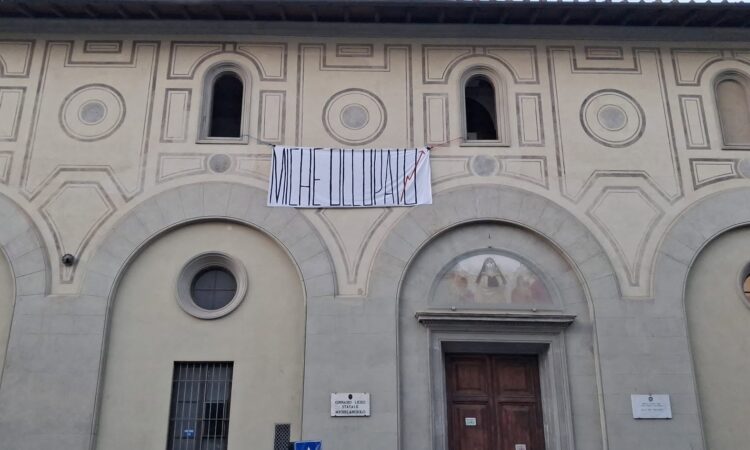
Student occupations are spreading across Florence, with pupils at more than ten public secondary schools announcing protests against government education policies, deteriorating school facilities and spending priorities.
The mobilisation began on Monday 19 October 2026 at the Gramsci science-focused high school and expanded on Tuesday to other institutions, including the Castelnuovo, Galileo-Michelangiolo, Machiavelli-Capponi and Leonardo da Vinci schools.
The occupations reported so far involve state-run secondary schools, attended mainly by teenagers aged 14 to 19. There have been no reports of similar actions at private schools or universities in Florence.
The students criticised what they see as the government’s decision to prioritise military expenditure over education. They cited approximately €620 million in planned funding cuts between 2026 and 2028 and described problems ranging from leaking classrooms and inadequate heating to mould, damaged facilities and shortages of teaching staff.
The protesters are also demanding changes to government policies on sex and relationships education, foreign pupils and compulsory school-to-work training.
School occupations are a longstanding form of protest in Italy. Students typically take control of school buildings, interrupting ordinary lessons and organising assemblies or alternative activities.
From Florence to France: a wider wave of protests
The Florence occupations come amid a broader wave of youth demonstrations in Europe, particularly in France, where protests initially focused on overcrowded classrooms, teacher shortages and deteriorating public schools.
The French movement began in September and expanded rapidly, with students blocking school entrances and organising demonstrations in Paris and other cities.
While many protests remained peaceful, others escalated into serious violence. Recent demonstrations in Paris, Marseille, Lyon and other French cities have involved clashes with police, vandalism, arson and widespread property damage.
During the weekend of October 17–18, rioters smashed shop windows, looted businesses, burned vehicles and damaged public buildings. Some of those involved were teenagers, although the unrest also attracted groups outside the student movement.
Social media has played a significant role in spreading images of the demonstrations, mobilising participants and circulating sometimes misleading accounts of the violence.
Violence in Milan and the government’s response
Similar concerns have emerged in Italy following violent disturbances in Milan, where demonstrations escalated into clashes with police, looting and damage to shops and other property.
The involvement of young people, including minors, has prompted a debate about the influence of social media, political radicalisation and the distinction between legitimate protest and criminal violence.
Speaking in Rome on Tuesday, Defence Minister Guido Crosetto described the events in Milan and elsewhere in Italy as a possible consequence of what he calls hybrid warfare against Western societies.
According to Crosetto, platforms such as TikTok, YouTube and other social networks can expose young people to messages that undermine democratic values and encourage confrontation with established institutions.
His argument is that online influence campaigns, potentially involving anonymous or fake accounts, can be used as unconventional instruments to amplify social divisions, mobilise young people and generate instability.
The minister suggested that the scale of youth participation and sympathy for the demonstrations reflected a process of ideological influence extending beyond families and schools.
For now, the protests in Florence remain focused on public education and government spending. Their duration is uncertain, and further disruption to lessons is possible in the coming days.
Trade unions join the mobilisation ahead of elections
The protests are also gaining support from Italy’s trade union movement. Maurizio Landini, leader of the CGIL, one of the country’s largest trade union confederations, has announced a nationwide general strike for November 20, 2026, coinciding with a European day of student protest.
The growing mobilisation comes as Italy approaches its next general election, due in 2027, potentially as early as spring, although no date has been set.
❤️ Support Florence Daily News
If you liked this article, please consider supporting Florence Daily News.
We are an independent news site, free from paywalls and intrusive ads, committed to providing clear and reliable reporting on Florence and Tuscany for everyone.
Your support — whether a one-time gift or a regular contribution — helps us stay independent and keep telling the stories that matter.
Donate securely via Stripe below.
Make a one-time donation
Make a monthly donation
Make a yearly donation
Choose an amount
Or enter a custom amount
Your contribution is appreciated.
Your contribution is appreciated.
Your contribution is appreciated.
Discover more from Florence Daily News
Subscribe to get the latest posts sent to your email.