
It all began with Eni. On September 28, as fuel prices continued to climb, Enilive introduced a price ceiling: €1.99 a liter for gasoline and €2.19 for diesel. The measure was set to last at least thirty days, and its effect on the rest of the market was almost immediate.
After Eni came IP, owned by Socar, Azerbaijan’s state energy company. On October 1, Q8 introduced its own thirty-day price cap. Three major operators, millions of motorists, and a market that, within a matter of days, had begun moving in the same direction.
This was not a price imposed by the state. It was something subtler.
Eni is a publicly traded company, operating in the market alongside other major energy companies. Yet the Italian state effectively retains control: the Ministry of Economy and Finance and Cassa Depositi e Prestiti together hold 33.09 percent of the company. When Eni moves, then, it is difficult to ignore the peculiar position it occupies—private enough to answer to the market, public enough to find itself inside a broader idea of the national interest.
This is where gasoline becomes interesting.
The government has acted directly on excise duties as well, keeping the diesel cut in place through October 5 and introducing, from the following day, a mechanism that allows excise taxes to move with fuel prices. But its influence does not operate only through taxation. It can also operate through ownership, through pressure on major operators, through the ability to alter the expectations of an entire industry.
And when the first major distributor moves, the others have to decide whether to follow.
The result is a small experiment in how markets actually work. Eni lowers its ceiling; IP follows; Q8 joins the game. No one has abolished competition. On the contrary: it is precisely competition that turns the intervention of a single operator into a broader pressure on the market.
But a question remains in the background: what changes when a significant share of a company selling an essential good belongs, directly or indirectly, to the public?
A much smaller answer can be found in Abruzzo.
In Valle Castellana, in the province of Teramo, the local gas station belongs to the municipality. The administration bought the station in 2019, when the facility was at risk of closing, in a territory made up of forty-seven hamlets and with barely six inhabitants per square kilometer. Today, the municipality says it has eliminated its profit margin altogether: the price is designed to cover costs, not to generate a return.
The difference can be as much as twenty-five cents a liter compared with the average price. And the small station, which has since become a national curiosity, now sells around 2,000 liters a day.
Here, too, the logic is simple: preserve the service, rather than maximize the profit. Even purchasing is organized around that objective. When the municipality’s financial manager anticipates a rise in wholesale prices, she brings forward purchases, allowing the station to keep its prices lower when others raise theirs.
Eni and Valle Castellana are almost opposite worlds. On one side, a vast publicly traded energy company, with the state as its controlling shareholder; on the other, a small municipality running a gas station to prevent an essential service from disappearing.
And yet, from opposite ends, they tell much the same story.
A price is not simply the outcome of a market. It is also the outcome of who owns what, who regulates it, and which objective is given priority.
Sometimes the objective is to protect margins. Sometimes it is to gain market share. Sometimes, quite simply, it is to make sure that a community can still fill its tank.
In the end, the difference may come down to a very simple question: when profit is no longer the only measure, how much can the price of everyday life change?
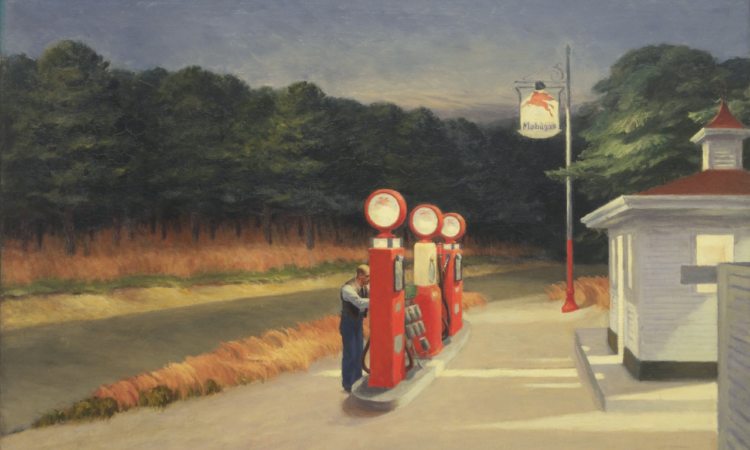
(Cover photo Edward Hopper, photo of 1940 painting – Public domain)
❤️ Support Florence Daily News
If you liked this article, please consider supporting Florence Daily News.
We are an independent news site, free from paywalls and intrusive ads, committed to providing clear and reliable reporting on Florence and Tuscany for everyone.
Your support — whether a one-time gift or a regular contribution — helps us stay independent and keep telling the stories that matter.
Donate securely via Stripe below.
Make a one-time donation
Make a monthly donation
Make a yearly donation
Choose an amount
Or enter a custom amount
Your contribution is appreciated.
Your contribution is appreciated.
Your contribution is appreciated.

Eirini Lavrentiadou is an actress and singer, born in Thessaloniki in 1992. She lives in Florence, where she trained at the city’s Theatre Academy and the Fiesole School of Music. She has performed in classical Greek and European plays, worked with international directors and companies, and appeared in concerts ranging from opera to jazz. She contributes to Florence Daily News as a writer.
Discover more from Florence Daily News
Subscribe to get the latest posts sent to your email.