
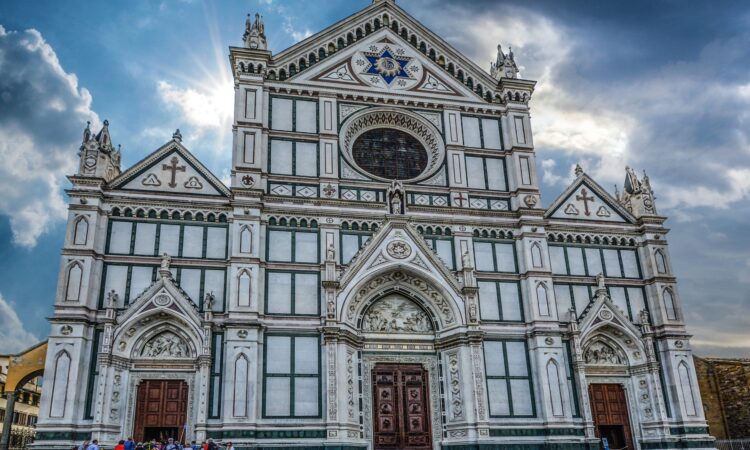
A medieval natural ventilation system designed to protect wooden roof structures from water damage has been documented at the Basilica of Santa Croce in Florence. The discovery is among the main findings of a study by Italy’s National Research Council (CNR), which carried out the first systematic assessment of the timber structures supporting the church’s roofs.
The research, conducted by the CNR’s Institute for Bioeconomy (CNR-IBE), provides new information about the construction techniques used by medieval builders and the condition of the wooden structures that have supported the basilica for centuries.
According to Nicola Macchioni, who coordinated the research alongside Margherita Vicario and Margherita Franchi, the ventilation system was designed to allow the timber to dry naturally in the event of water infiltration. This approach helped prevent prolonged exposure to moisture and contributed significantly to the preservation of the roof structures.
The findings suggest that medieval craftsmen had a detailed understanding of timber and its behaviour over time, incorporating practical solutions to improve the durability of the building.
A complex wooden structure above the basilica
Built between 1295 and 1385 for Florence’s Franciscan community, Santa Croce is one of Italy’s largest Franciscan churches. Measuring approximately 115 metres in length and 38 metres in width, it is known for its frescoes by Giotto and the tombs of Michelangelo, Galileo Galilei, Niccolò Machiavelli and Ugo Foscolo.
Less familiar to visitors is the extensive system of wooden beams and trusses supporting its roofs.
Above the central nave, 31 traditional Italian-style timber trusses stand approximately 35 metres above the floor. Each spans around 20 metres, supporting the roof across the church’s wide interior without the need for intermediate columns.
Additional wooden structures cover the side aisles, transept and chapels, forming a complex architectural system that has undergone modifications and repairs over the centuries.
Where the medieval timber came from
The researchers surveyed approximately 530 cubic metres of timber, recording the characteristics and condition of hundreds of structural elements.
The study also helped reconstruct the geographical origins of the principal types of wood used in the basilica.
Silver fir, which was used for the largest structural components, came from forests in the upper Arno river basin, particularly the Casentino and Mugello areas of Tuscany.
Smaller elements were made from other species, including chestnut, sourced from the hills surrounding Florence.
These findings provide evidence of how medieval builders selected different types of timber according to their structural requirements and obtained materials from forests across the region.
New information for conservation
Beyond identifying the ventilation system and the origins of the timber, the assessment documented the condition of individual structural elements, potential weaknesses and evidence of repairs carried out over time.
The resulting inventory provides a more detailed understanding of the basilica’s roof structures and a basis for planning future conservation and maintenance work.
The research was promoted by the Opera di Santa Croce, the institution responsible for managing and preserving the monumental complex, in collaboration with CNR-IBE.
It was conducted through the Cobalto and Palco research projects, funded by the Tuscany regional government through its Giovanisì programme and co-financed by the Opera di Santa Croce.
The findings highlight an aspect of Santa Croce that is largely invisible to visitors: the engineering knowledge of its medieval builders, whose construction methods have helped preserve the basilica’s wooden roofs for more than six centuries.
❤️ Support Florence Daily News
If you liked this article, please consider supporting Florence Daily News.
We are an independent news site, free from paywalls and intrusive ads, committed to providing clear and reliable reporting on Florence and Tuscany for everyone.
Your support — whether a one-time gift or a regular contribution — helps us stay independent and keep telling the stories that matter.
Donate securely via Stripe below.
Make a one-time donation
Make a monthly donation
Make a yearly donation
Choose an amount
Or enter a custom amount
Your contribution is appreciated.
Your contribution is appreciated.
Your contribution is appreciated.
Discover more from Florence Daily News
Subscribe to get the latest posts sent to your email.