
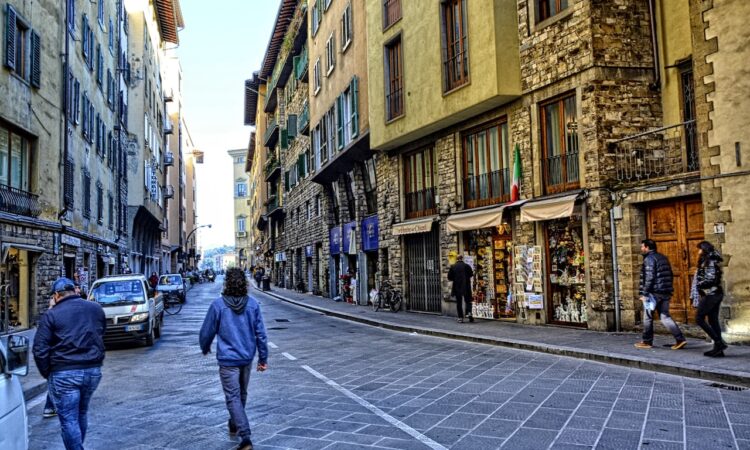
Florence’s attempt to curb the expansion of short-term tourist rentals could gain a stronger European legal framework under the Affordable Housing Act proposed by the European Commission on 9 September, 2026.
The proposed EU regulation is aimed at areas where housing has become particularly difficult to afford. It would establish common criteria for identifying “areas under housing stress” and set conditions under which national, regional or local authorities can justify measures affecting short-term rentals and residential properties not used as primary homes.
For Florence, the proposal is particularly significant because the city has already introduced some of the restrictions that the European framework is designed to address.
According to an analysis reported by Corriere Fiorentino, applying one of the central affordability indicators contained in the Commission proposal to local data would put 28 of Florence’s 33 housing-market zones above the initial threshold for housing stress.
The areas include much of the historic centre as well as neighbourhoods farther from the main tourist district, including parts of Rifredi, Novoli, Campo di Marte and Isolotto.
How the EU proposal would work
The Commission’s proposal does not introduce an EU-wide ban on Airbnb-style accommodation, nor does it require cities to restrict short-term rentals.
Instead, it creates a common methodology that authorities could use when restrictions are considered necessary to protect housing affordability and availability. Housing policy itself would remain primarily a national, regional and local responsibility.
One of the main tests is the price-to-income ratio. An area could qualify as being under housing stress when buying an average-sized home would cost at least eight years of representative disposable per-capita income.
Normally, the authority would also have to show that this ratio has increased over the previous ten years and that the situation is unlikely to improve over the following three years, taking into account population trends and housing supply and demand. If the price-to-income ratio reaches 10 or more, the requirement to demonstrate an increase over the previous ten years would no longer apply.
Crossing those thresholds would not automatically produce restrictions. Authorities would still have to justify their intervention and show that it was necessary and proportionate.
For measures specifically targeting short-term rentals, they would also have to demonstrate that such rentals had had a significant negative effect on housing affordability or availability in the area for at least three years. Restrictions adopted solely under this housing framework could not apply to people occasionally renting out their own primary residence.
The proposal also covers possible restrictions on the acquisition or use of residential property that is not intended as a primary residence. Authorities would, however, have to consider less restrictive alternatives before imposing outright prohibitions, and measures would generally last no more than five years before requiring review.
Florence already has restrictions in place
The rules require a five-year municipal authorisation for each property used for short-term tourist accommodation and created a municipal register. Properties must also comply with minimum housing, safety and other requirements.
New short-term rental activities were initially blocked in the UNESCO historic centre. In June 2026, the City Council extended the restrictions to several areas surrounding central Florence, including parts of Campo di Marte, Rifredi, Statuto, Gavinana and other neighbourhoods where municipal monitoring had identified increasing pressure from tourist accommodation. The expanded restrictions came into force on 21 June.
Properties that were already legally used for short-term tourist rentals during 2024 benefit from a transitional exemption lasting until 31 May 2028 under Tuscany’s regional tourism legislation. Renting part of the home in which the owner lives and has their registered residence is also excluded from Florence’s municipal authorisation requirement.
The European proposal therefore arrives as Florence is already testing how far a city can go in regulating the conversion of residential housing into tourist accommodation.
Funaro: Florence “led the way”
Florence Mayor Sara Funaro welcomed the Commission proposal and called on the Italian government to give cities clearer powers to regulate the sector.
“Europe now recognises that, in cities where housing pressure is strongest, tools are needed to manage the phenomenon of short-term rentals,” Funaro said. “It is an important direction, and Florence can once again say that it led the way.”
Funaro said Florence had decided to intervene because leaving the short-term rental market without regulation risked changing entire parts of the city. The municipality first concentrated restrictions on the historic centre before extending them as data showed the phenomenon spreading into other neighbourhoods.
“I hope the Government will now take up this indication and finally give cities the tools they need to manage short-term rentals effectively,” she said.
Tourism and Economic Development Councillor Jacopo Vicini said the Commission proposal recognised that tourism and access to housing needed to coexist, particularly in destinations where visitor demand places additional pressure on the residential market.
What could change for Florence
The Commission proposal does not immediately change Florence’s rules. It still has to pass through the EU legislative process, and the regulation explicitly states that it would not create powers for local authorities that they do not already have under national law.
Its importance for Florence lies instead in the legal framework it could provide in the future.
Cities seeking to restrict short-term rentals have had to balance local housing policies against EU rules on the freedom to provide services, establishment and movement of capital. The Commission says its proposal is intended to reduce that legal uncertainty by establishing common standards for demonstrating housing stress and assessing whether restrictions are justified and proportionate.
That distinction also explains Funaro’s appeal to the Italian government. Even if the regulation is approved, national law will remain important in determining what measures Italian municipalities are actually allowed to adopt.
(Cover photo: Image by Rangoni-Gianluca from Pixabay)
❤️ Support Florence Daily News
If you liked this article, please consider supporting Florence Daily News.
We are an independent news site, free from paywalls and intrusive ads, committed to providing clear and reliable reporting on Florence and Tuscany for everyone.
Your support — whether a one-time gift or a regular contribution — helps us stay independent and keep telling the stories that matter.
Donate securely via Stripe below.
Make a one-time donation
Make a monthly donation
Make a yearly donation
Choose an amount
Or enter a custom amount
Your contribution is appreciated.
Your contribution is appreciated.
Your contribution is appreciated.
Discover more from Florence Daily News
Subscribe to get the latest posts sent to your email.