
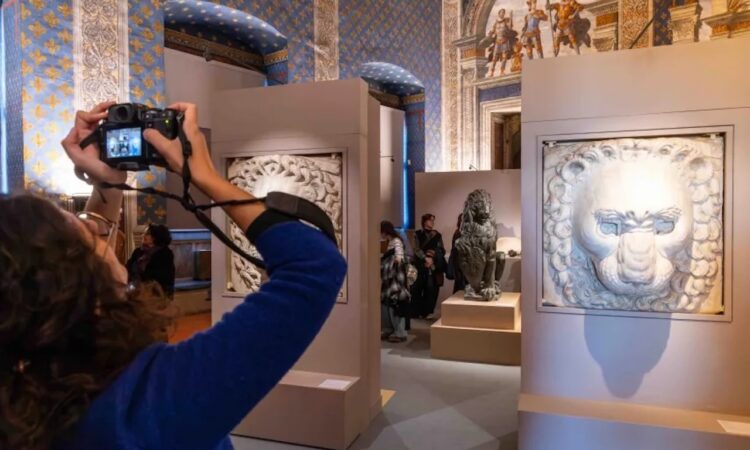
A new exhibition at Palazzo Vecchio explores one of Florence’s oldest and most recognisable symbols: the lion, known locally as the Marzocco, which represented the authority, independence and political identity of the Florentine Republic.
Entitled I Leoni di Firenze (The Lions of Florence), the exhibition opened on 27 October 2026 and runs until 18 January 2027 in the Sala dei Gigli, one of the historic rooms of Palazzo Vecchio, the building that has served as the centre of Florence’s civic government for centuries.
The exhibition brings together sculptures, paintings, manuscripts and archival documents dating from Roman times to the modern period. It examines how the lion became associated with Florence and why its image continues to appear on buildings, monuments and public decorations throughout the city.
What is the Marzocco?
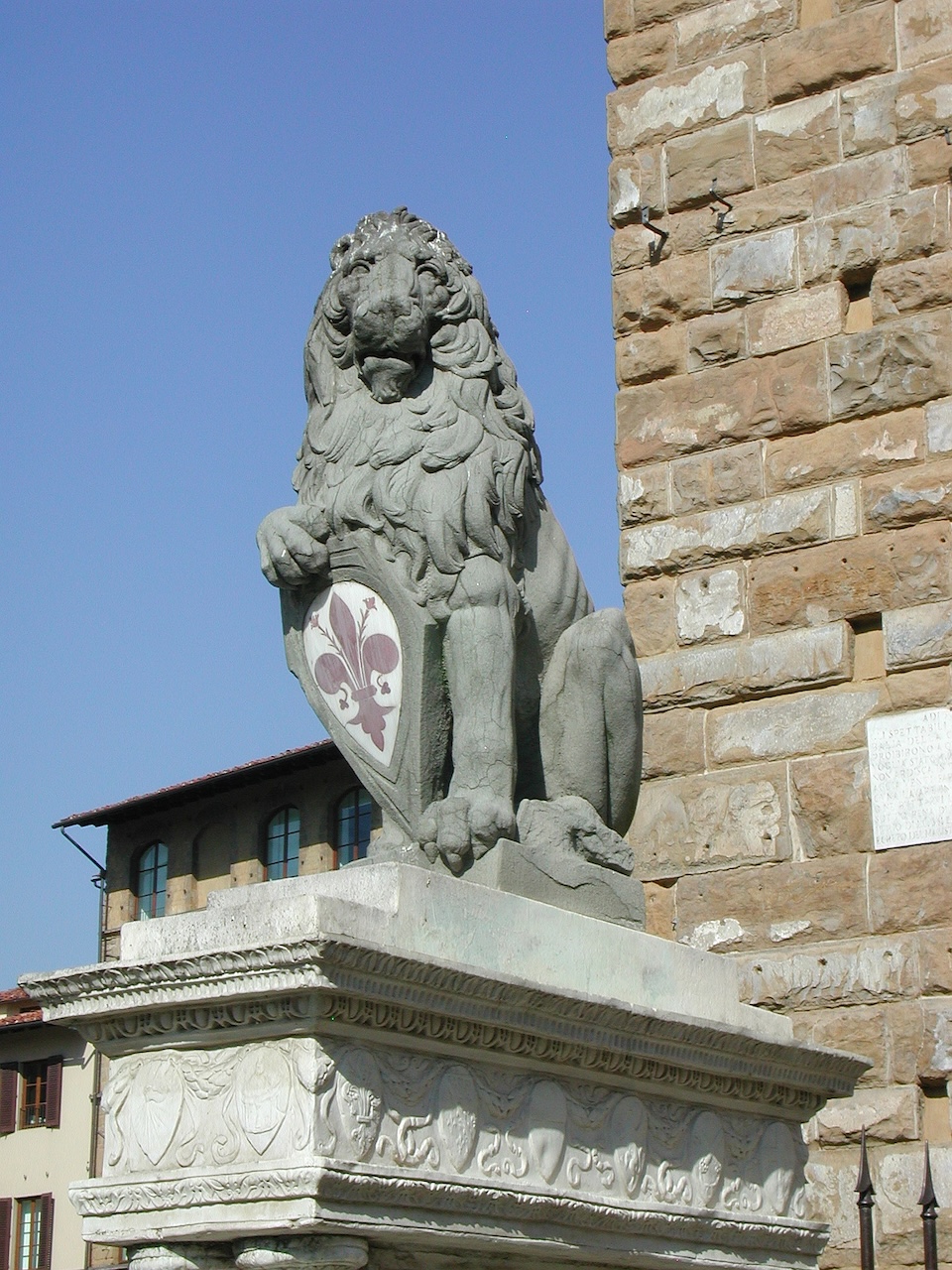
Donatello’s Marzocco, with the Florentine lily on its shield. The Marzocco is a lion traditionally shown seated, with one front paw resting on a shield bearing the Florentine lily, or giglio. The lily is the city’s heraldic emblem, while the lion came to represent civic strength and political authority.
During the Middle Ages, Florence developed into a powerful self-governing republic. The Marzocco became a symbol of its institutions and its claim to political independence, rather than the personal emblem of a monarch.
The origin of the name Marzocco is not entirely certain. One of the most widely accepted explanations connects it to Mars, the Roman god of war, traditionally regarded as Florence’s protector before St John the Baptist became the city’s Christian patron saint.
According to Florentine tradition, a statue believed to represent Mars once stood near Ponte Vecchio, the bridge across the River Arno. The statue was swept away during the devastating flood of 1333. The name Marzocco may have developed from the Latin Martius, meaning associated with Mars, or from a medieval form interpreted as little Mars.
The connection is widely recognised, including by Italian dictionaries, but its precise linguistic development remains uncertain. The Marzocco also had a political significance beyond Florence itself. Images of the lion were placed in territories controlled by the Florentine Republic as visible signs of its authority.
From medieval sculptures to Renaissance art
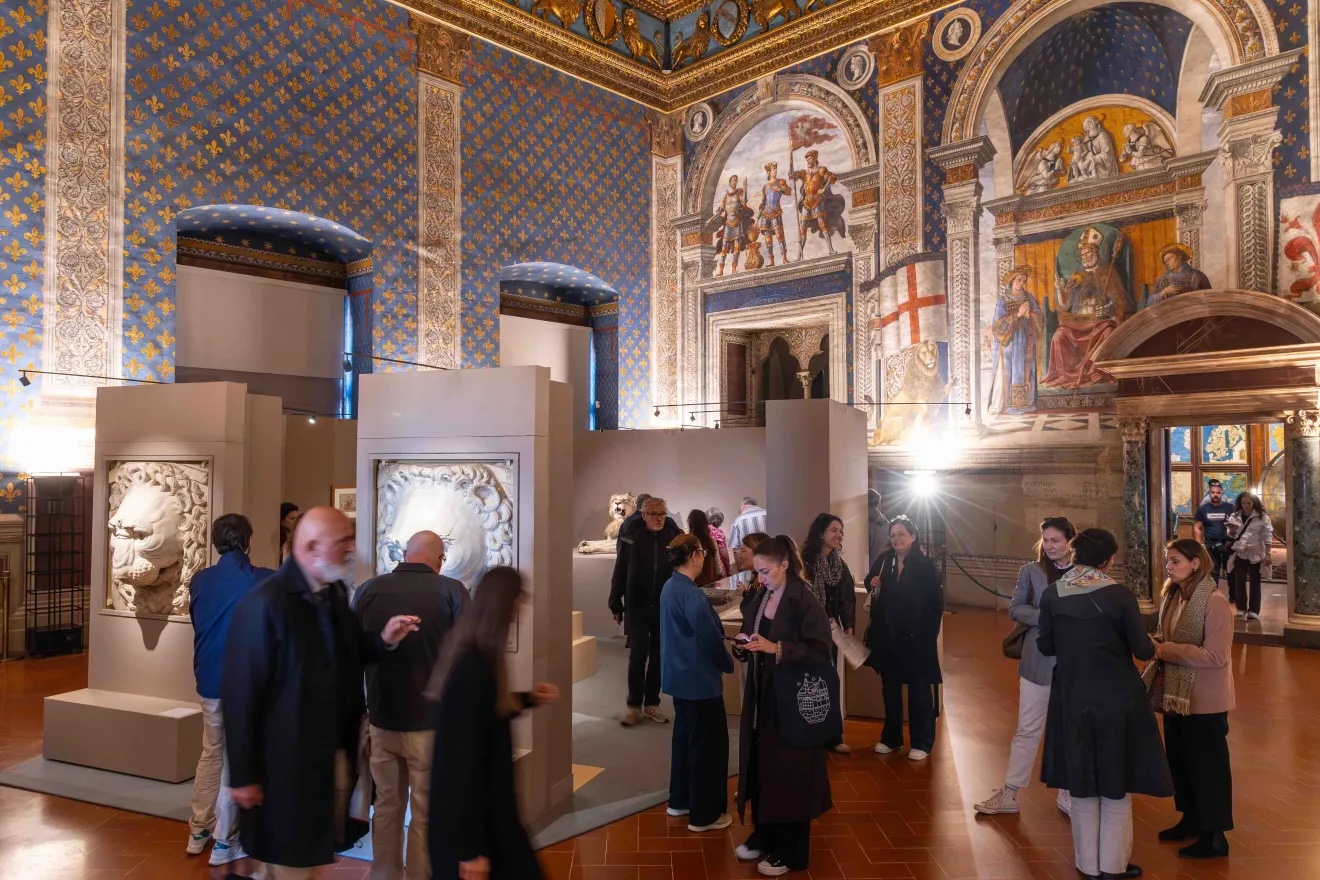
The exhibition includes works that show how the lion appeared in Florentine art over several centuries. Among the pieces on display are two monumental lion heads by Baccio d’Agnolo, two Marzocco sculptures dating from 1383 and a bronze reproduction of the Marzocco made by Clemente Papi for Piazza della Signoria.
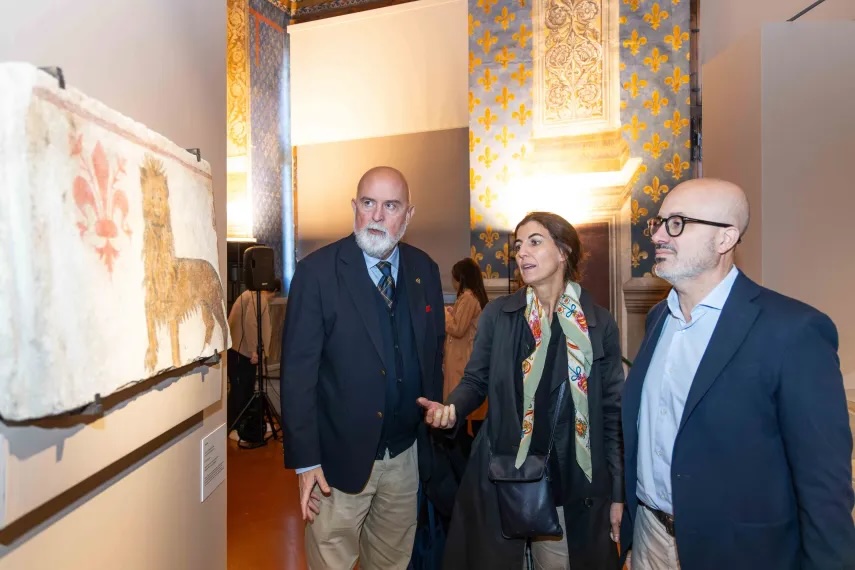
Visitors can also see a detached fresco depicting a lion and the Florentine lily, a painting attributed to Bartolomeo Bimbi, an illuminated manuscript from the institution responsible for Florence Cathedral and historical documents illustrating the spread of lion imagery throughout the city.
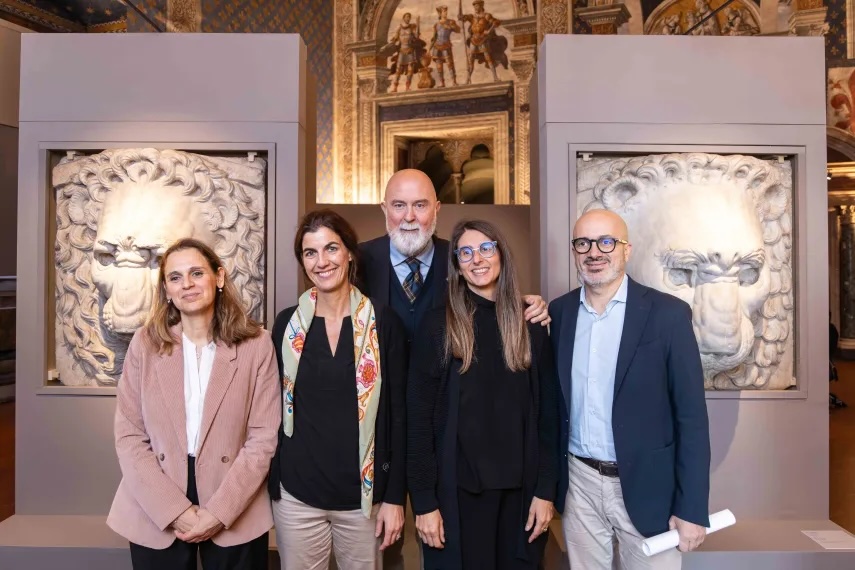
The exhibition is curated by Carlo Francini and Valentina Zucchi, organised by Fondazione MUS.E and promoted by Florence’s municipal museums, in collaboration with the Galleria dell’Accademia di Firenze and Musei del Bargello.
The Sala dei Gigli provides a particularly relevant setting. Its historic decorations and images of lions place the works within a building where the Republic’s political authority was exercised and represented.
The lions once kept in Florence
One of the exhibition’s more unusual subjects is the presence of live lions in Florence during the Middle Ages and Renaissance. For centuries, the city maintained lion enclosures as public displays of prestige and authority. The animals were initially kept in locations including Piazza San Giovanni, near Florence Cathedral, and the Palazzo del Podestà.
From the mid-14th century until 1550, a lion enclosure was maintained at Palazzo Vecchio. The nearby street, Via dei Leoni, still preserves the memory of these animals. Historical records also describe hunts and animal combats organised during public celebrations. The exhibition includes a drawing by Giovanni Stradano documenting this tradition, alongside an 18th-century plan of the lion enclosure by architect Ferdinando Ruggieri. Another exhibit is a taxidermied lion from the Natural History Museum of the University of Florence.
Donatello’s Marzocco and the Bargello
The best-known artistic representation of the Marzocco was created by Donatello around 1418–1420. His sculpture depicts a seated lion resting one paw on a shield bearing Florence’s lily. The image combines the animal’s physical strength with the civic identity of the Florentine Republic.
The original sculpture is preserved at the Museo Nazionale del Bargello, while a replica stands outside Palazzo Vecchio in Piazza della Signoria. Although the original is not part of the display in the Sala dei Gigli, the Bargello is participating in the exhibition project with a thematic route highlighting lion imagery in its collections.
Visitors can also explore the subject at the Museo Stefano Bardini, where a dedicated map identifies the many depictions of lions collected by the Florentine antiquarian Stefano Bardini. Together, the three museums show how the lion moved between political symbolism, monumental sculpture and decorative art, remaining a recurring feature of Florence’s visual identity.
Visiting the exhibition
The exhibition I Leoni di Firenze runs from 27 October 2026 to 18 January 2027 at the Museo di Palazzo Vecchio, in Piazza della Signoria.
According to the museum’s published visitor information, Palazzo Vecchio is open from 9 a.m. to 7 p.m. on Mondays, Tuesdays, Wednesdays, Fridays, Saturdays and Sundays, and from 9 a.m. to 2 p.m. on Thursdays. Standard admission is €18, with a reduced ticket of €12 and free admission for visitors aged 17 and under.
Guided exhibition visits are scheduled on Sundays at 3 p.m. There are also Sunday activities for children focusing on the history of the Marzocco, as well as lectures during the exhibition period.
Reservations and further information are available through Fondazione MUS.E at +39 055 0541450 or [email protected].
❤️ Support Florence Daily News
If you liked this article, please consider supporting Florence Daily News.
We are an independent news site, free from paywalls and intrusive ads, committed to providing clear and reliable reporting on Florence and Tuscany for everyone.
Your support — whether a one-time gift or a regular contribution — helps us stay independent and keep telling the stories that matter.
Donate securely via Stripe below.
Make a one-time donation
Make a monthly donation
Make a yearly donation
Choose an amount
Or enter a custom amount
Your contribution is appreciated.
Your contribution is appreciated.
Your contribution is appreciated.
Discover more from Florence Daily News
Subscribe to get the latest posts sent to your email.