
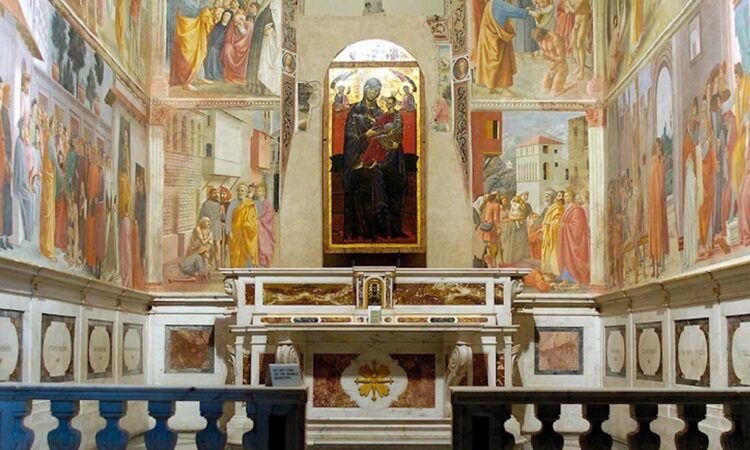
A new pilot project at Florence’s Brancacci Chapel will use advanced environmental monitoring technology to help preserve the chapel’s Renaissance frescoes while maintaining public access to one of the city’s most visited cultural sites.
The initiative is part of the European AccesS project, in which the Municipality of Florence is a partner. The pilot system was developed with scientific support from the National Research Council’s Institute of Heritage Science (CNR-ISPC), technological collaboration from Axians Italia and in coordination with Florence’s cultural heritage authorities.
The Brancacci Chapel, located inside the Church of Santa Maria del Carmine in the Oltrarno district, is known for its fresco cycle by Masaccio, Masolino and Filippino Lippi. The paintings are considered among the defining works of early Renaissance art.
The new system combines environmental monitoring with visitor-flow analysis. Sensors installed inside the chapel measure temperature, humidity, air quality and carbon dioxide levels, while separate devices anonymously count visitors and track how long they remain inside the space.
Researchers and conservation specialists will use the combined data to better understand how visitor presence affects the chapel’s internal microclimate and, consequently, the long-term preservation of the frescoes.
According to the Municipality of Florence, the system has been designed to be minimally invasive. The monitoring devices are wireless, compact and intended to blend discreetly into the historic setting.
Culture councillor Giovanni Bettarini said the project aims to balance accessibility and conservation by improving visitor comfort while protecting the artworks.
Innovation councillor Laura Sparavigna said Florence continues to position itself as a testing ground for the use of smart technologies in the management of historic and artistic heritage.
The data collected by the sensors is processed through the Xsona digital platform developed by Axians Italia. The platform is expected to support increasingly detailed analysis of the relationship between visitor numbers and environmental changes inside the chapel.
Cristiano Riminesi, a researcher at CNR-ISPC, said advances in miniaturised monitoring technologies now make it possible to carry out continuous conservation analysis with limited impact on historic sites.
The project reflects a broader trend in museums and heritage sites toward preventive conservation strategies, especially in locations where large visitor numbers can affect fragile artworks and interiors.
❤️ Support Florence Daily News
If you liked this article, please consider supporting Florence Daily News.
We are an independent news site, free from paywalls and intrusive ads, committed to providing clear and reliable reporting on Florence and Tuscany for everyone.
Your support — whether a one-time gift or a regular contribution — helps us stay independent and keep telling the stories that matter.
Donate securely via Stripe below.
Make a one-time donation
Make a monthly donation
Make a yearly donation
Choose an amount
Or enter a custom amount
Your contribution is appreciated.
Your contribution is appreciated.
Your contribution is appreciated.
Discover more from Florence Daily News
Subscribe to get the latest posts sent to your email.