
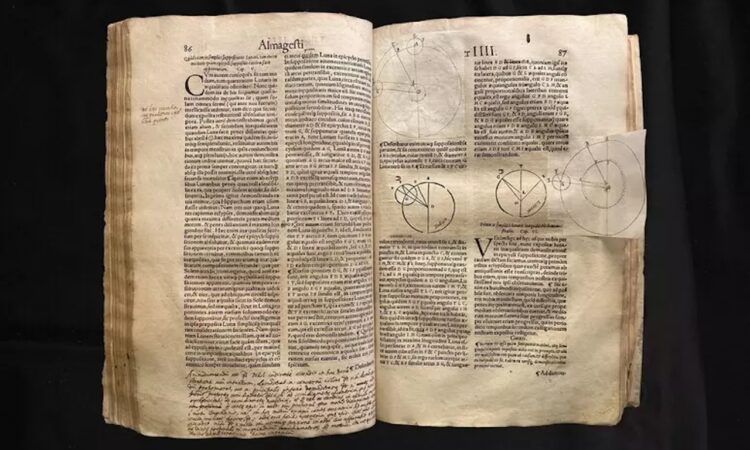
A copy of Almagest by the ancient astronomer Claudius Ptolemy, preserved at the Biblioteca Nazionale Centrale di Firenze, has been identified as containing numerous handwritten notes attributed to Galileo Galilei.
The discovery was made by Ivan Malara, a research fellow at the University of Milan, and later confirmed through handwriting analysis. It was presented in Florence on February 17, 2026.
A 16th-century edition with 16th-century annotations
The volume is a 1551 Basel edition of the Latin translation of Ptolemy’s Almagest, the foundational astronomical treatise written in the 2nd century AD. The book is part of the Magliabechiano collection, one of the historic fonds of the Florence National Library.
The work is divided into 13 books. According to Malara, the first five contain numerous marginal notes in a handwriting that closely matches Galileo’s early script.
Based on palaeographic analysis and on the content of the annotations, the notes are believed to date from between 1589 and 1592, when Galileo was teaching mathematics at the University of Pisa.
Technical notes from a young scholar
The annotations focus mainly on technical and mathematical passages. Malara explained that the notes show Galileo attempting to understand, clarify and expand on complex sections of the text.
So far, no outright refutations of Ptolemy’s geocentric model have been identified in the margins. However, in at least one passage, the annotator notes that experience suggests something different — a remark consistent with Galileo’s later emphasis on empirical observation.
The content of some marginal notes also recalls ideas found in other early Galilean writings, reinforcing the attribution.
A glimpse into Galileo’s study habits
One unusual detail found in the volume is a short prayer written before the study of the text. Historical testimonies from the period report that Galileo would pray before reading the Almagest, aware of the difficulty and complexity of the work.
The newly identified annotations therefore offer insight not only into Galileo’s intellectual development, but also into his approach to study at the beginning of his academic career.
Why the discovery matters
The Almagest was the central astronomical authority in Europe for more than a millennium. Understanding which edition Galileo used and how he engaged with it helps scholars trace the evolution of his thinking, from a young mathematics lecturer in Pisa to one of the leading figures of the Scientific Revolution.
For Florence, the finding highlights once again the importance of its libraries and archives as repositories of manuscripts and early printed books that continue to yield new discoveries centuries later.
❤️ Support Florence Daily News
If you liked this article, please consider supporting Florence Daily News.
We are an independent news site, free from paywalls and intrusive ads, committed to providing clear and reliable reporting on Florence and Tuscany for everyone.
Your support — whether a one-time gift or a regular contribution — helps us stay independent and keep telling the stories that matter.
Donate securely via Stripe below.
Make a one-time donation
Make a monthly donation
Make a yearly donation
Choose an amount
Or enter a custom amount
Your contribution is appreciated.
Your contribution is appreciated.
Your contribution is appreciated.
DonateDonate monthlyDonate yearlyDiscover more from Florence Daily News
Subscribe to get the latest posts sent to your email.