
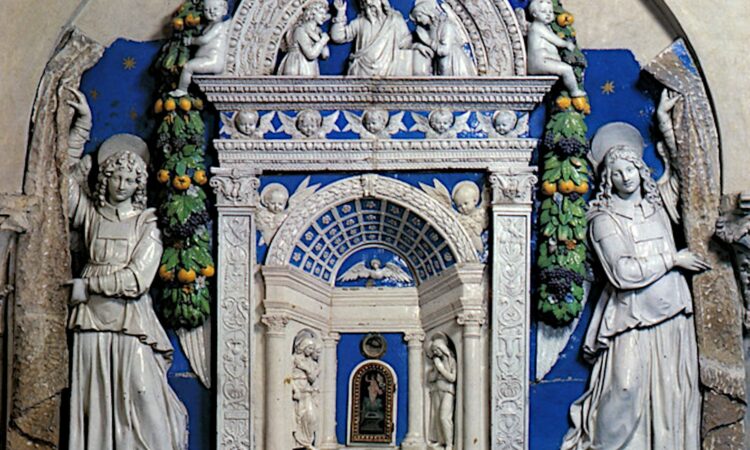
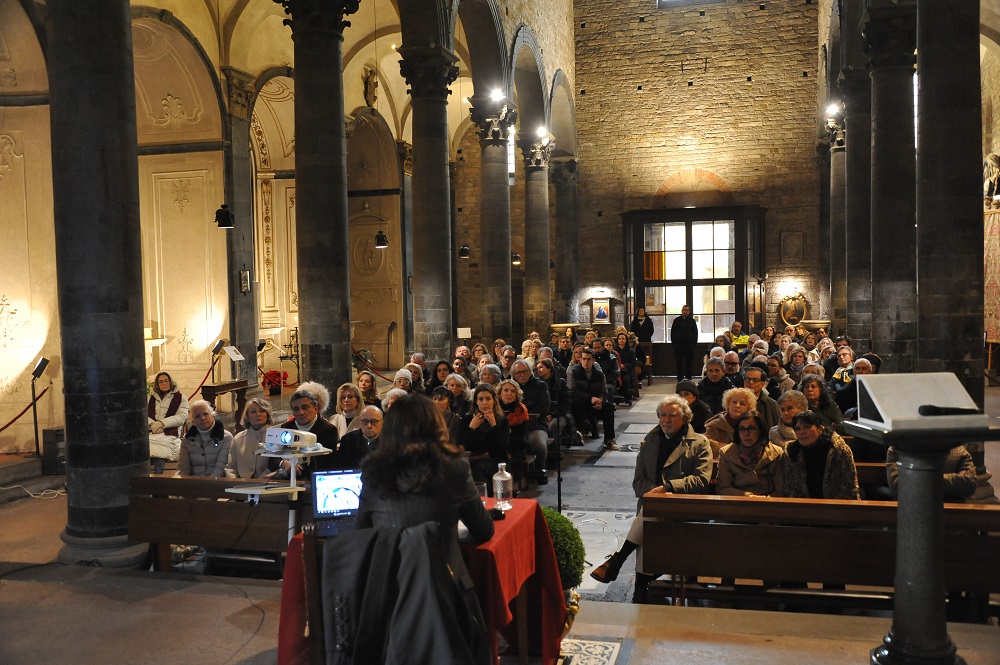
On 17 January 2026, the church of Santi Apostoli and Biagio in Florence hosted a public lecture by art historian and journalist Fiamma Domestici, dedicated to the glazed terracotta tabernacle by Andrea della Robbia preserved inside the church. The talk explored the work’s artistic, spiritual and historical significance, following its recent restoration supported by Friends of Florence. This is a summary of the presentation, while the full video is embedded in the article and English subtitles can be activated via YouTube’s settings.
Positioned high along the left aisle of the church of Santi Apostoli and Biagio, a glazed terracotta tabernacle by Andrea della Robbia combines architecture, sculpture and devotion into a single work. Despite this, it has received limited attention within the broader history of Florentine Renaissance art, remaining largely outside the most familiar narratives of the period.
Dating to the early 16th century, the tabernacle occupies a visually prominent yet physically distant position within the church, a circumstance that has contributed to its relative marginalisation. Its renewed legibility today is also the result of a careful restoration completed in 2019 by Florentine conservator Francesca Rossi, made possible through the support of Friends of Florence. The intervention restored the clarity of the glazed surfaces, allowing the work’s original chromatic balance and expressive restraint to emerge once again.
A sacred architecture of light
The tabernacle is conceived as a unified architectural organism rather than a simple sculptural ensemble. Angels draw back a sculpted curtain, transforming the structure into a kind of permanent revelation, a threshold between the earthly space of the nave and the sacramental presence it was designed to frame. Even though part of the original background and drapery has been lost, the remaining elements preserve a strong sense of spatial coherence and devotional intensity.
The glazed terracotta medium plays a central role in this effect. White and blue dominate the composition, punctuated by restrained pastel tones that catch and reflect light. This luminous quality, far from being merely decorative, reinforces the theological meaning of the work, transforming material substance into a vehicle for contemplation.
The Della Robbia tradition
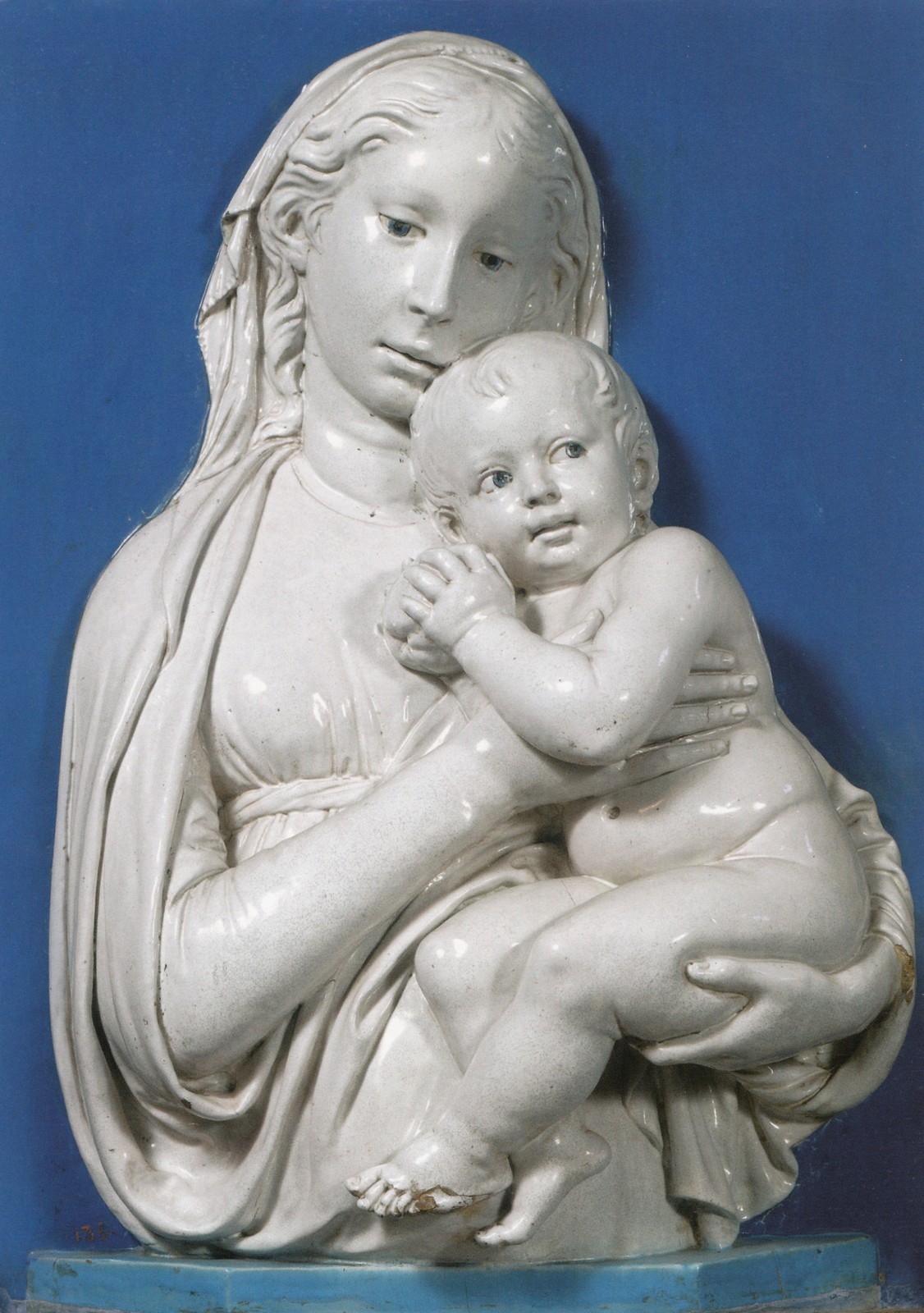
Andrea della Robbia belonged to a family workshop that shaped the visual identity of Florence and much of central Italy for more than a century. The tradition began with his uncle Luca della Robbia, one of the innovators of early Renaissance sculpture alongside Brunelleschi, Donatello and Masaccio. Luca’s development of glazed terracotta introduced a new artistic language that combined technical durability with an unprecedented clarity of form.
Andrea absorbed this legacy while gradually refining it. His works reveal a growing attention to spatial articulation, narrative clarity and emotional nuance, while remaining firmly rooted in the principles of balance and harmony that defined the family’s production. As Giorgio Vasari famously observed, these glazed sculptures were “almost eternal”, and their success led to widespread dissemination throughout Tuscany, central Italy and eventually to major European courts.
Between generations and changing styles
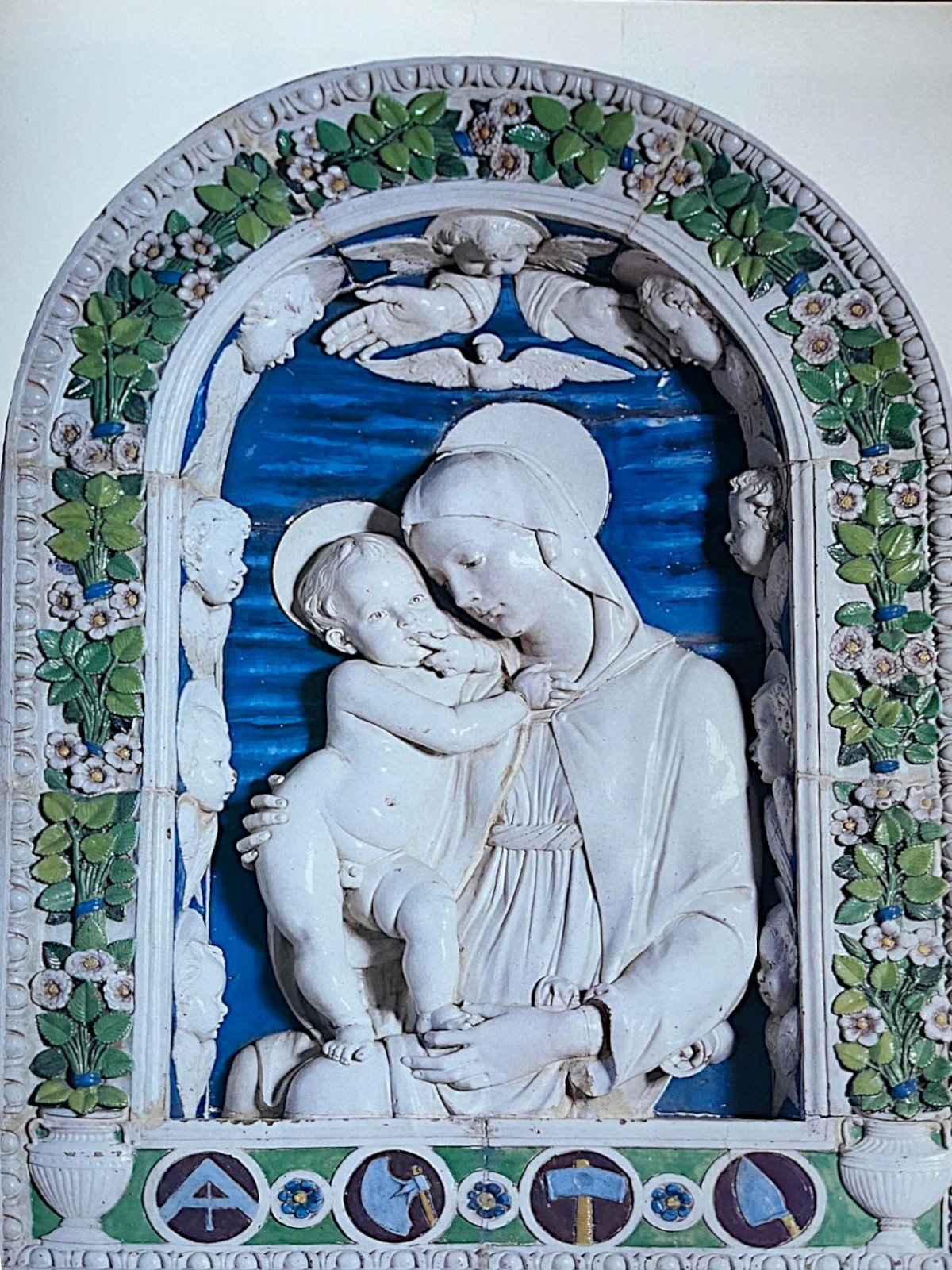
The tabernacle at Santi Apostoli belongs to a moment of transition within the Della Robbia workshop. While its overall composition adheres to the classical restraint typical of Andrea’s mature production, the more complex spatial organisation and animated gestures of the figures suggest the involvement of his son Giovanni della Robbia.
This generational dialogue reflects broader changes in Florentine art at the turn of the 16th century. Florence remained the artistic centre of Italy, but the visual language of the previous generation was being challenged by new paradigms introduced by Leonardo, Michelangelo and Raphael. The dramatic tension of Michelangelo’s sculpture, the psychological depth of Leonardo’s painting and the ideal grace of Raphael rapidly reshaped artistic expectations.
Against this backdrop, the refined and devotional language of glazed terracotta began to appear conservative, even as it retained extraordinary technical and expressive qualities. The gradual decline of the Della Robbia workshop does not signal a loss of artistic value, but rather a shift in taste and cultural priorities.
Patronage, devotion and memory
The tabernacle was commissioned in 1512 by Giovanni di Piero Acciaiuoli for his family chapel, as documented by a payment record studied by the art historian John Pope-Hennessy. The commission reflects the close relationship between private patronage, public worship and artistic excellence in Renaissance Florence.
Works such as this were not conceived as autonomous artworks, but as integral components of lived religious spaces. Their meaning unfolded through daily ritual, prayer and communal experience. In this sense, the tabernacle at Santi Apostoli continues to fulfil its original function. Its serene angels, luminous surfaces and measured gestures still invite contemplation, offering a form of visual theology grounded in material beauty.
More than five centuries later, renewed scholarly attention, restoration and public engagement allow this work to speak again. It reminds us that Florence’s artistic heritage is not limited to its most celebrated monuments, but also survives in quieter spaces, where art becomes prayer and where beauty continues to shape the spiritual and cultural life of the city.
❤️ Support Florence Daily News
If you liked this article, please consider supporting Florence Daily News.
We are an independent news site, free from paywalls and intrusive ads, committed to providing clear and reliable reporting on Florence and Tuscany for everyone.
Your support — whether a one-time gift or a regular contribution — helps us stay independent and keep telling the stories that matter.
Donate securely via Stripe below.
Make a one-time donation
Make a monthly donation
Make a yearly donation
Choose an amount
Or enter a custom amount
Your contribution is appreciated.
Your contribution is appreciated.
Your contribution is appreciated.
DonateDonate monthlyDonate yearlyDiscover more from Florence Daily News
Subscribe to get the latest posts sent to your email.