
For most of human history, migration was not a political choice. It was a condition of existence. People moved out of necessity, curiosity, survival. Movement was not an exception to be regulated, but the ordinary process through which societies took shape. Civilization, as we know it, was born on the move.
The Greece we continue to call the cradle of Western civilization did not emerge in isolation. It was the product of constant crossings—Anatolian, Levantine, Mediterranean influences layered over time. In its myths, its narrative structures, its vision of the world, traces of the East are unmistakable. Homer himself—a figure elusive, almost placeless—is claimed by multiple peoples. Not as an object of dispute, but as shared memory from a time when stories traveled even before people did.
When the Greeks moved toward Italy, they did not export a finished civilization. They created hybrids. The colonies were spaces of mutual transformation, not replicas. Rome, which would come later, made a principle of this approach: absorbing, reworking, including. There is no pure Rome, just as there is no original Greece. Our roots are far older than our borders.
The criminalization of immigration is a recent phenomenon. It begins when the nation-state turns identity into property—something to be protected and policed. Borders, porous for centuries, harden. Crossing them is no longer a human act, but an administrative violation. What had long generated exchange and innovation is gradually rewritten as a threat.
Today we celebrate a past built on encounters, yet struggle to accept a present that repeats the same dynamic. We speak of Europe as the “old continent,” as if it were fragile or besieged, when in fact it is the result of continuous mixing. Immigration does not interrupt European civilization; it represents its historical continuity.
The real question, then, is not whether movement endangers our identity.
It is whether a civilization can continue to evolve while denying the very movement that created it.
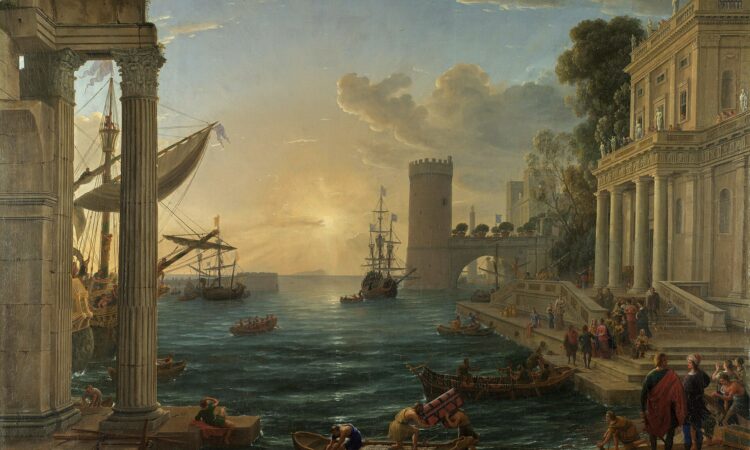
(Cover photo: Claude Lorrain, public domain)
❤️ Support Florence Daily News
If you liked this article, please consider supporting Florence Daily News.
We are an independent news site, free from paywalls and intrusive ads, committed to providing clear and reliable reporting on Florence and Tuscany for everyone.
Your support — whether a one-time gift or a regular contribution — helps us stay independent and keep telling the stories that matter.
Donate securely via Stripe below.
Make a one-time donation
Make a monthly donation
Make a yearly donation
Choose an amount
Or enter a custom amount
Your contribution is appreciated.
Your contribution is appreciated.
Your contribution is appreciated.
DonateDonate monthlyDonate yearly
Eirini Lavrentiadou is an actress and singer, born in Thessaloniki in 1992. She lives in Florence, where she trained at the city’s Theatre Academy and the Fiesole School of Music. She has performed in classical Greek and European plays, worked with international directors and companies, and appeared in concerts ranging from opera to jazz. She contributes to Florence Daily News as a writer.
Discover more from Florence Daily News
Subscribe to get the latest posts sent to your email.
The author makes a powerful poetic case for migration as the historical engine of civilization, but conflating premodern human movement with contemporary border policy overlooks essential realities of scale, economics, and governance. The ancient migrations that shaped Greece or Rome occurred in societies without welfare systems, complex labor markets, or the resource management obligations of the modern state. People moved freely because political and administrative borders—as we know them—did not exist. The fiscal and social consequences of movement fell to small communities, not to an interdependent national economy.
Open borders in the modern context cannot be discussed as a philosophical inevitability divorced from financial constraints. Nations today are not collections of small city-states absorbing incremental cultural exchange; they are welfare economies, infrastructure networks, and bureaucratic systems that depend on predictability and planning. Health care, housing, education, and employment are limited goods that must be distributed fairly among taxpayers and residents. To argue for “movement as continuity” without reckoning with this practical foundation is to treat governance as optional.
Yes, Europe—and indeed all of civilization—was forged through movement and exchange. But the relevant lesson is not that borders are illegitimate, but that openness must be paired with mechanisms of integration, sustainability, and reciprocity. Civilization grew not merely from migration, but from the capacity to assimilate and reorganize after it.
In short, the author romanticizes movement without confronting its modern costs or the responsibilities that accompany it. History shows that mobility built cultures; modernity reminds us that stewardship sustains them. The question is not whether civilization can survive borders, but whether it can survive the abandonment of coherent social policy.