
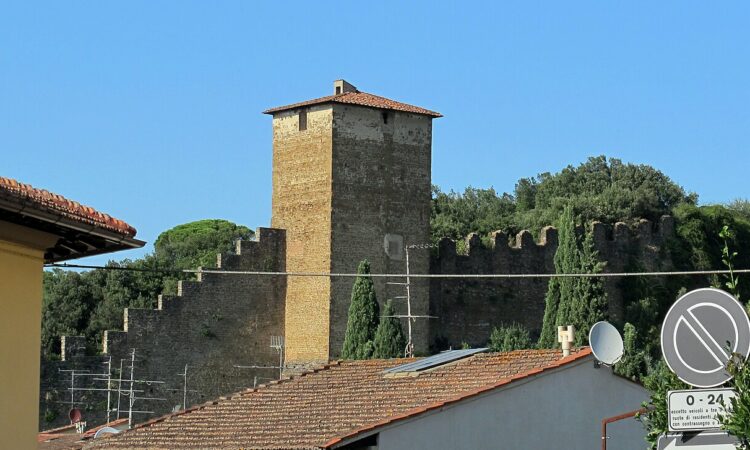
Florence is preparing a coordinated programme to conserve and make better use of the surviving sections of its medieval city walls, including gates, towers, ramparts and elevated walkways.
The Piano Unitario Mura Arnolfiane, or PUMA, covers the 2026-2029 period and has been developed by the Fine Arts Service within Florence City Council’s technical services department. The plan is intended to replace a more fragmented approach to maintenance and restoration with a single framework for managing the historic fortifications.
The so-called Arnolfian walls formed Florence’s last major medieval defensive circuit, built largely between the late 13th and first half of the 14th century. Much of the fortification north of the Arno was demolished during the 19th-century transformation of Florence, while longer stretches survived south of the river in the Oltrarno area.
According to figures provided by the city, the surviving system includes more than 86,000 square metres of stone surfaces, excluding the Fortezza da Basso and Forte Belvedere.
More sections could open to visitors
One of the main objectives is to increase public access. At present, only around 30-35% of the surviving gates and towers are accessible, while about 6% of the wall-top walkways are included in visitor routes.
The plan envisages gradually expanding those areas and creating new elevated routes along sections of the walls. Among the areas identified are Via di Belvedere, on the hillside below Piazzale Michelangelo, and the stretch between Viale Petrarca and Viale Ariosto in the Oltrarno district.
The programme combines three main areas of work: conservation and restoration, improved public access and cultural use, and the introduction of new technology for monitoring the monuments.
A three-dimensional database using Building Information Modelling (BIM) is planned to provide detailed information on the condition of the walls. The system is intended to help technicians monitor deterioration and plan future maintenance, while also supporting digital tools for visitors.
A surviving part of medieval Florence
Florence’s final medieval wall circuit extended for about eight kilometres. Large sections on the northern side of the Arno disappeared when architect Giuseppe Poggi redesigned the city in the 19th century, particularly during the years when Florence served as capital of the newly unified Kingdom of Italy.
Several monumental gates and towers survived, however, while much more of the fortifications remains standing in Oltrarno.
The city has already begun connecting individual restoration projects to the PUMA framework. In May 2026, the municipal government approved a €250,000 conservation project for Porta Romana, one of Florence’s principal surviving medieval gateways. The work is expected to begin in early 2027 and last around six months.
Porta Romana was built between 1327 and 1331 and retains its large historic wooden doors. It is currently the only city gate where visitors can access the wall-top walkway, through guided visits available since 2005.
Funding conservation over the longer term
The PUMA programme is designed around an initial four-year period but also sets out a longer-term approach extending into the following four years.
Alongside municipal funding already allocated to maintenance, Florence plans to seek private support through schemes including FLIC – Florence I Care and Italy’s Art Bonus programme, which provides tax incentives for donations supporting public cultural heritage.
The aim is to establish a more continuous system of conservation rather than relying mainly on individual restoration projects as problems emerge.
For residents and visitors, the most visible result could eventually be greater access to a part of Florence that remains largely closed: the surviving walls themselves and the elevated routes that once formed the city’s medieval defensive perimeter.
(Cover photo: Sailko via Wikipedia)
❤️ Support Florence Daily News
If you liked this article, please consider supporting Florence Daily News.
We are an independent news site, free from paywalls and intrusive ads, committed to providing clear and reliable reporting on Florence and Tuscany for everyone.
Your support — whether a one-time gift or a regular contribution — helps us stay independent and keep telling the stories that matter.
Donate securely via Stripe below.
Make a one-time donation
Make a monthly donation
Make a yearly donation
Choose an amount
Or enter a custom amount
Your contribution is appreciated.
Your contribution is appreciated.
Your contribution is appreciated.
Discover more from Florence Daily News
Subscribe to get the latest posts sent to your email.