
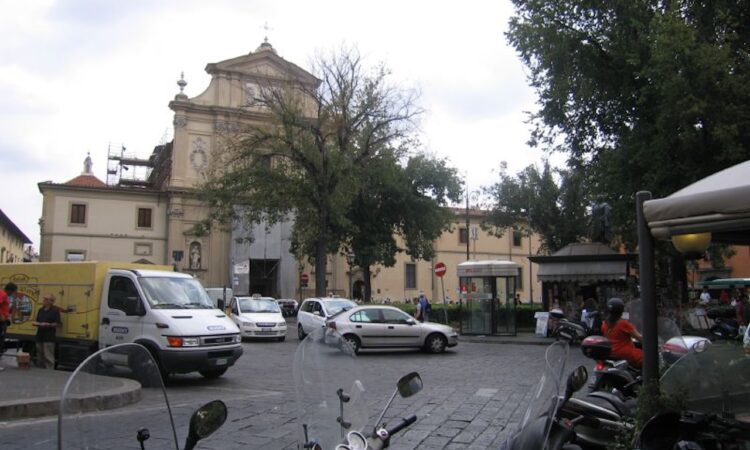
Florence will replace part of the stone paving in Piazza San Marco with high-performance printed asphalt, in an attempt to solve a practical problem created by the heavy and repeated loads of public transport in one of the historic centre’s most recognisable squares.
The work is scheduled from 14 to 23 August, according to the Municipality of Florence, and will affect the junctions of Piazza San Marco with Via degli Arazzieri and Via Cesare Battisti. There will also be changes and restrictions affecting bus services and the T2 tram line, which terminates in the square.
The new surface has been agreed with the Soprintendenza, the state heritage authority responsible for protecting Florence’s historic and architectural heritage. Instead of conventional road asphalt, the city will use a high-performance material that is stamped to reproduce the appearance of the existing stone.
It will also be treated with heat-reflective resins intended to reduce the amount of solar heat absorbed by the surface.
Why the stone is being replaced
The change highlights one of the less visible consequences of bringing modern public transport into Florence’s historic urban fabric: traditional paving is not necessarily suited to the weight and turning forces generated by large vehicles.
Technical documents prepared for the San Marco tram project had already identified the problem. They noted that the square would continue to carry significant numbers of 12-metre public buses and that their route between Via Cesare Battisti and Via degli Arazzieri involves four demanding 90-degree turns. The documentation concluded that stone paving is generally not suited to this type of load and stress.
The pressure has increased with the arrival of the tram. The extension of the T2 Vespucci line to Piazza San Marco opened in 2025, making the square the central Florence terminus of the route connecting the historic centre with Santa Maria Novella railway station and Florence Airport.
The new asphalt is therefore intended to provide a more durable surface at the points subjected to the greatest stress, reducing the need for repeated repairs and the resulting disruption to public transport.
A more practical surface, but no longer real stone
There is, however, an aesthetic trade-off.
The existing paving uses actual stone, a material that contributes to the texture and appearance of Piazza San Marco. The replacement will instead be asphalt made to look like stone.
The solution preserves the visual pattern rather than the original material. From a maintenance perspective, this should make the two junctions more suitable for intensive public transport. From a heritage and streetscape perspective, it introduces an imitation surface into a historic square.
The distinction is particularly notable because project documents for the tramway indicate that stone paving in Piazza San Marco had itself been required by the Soprintendenza. The same technical documentation describes the stone used for vehicle areas as Alberese calcarenite slabs, while acknowledging the difficulties caused by repeated bus movements.
The decision therefore reflects a compromise between two competing requirements: retaining the appearance expected in a historic Florentine square and providing a road surface capable of coping with modern buses and tram traffic.
Whether the printed asphalt convincingly reproduces the character of the existing paving will become clearer once the work is completed.
Other repairs in Piazza San Marco
Not all of the square’s stone paving will be replaced.
The municipality says smaller repairs will also be carried out on existing stone surfaces elsewhere in Piazza San Marco, particularly on the side facing the Museo di San Marco.
The intervention comes less than two years after the tramway transformed the transport role of the square. T2 now runs between Florence Airport and Piazza San Marco, passing through Santa Maria Novella and the northern edge of the historic centre.
Practical information
The resurfacing work is scheduled for 14–23 August 2026 at the junctions of Piazza San Marco with Via degli Arazzieri and Via Cesare Battisti.
Bus services and the T2 tram will be subject to changes and restrictions during the works. Travellers using Piazza San Marco during the August holiday period should check the latest public transport information before travelling.
(Cover photo: mindfieldz via Flickr)
❤️ Support Florence Daily News
If you liked this article, please consider supporting Florence Daily News.
We are an independent news site, free from paywalls and intrusive ads, committed to providing clear and reliable reporting on Florence and Tuscany for everyone.
Your support — whether a one-time gift or a regular contribution — helps us stay independent and keep telling the stories that matter.
Donate securely via Stripe below.
Make a one-time donation
Make a monthly donation
Make a yearly donation
Choose an amount
Or enter a custom amount
Your contribution is appreciated.
Your contribution is appreciated.
Your contribution is appreciated.
Discover more from Florence Daily News
Subscribe to get the latest posts sent to your email.