
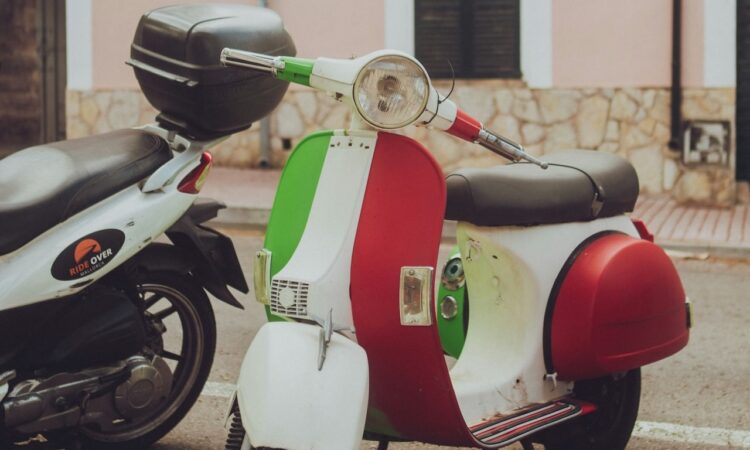
The iconic Italian scooter Vespa turns 80 in 2026, marking a milestone that highlights both its industrial roots in Tuscany and its global cultural impact. First patented on 23 April 1946 by Piaggio, the vehicle quickly evolved from a practical means of transport in post-war Italy into one of the most recognisable symbols of Italian style worldwide.
A Tuscan origin with global reach
The story of Vespa is closely tied to Pontedera, a town about 30 kilometres west of Florence, where Piaggio established its main factory and where production continues today. The area became a key industrial hub in the decades after the Second World War, contributing to Tuscany’s economic recovery and industrial identity.
Designed by aeronautical engineer Corradino D’Ascanio under the direction of Enrico Piaggio, the original Vespa introduced technical solutions that set it apart from traditional motorcycles, including a self-supporting body, handlebar gear shift and protective frame. These features made it accessible to a broader public and helped redefine personal mobility.
Within a few years, Vespa production expanded beyond Italy, reaching international markets and eventually exceeding nearly 20 million units worldwide. The scooter became part of everyday life in many countries, while also gaining visibility through cinema and popular culture.
Exhibition and events in Pontedera
To mark the anniversary, celebrations in Tuscany focus on the Museo Piaggio, located next to the historic factory. On Thursday 23 April 2026, an exhibition titled “Buon Compleanno Vespa”, curated by Filippo Lotti, opens to the public, with an inaugural event from 5 p.m. to 8 p.m.
The exhibition is part of a broader programme that connects industrial heritage with contemporary art. In the outdoor spaces of the Piaggio Foundation, six Tuscan street artists — Danmariti, LDB, Umberto Staila, Skim, Freddy Pills and Forma — have created large-scale works inspired by Vespa. Using graffiti and stencil techniques, the artists reinterpret the scooter as a symbol of movement, freedom and design across generations.
The works, produced live on site, form a collective installation that links the history of the factory with current urban artistic languages. A video by Slava Viacheslav Zakharov documents the creative process, offering an additional narrative layer to the project.
The exhibition will remain open until 30 June 2026 during the museum’s regular opening hours, and the artworks will become part of the Piaggio Foundation’s permanent collection.
Between tradition and innovation
Over eight decades, Vespa has maintained a consistent design identity while adapting to new technologies and markets. From early models such as the Vespa 98 and 125 to more recent versions like Primavera, Sprint and GTS, the brand has combined continuity in design with improvements in efficiency and safety.
Today, Vespa is produced in multiple plants across Europe and Asia and remains one of Italy’s most recognisable industrial products. The anniversary celebrations in Pontedera underline not only the scooter’s global success, but also Tuscany’s role as the birthplace of a product that continues to shape ideas of mobility and design.
(Cover photo: Raymond Petrik via Unsplash)
❤️ Support Florence Daily News
If you liked this article, please consider supporting Florence Daily News.
We are an independent news site, free from paywalls and intrusive ads, committed to providing clear and reliable reporting on Florence and Tuscany for everyone.
Your support — whether a one-time gift or a regular contribution — helps us stay independent and keep telling the stories that matter.
Donate securely via Stripe below.
Make a one-time donation
Make a monthly donation
Make a yearly donation
Choose an amount
Or enter a custom amount
Your contribution is appreciated.
Your contribution is appreciated.
Your contribution is appreciated.
Discover more from Florence Daily News
Subscribe to get the latest posts sent to your email.