
A group of previously unregistered archaeological artefacts has been rediscovered in storage at the Uffizi Galleries in Florence. The objects, packed in several crates and never formally inventoried, include 164 pieces such as terracotta figurines, small vessels, lamps and Egyptian bronze statuettes.
The discovery emerged during inspections of the museum’s storage rooms in 2020, when staff were asked to review the condition of artworks during the pandemic closure. The artefacts and the reconstruction of their history are described in an article by scholar Ylenia Carbonari published in the Uffizi’s official magazine.
The objects and their origins
The collection includes 111 terracotta figurines, seven small vessels, 38 clay oil lamps and eight Egyptian bronzes. Together they cover a wide chronological range, from the late dynastic period of ancient Egypt to the early Christian era.
The largest group consists of terracotta figurines, likely produced in the region of Alexandria in Egypt. Many still show traces of polychrome decoration. They depict figures such as Aphrodite, Nike, Athena, Isis and Serapis and were probably used as religious votive offerings or as funerary objects placed in tombs.
A collection linked to a German doctor
Research into the provenance of the artefacts has linked them to the collection of Max Reich, a German doctor who lived in Merano during the Second World War.
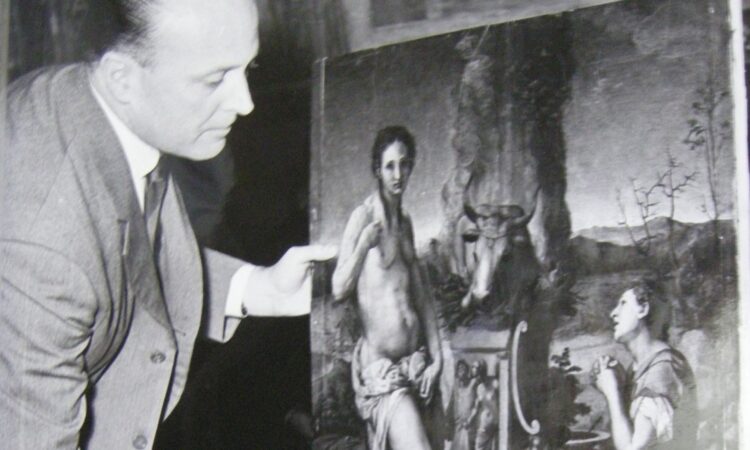
After Reich’s death, the objects were confiscated in 1947 by the Italian government’s art recovery office led by Rodolfo Siviero, a diplomat and intelligence figure who played a key role in tracing works of art removed from Italy during the Nazi occupation. The collection was then transferred to Rome.
Some of the artefacts were later displayed in exhibitions dedicated to recovered artworks, including the Second National Exhibition of Works Recovered from Germany held in 1950 at Palazzo Venezia in Rome and again in 1952 at Palazzo Vecchio in Florence.
Part of the collection still missing
Archival records from 1949 list more than 300 objects belonging to the Reich collection. The pieces rediscovered in the Uffizi correspond to those exhibited in the post-war shows, suggesting that other items from the same group are currently unaccounted for.
The Uffizi Galleries said that further research is under way to trace the missing artefacts, in cooperation with Italy’s Carabinieri unit for the protection of cultural heritage.
The role of Rodolfo Siviero
Rodolfo Siviero is widely known in Italy as the “art detective” who coordinated the post-war recovery of artworks removed from the country. Appointed in 1946 to head the national recovery office, he worked to bring back pieces taken after the German occupation of Italy in 1943 as well as works exported illegally in earlier years with the support of the Fascist regime.
Among the artworks returned to Italy through his efforts are Titian’s Danaë, now in the Museo di Capodimonte in Naples, and the Pollaiolo panels depicting the Labours of Hercules, today preserved in the Uffizi Galleries.
(Cover photo from the museum of Casa Siviero)
❤️ Support Florence Daily News
If you liked this article, please consider supporting Florence Daily News.
We are an independent news site, free from paywalls and intrusive ads, committed to providing clear and reliable reporting on Florence and Tuscany for everyone.
Your support — whether a one-time gift or a regular contribution — helps us stay independent and keep telling the stories that matter.
Donate securely via Stripe below.
Make a one-time donation
Make a monthly donation
Make a yearly donation
Choose an amount
Or enter a custom amount
Your contribution is appreciated.
Your contribution is appreciated.
Your contribution is appreciated.
Discover more from Florence Daily News
Subscribe to get the latest posts sent to your email.