
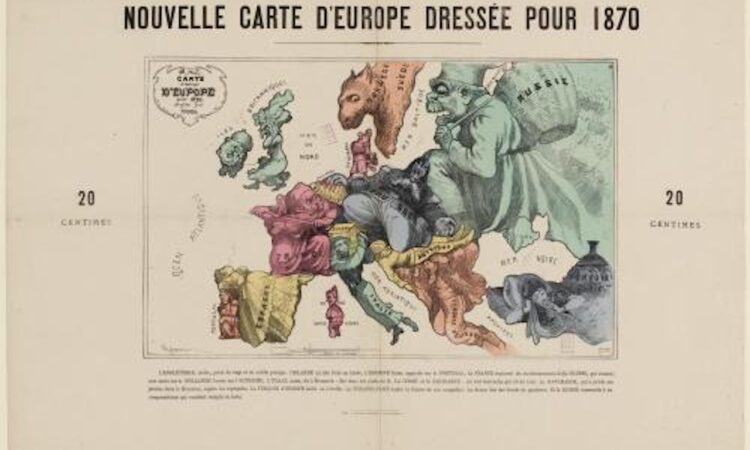
In 1870, shortly before the Franco-Prussian War turned political certainties to ashes, a visitor to a bookshop in Montepulciano might have come across a map that quite literally folded Europe in on itself. The Nouvelle Carte d’Europe dressée pour 1870 does more than mark borders: the continent takes shape as a nervous creature rendered in grotesque figures. Prussia resembles a soldier striking a cover-ready pose, France a boxer standing at the centre of the ring, Russia a giant stumbling over its own legs. Italy, young and newly unified, has the look of an adolescent who has just put on a suit that is too large. Greece, only recently established as a nation, is still labelled “Turkey in Europe”. The United Kingdom observes the scene with the detachment of a theatre critic, wearing an invisible monocle and a smile that seems to say: “These Europeans…”
A few months later, Napoleon III would fall, Germany would proclaim itself an empire, and history would write its dramatic script. Yet the map anticipates it all with irony: Europe as a single organism, where a slight jolt in Prussia sends tremors through every other limb.
In London, Fred W. Rose was producing similar maps, built on the same concept and the same bodily tension. Europe appeared as an interconnected system, a single body in which the diversity of its members did not remove the need for coordination — though it certainly did not make it easy.
Today, that organism continues to breathe. At times, the cells of individual states cooperate, exchange impulses and build shared ideas; at other times, they retreat into domestic concerns, wag their tails in self-absorption or quarrel with neighbours over minor details. The idea of a shared Europe is not modern: it already existed in the nineteenth-century imagination. Countries divided by language, religion, memory and temperament sought a fragile balance, an ongoing experiment in collaboration.
The broader European vision grew from concrete exchanges: goods moving through ports, artists performing in theatres, scientists gathering at conferences, philosophers teaching in universities. A fabric of real contacts that functioned as a bond stronger than any treaty. Yet, like any complex organism, the body does not function without friction: each state tends to withdraw, protect its identity and cultivate its own idiosyncrasies.
America watches from afar, with a shorter but equally complex history. There, too, each state preserves its own character and memory. Unity is not automatic; it must be achieved, negotiated and respected. American “cells”, like European ones, must learn to survive without fragmenting the larger body — often with an irony that Europeans immediately recognise, and that their politicians systematically ignore.
And as Andrei Tarkovsky once suggested, every generation needs to make its own mistakes in order to learn. The irony is that we never truly learn, yet we can at least observe these recurring patterns with a bitter smile, as spectators in a theatre that has been repeating the same performance for centuries. This nineteenth-century map reminds us that the desire for unity and the difficulty of harmonising diversity are not modern inventions: they are the perennial playing field of political organisms, whether European or American.
Originally written in English for an international readership, the article also exists in Italian. While both versions stem from the same core reflections, they differ in tone and development. The Italian text can be read at the following link.
❤️ Support Florence Daily News
If you liked this article, please consider supporting Florence Daily News.
We are an independent news site, free from paywalls and intrusive ads, committed to providing clear and reliable reporting on Florence and Tuscany for everyone.
Your support — whether a one-time gift or a regular contribution — helps us stay independent and keep telling the stories that matter.
Donate securely via Stripe below.
Make a one-time donation
Make a monthly donation
Make a yearly donation
Choose an amount
Or enter a custom amount
Your contribution is appreciated.
Your contribution is appreciated.
Your contribution is appreciated.
DonateDonate monthlyDonate yearlyDiscover more from Florence Daily News
Subscribe to get the latest posts sent to your email.