
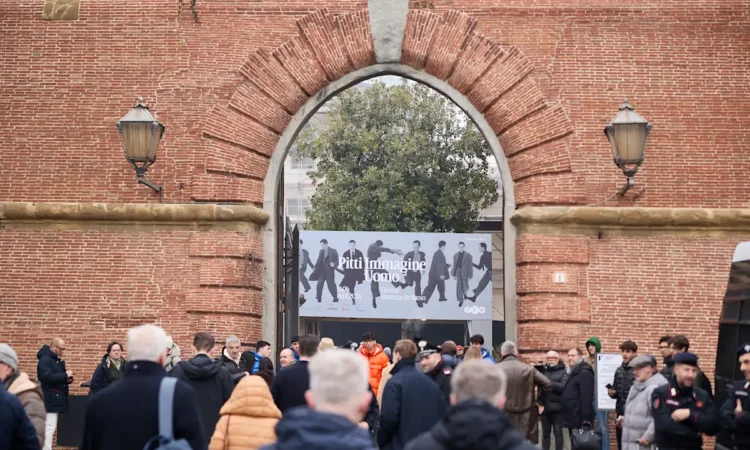
Having lived in Florence for many years, I have learned that there are two moments each year when the city changes its face. It is not just a matter of crowds or traffic; it is something you feel while walking through the streets, watching people, the way they move and dress. Suddenly, attention to detail becomes visible, and elegance returns to occupy the urban space.
I clearly remember afternoons at Florence’s train station while waiting for the bus. From a distance, I could see a stream of people coming out of Pitti Uomo: tailored jackets, carefully polished shoes, fabrics that spoke of research and quality. It felt like a spontaneous fashion show unfolding within the everyday rhythm of the city. At the time, I observed it with curiosity, but also with a certain detachment.
This year, for the first time, I had the opportunity to experience Pitti Uomo from the inside. And it was there that my idea of fashion changed. I used to think fashion was mainly about appearance—a desire to be seen, to impress. Instead, by observing closely, I discovered another meaning. I saw people who spoke about fabrics as if they were living matter, who chose a garment for the way it fell on the body, for the detail of a seam, for the time it carried within it. People who enjoy dressing well not to be looked at, but to feel comfortable and aligned with themselves.
Perhaps this sensibility is not new. In fact, it is deeply rooted in the history of Florence itself. In the 1950s, the city consecrated Italian fashion on an international level. Through innovative promotional direction and a masterful use of its historic locations, Florence became the ideal stage on which to present a different idea of elegance—one capable of challenging French dominance. Italian fashion asserted itself through imaginative materials, wearability, and refined tailoring.
The symbolic moment came on February 12, 1951, when the first Italian fashion show took place at Villa Torrigiani, in the home of Giovanni Battista Giorgini. The Fontana sisters, Jole Veneziani, Fabiani, Pucci, Noberasco, Carosa, and Schuberth presented their creations to American buyers and journalists. It was an extraordinary success: Florence definitively entered the history of fashion.
From 1952 until 1982, the White Hall of Palazzo Pitti became the beating heart of this phenomenon. For thirty years it hosted unforgettable fashion shows, transforming Italian fashion into a global language capable of influencing the economy, the collective imagination, and contemporary culture. Palazzo Pitti was no longer just a historic site—it became a symbol.
In the 1960s, however, something changed. The upheaval of 1968 challenged the very way fashion was conceived and represented. Haute couture moved increasingly toward Paris and Rome, while Florence attracted a new, more informal and experimental creativity, closer to everyday life. This shift was fundamental in preparing the ground for a new idea of style.
In 1972, Pitti Uomo was born. Initially conceived to promote the excellence of the Italian menswear industry on major international markets, the event quickly grew into a global reference point. Once again, Florence reinvented its role, becoming the place where menswear found identity, language, and a vision of the future.
Today, walking among the people attending Pitti Uomo, I have the feeling of witnessing a silent continuity. In an era in which we dress quickly, often choosing convenience and functionality, this world reminds us that dressing can still be a conscious act. Dressing well does not mean wearing designer labels, but choosing garments that respect the body and express a personal style, almost as if they were made to measure.
Thinking back on all of this, I am reminded of an episode from my years at drama school. During a class, a professor who came from the Royal Academy of Dramatic Art in London told us that whenever he was in Florence, he loved walking through the streets and observing people. According to him, Florentines dress in a theatrical way: every outfit has a clear purpose and is constructed with great attention to detail, just like a stage costume.
Perhaps it is precisely this everyday theatricality that forms the invisible thread connecting Florence and fashion. A way of being in the world in which dressing is not merely about covering oneself, but about self-expression. A gesture that moves through time and continues to live in the streets of the city.
❤️ Support Florence Daily News
If you liked this article, please consider supporting Florence Daily News.
We are an independent news site, free from paywalls and intrusive ads, committed to providing clear and reliable reporting on Florence and Tuscany for everyone.
Your support — whether a one-time gift or a regular contribution — helps us stay independent and keep telling the stories that matter.
Donate securely via Stripe below.
Make a one-time donation
Make a monthly donation
Make a yearly donation
Choose an amount
Or enter a custom amount
Your contribution is appreciated.
Your contribution is appreciated.
Your contribution is appreciated.
DonateDonate monthlyDonate yearly
Eirini Lavrentiadou is an actress and singer, born in Thessaloniki in 1992. She lives in Florence, where she trained at the city’s Theatre Academy and the Fiesole School of Music. She has performed in classical Greek and European plays, worked with international directors and companies, and appeared in concerts ranging from opera to jazz. She contributes to Florence Daily News as a writer.
Discover more from Florence Daily News
Subscribe to get the latest posts sent to your email.