
In recent years, we have witnessed events that, taken individually, seem to belong to very different contexts: police operations ending in the death of civilians, governments justifying the use of force in the name of security, political leaders increasingly speaking in the first person, as if the institutional role were merely a detail. Yet when observed together, these phenomena appear to point in the same direction.
What connects them is not violence itself, but the way power is conceived and narrated.
When a state tolerates, justifies, or minimizes violence against civilians—especially those who are distant, marginalized, or defined as “others”—it is not merely making a military or security decision. It is lowering a moral threshold. It is implicitly declaring that, under certain conditions, human life can become negotiable. And this logic, sooner or later, tends to return inward.
Not because there is a mechanical chain of cause and effect, but because the culture of power never remains confined. Practices, language, and justifications migrate: from foreign policy to domestic security, from war to policing, from exception to normality.
Alongside this runs another phenomenon, less visible but equally decisive: the personalization of power. Political discourse increasingly speaks not on behalf of institutions, but on behalf of the individual who occupies them. The leader no longer presents themselves as a temporary guardian of a role, but as an indispensable protagonist. The implicit message becomes: the system matters less than I do.
When this happens, institutions hollow out. Laws are no longer shared limits, but obstacles to be bypassed. Responsibility is no longer collective, but personal. And citizens are not asked to participate or to hold power accountable, but to believe.
This is where the picture comes together. Because when we no longer believe in institutions, but in a single person; not in rules, but in charisma; not in limits, but in permanent exception, power ceases to be constrained. And unconstrained power, historically, does not become more just—it merely becomes freer to strike.
History teaches us that democracies are not built on faith in the goodness of individuals, but on the opposite awareness: that human beings, when placed in positions of power, tend to lose their sense of limits. That is why separation of powers, checks and balances, procedures, and impersonal laws exist. Not out of distrust toward politics, but out of realism.
When everything is instead reduced to ego, personal narrative, and the idea that “only I can,” morality becomes subjective. And what is subjective can always be justified.
In this context, episodes of institutional violence are no longer just “incidents.” They become symptoms—signals of a drift in which force precedes responsibility and the individual replaces the function.
Rebuilding trust in institutions is not a nostalgic exercise, but an urgent necessity. Because where power answers only to itself, someone eventually pays the price. And it is almost never those who command.
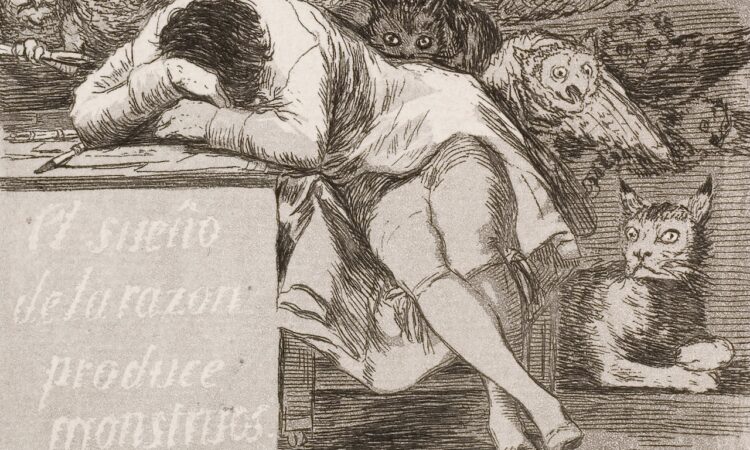
(Cover photo Francisco José de Goya y Lucientes – The sleep of reason produces monsters (No. 43), from Los Caprichos – Google Art Project – Public domain)
❤️ Support Florence Daily News
If you liked this article, please consider supporting Florence Daily News.
We are an independent news site, free from paywalls and intrusive ads, committed to providing clear and reliable reporting on Florence and Tuscany for everyone.
Your support — whether a one-time gift or a regular contribution — helps us stay independent and keep telling the stories that matter.
Donate securely via Stripe below.
Make a one-time donation
Make a monthly donation
Make a yearly donation
Choose an amount
Or enter a custom amount
Your contribution is appreciated.
Your contribution is appreciated.
Your contribution is appreciated.
DonateDonate monthlyDonate yearly
Eirini Lavrentiadou is an actress and singer, born in Thessaloniki in 1992. She lives in Florence, where she trained at the city’s Theatre Academy and the Fiesole School of Music. She has performed in classical Greek and European plays, worked with international directors and companies, and appeared in concerts ranging from opera to jazz. She contributes to Florence Daily News as a writer.
Discover more from Florence Daily News
Subscribe to get the latest posts sent to your email.