
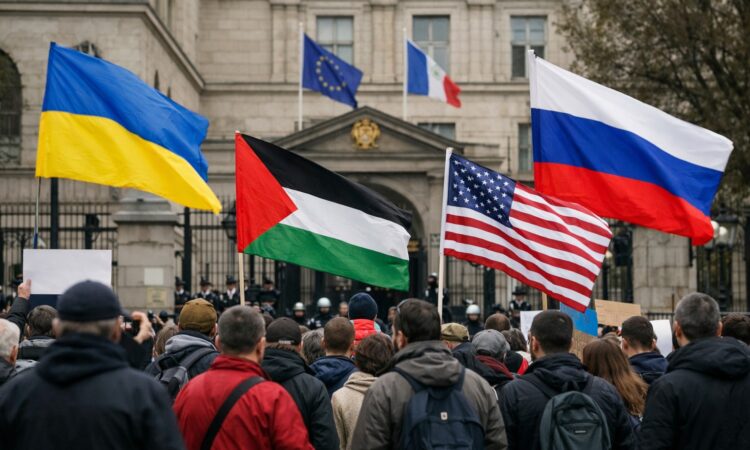
In Europe, international law is often presented as a clear dividing line between civilization and barbarism. It is invoked with conviction, almost with relief: finally an objective criterion, finally a rule that does not depend on power relations. The problem is that this loyalty to the law is not consistent. It depends on the context—and, above all, on who is in the dock.
Russia’s invasion of Ukraine was rightly condemned as a blatant violation of international law. Sanctions followed, statements were issued, flags were raised. Yet almost immediately, a significant part of European public opinion—particularly on the left—began to look for mitigating circumstances. NATO expansion, historical grievances, security concerns. International law remained on the table, but as one argument among others, not as the decisive standard.
With Israel and Palestine, the dynamic is reversed. Here international law suddenly becomes absolute and non-negotiable. Occupation, war crimes, systematic violations: everything is read strictly through the lens of legality. There is little talk of strategic necessity or provocation. The law applies in full, without discounts.
The same pattern appears elsewhere. The American intervention in Venezuela is denounced as imperialism and a violation of sovereignty, while the authoritarian nature of the Maduro regime becomes a secondary detail. Once again, international law functions not as a universal principle, but as a selective instrument.
The result is a political scene that borders on the tragicomic. The same actors defend or suspend legality depending on the camp they belong to. The law does not guide positions; it justifies them after the fact.
Why does this happen? Why is it so difficult to adopt a simple and coherent stance: an invasion is a violation of international law, whoever commits it?
The answer is not only political, but psychological. Human beings have a deep need for belonging. For most of history, survival depended on the group, not on abstract moral consistency. That reflex has not disappeared; it has migrated into politics. Taking sides is not only a way to interpret the world, but a way to give meaning to oneself.
International law is impersonal. It does not create identity, it does not inspire loyalty, it does not comfort. Political camps do. They offer clear narratives, reduce complexity, and allow for a controlled form of moral outrage. Being “only” in favor of the law often feels insufficient, sometimes even suspect. Neutrality is easily mistaken for indifference.
But this selectivity comes at a cost. When legality applies only to one’s adversaries, it ceases to function as a limit. It becomes negotiable. And when the law is negotiable, someone will eventually stop pretending to respect it.
We can see this clearly today. For decades, the United States at least felt compelled to justify its violations of international law. Now it no longer does. With Trump, this shift did not begin—it simply became explicit. The world had already accepted that legality was optional.
Europe’s moral selectivity is therefore more than an intellectual inconsistency. It is a cultural surrender. When international law stops being universal, only power remains—or, at best, the illusion of standing on the right side.
(Cover photo created by the Artificial Intelligence)
🎄 Support Florence Daily News this holiday season
If you value our work, please consider supporting Florence Daily News this Christmas.
We’re an independent news site — free from paywalls and intrusive ads — committed to offering clear and reliable reporting on Florence and Tuscany for everyone.
Your contribution helps us remain independent and continue telling the stories that matter.
As a small thank-you, supporters this holiday season will receive an original photograph of Florence — a simple, meaningful gift to celebrate the city we all love.
🎁 Donate securely via Stripe below and make your gift count for good journalism in Tuscany.
Make a one-time donation
Make a monthly donation
Make a yearly donation
Choose an amount
Or enter a custom amount
Your contribution is appreciated.
Your contribution is appreciated.
Your contribution is appreciated.
DonateDonate monthlyDonate yearly
Eirini Lavrentiadou is an actress and singer, born in Thessaloniki in 1992. She lives in Florence, where she trained at the city’s Theatre Academy and the Fiesole School of Music. She has performed in classical Greek and European plays, worked with international directors and companies, and appeared in concerts ranging from opera to jazz. She contributes to Florence Daily News as a writer.
Discover more from Florence Daily News
Subscribe to get the latest posts sent to your email.