
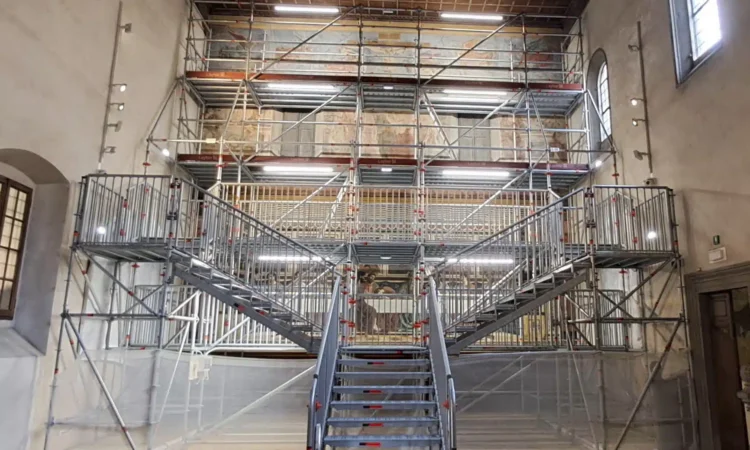
Florence’s Cenacolo di Sant’Apollonia is reopening its doors with an unusual opportunity: visitors can observe the restoration of Andrea del Castagno’s Last Supper, one of the most significant works of the early Florentine Renaissance, from a platform installed directly in front of the paintings.
Beginning on Sunday, 15 November 2026, the museum will offer access to a specially constructed scaffolding structure, allowing small groups to examine details of the monumental fresco cycle, painted around 1447, that are normally difficult to appreciate from the ground.
The initiative will run until 26 June 2027, giving visitors the chance to see the artwork from a different perspective while learning about the techniques used to conserve centuries-old paintings.
A closer look at a Renaissance masterpiece
The Cenacolo di Sant’Apollonia occupies the former refectory, or dining hall, of a Benedictine convent founded in 1339, in Florence’s historic centre.
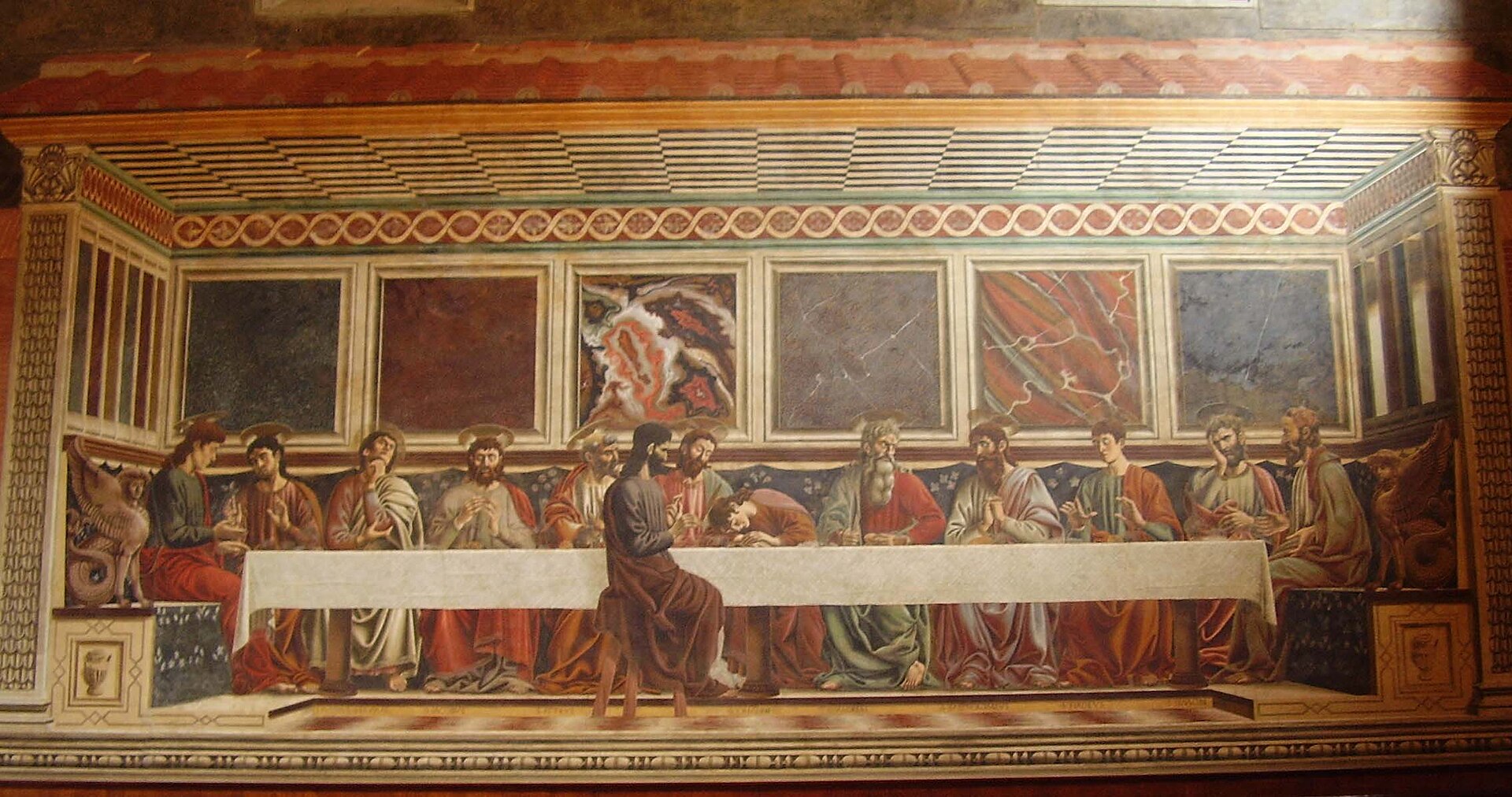
Andrea del Castagno decorated the hall around 1447 with a large cycle depicting scenes from the Passion and Resurrection of Christ.
The lower section contains the Last Supper, showing Christ and the apostles seated at a long table inside an architectural setting created through perspective. Painted marble panels, a carefully constructed ceiling and a geometric floor give the scene an unusual sense of depth.
Above it are three further episodes: the Resurrection on the left, the Crucifixion in the centre and the Entombment on the right.
The prominence given to the Last Supper distinguishes the composition from many other Florentine convent refectories, where the Crucifixion traditionally occupied the central position.
The new viewing platform will allow visitors to examine the painted architecture, figures and decorative details at close range, revealing aspects of the composition that are less visible during an ordinary museum visit.
Restoration work open to the public
The conservation project aims to address the condition of the entire painted cycle and improve its legibility while preserving the surviving original materials.
Alongside the restoration, specialists are carrying out scientific investigations into the pigments, painting techniques and previous conservation treatments.
The work is coordinated by the Regional Directorate of National Museums of Tuscany, part of Italy’s Ministry of Culture, through the Museum of San Marco and the Cenacoli museums.
The Opificio delle Pietre Dure, Florence’s specialist conservation institute, is providing scientific and methodological support. The project also involves the local Soprintendenza, the government authority responsible for protecting cultural heritage, and Italy’s National Research Council (CNR).
The Isabel and Balz Baechi Foundation, a private non-profit organisation supporting cultural heritage conservation, is contributing financial and operational assistance.
By opening the restoration site to visitors, the museum is also offering an opportunity to understand the work involved in maintaining historic artworks, from scientific analysis to the practical challenges of conservation.
A painting hidden from the public for centuries
Although Andrea del Castagno completed the frescoes in the 15th century, they remained largely unknown outside the convent for hundreds of years.
The strict enclosure of the Benedictine nuns prevented outsiders from entering the refectory. Even Giorgio Vasari, the 16th-century artist and biographer who documented the lives of Renaissance painters, did not mention the cycle in his account of Andrea del Castagno.
The paintings became accessible only after the suppression of the convent in the 19th century. Their rediscovery eventually led to the establishment of a museum dedicated to the artist, which opened on 1 April 1891.
The frescoes have also undergone substantial conservation work over the years.
While the Last Supper remains on its original wall, the three scenes above it were detached in 1953 and transferred to new supports.
That intervention revealed the sinopie, the preparatory drawings made beneath the painted surface. These were detached in 1961 and are now displayed on the opposite wall of the former refectory.
The current restoration therefore offers an opportunity to study a work whose history includes both centuries of restricted access and major changes in conservation methods.
How to visit the Last Supper restoration site
The Cenacolo di Sant’Apollonia offers several visiting options, including ordinary museum admission, access to the restoration scaffolding and guided tours.
Museum admission
Standard ticket: €3.
Reduced ticket for visitors aged 18–25: €2.
Free admission for visitors under 18 and for everyone on the first Sunday of each month, alongside other statutory concessions.
Visits to the restoration scaffolding
From 15 November 2026 to 26 June 2027, visitors can book a 30-minute visit to the platform.
Standard ticket: €8.
Reduced ticket for children and young people up to 25: €4.
Advance booking is recommended for individuals and compulsory for groups.
Groups are limited to 10 people, including the guide.
Guided museum and scaffolding visits
From 21 November 2026 to 26 June 2027, educational staff will offer guided visits on Saturdays and on the first and third Sundays of each month, at 10 a.m. and 11.30 a.m.
Standard ticket: €10.
Reduced ticket for children and young people up to 25: €6.
Booking is compulsory, with a maximum of 10 participants per group.
Opening hours
The museum is open from 8.30 a.m. to 1.50 p.m., Monday to Saturday and on the first and third Sundays of each month. It closes on the Monday following a Sunday opening.
Access restrictions
Scaffolding visits are only permitted for children aged seven and over. Visitors must wear a safety helmet, and children under 10 must be accompanied by an adult holding their hand.
The scaffolding is not accessible to people with mobility difficulties. Ordinary museum visits remain available without climbing the platform.
Information and bookings
Tickets and reservations are available through CoopCulture’s official booking page.
❤️ Support Florence Daily News
If you liked this article, please consider supporting Florence Daily News.
We are an independent news site, free from paywalls and intrusive ads, committed to providing clear and reliable reporting on Florence and Tuscany for everyone.
Your support — whether a one-time gift or a regular contribution — helps us stay independent and keep telling the stories that matter.
Donate securely via Stripe below.
Make a one-time donation
Make a monthly donation
Make a yearly donation
Choose an amount
Or enter a custom amount
Your contribution is appreciated.
Your contribution is appreciated.
Your contribution is appreciated.
Discover more from Florence Daily News
Subscribe to get the latest posts sent to your email.