
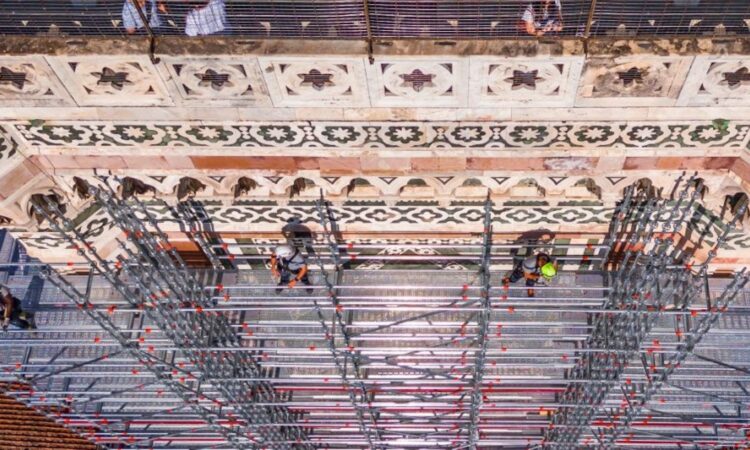
Restoration work on Giotto’s Bell Tower in Florence is moving into its main phase following the completion of an 86-metre-high scaffolding structure around the monument.
The project is expected to last about five years and cost more than €7 million, entirely funded by the Opera di Santa Maria del Fiore, the institution responsible for Florence Cathedral and the other monuments in Piazza del Duomo. It is the first restoration programme to cover the bell tower in its entirety, both inside and outside.
The work is being carried out under the supervision of Florence’s heritage authorities and is intended in particular to address deterioration affecting the tower’s external marble surfaces.
Restoration will move from the top down
The scaffolding was completed in just over four months and has been designed to minimise its visual impact while allowing the monument to remain accessible.
The restoration will proceed in stages from the top of the tower towards ground level. As each section is completed, the worksite will move downwards, gradually revealing the restored surfaces.
The conservation work will include removing deposits, encrustations and black crusts from the tower and addressing deterioration affecting its white, green and red marble cladding. Previous restoration projects have been documented since at least 1939, but they covered individual sections rather than the entire monument.
The scaffolding uses a modular steel system that can adapt to the projecting architectural elements of the tower. According to the Opera, the materials and equipment have also been selected so they can be recovered and reused on future construction sites.
Visitors can continue climbing the tower
Giotto’s Bell Tower remains open during the restoration. Visitors can continue to climb the 414 steps to the panoramic terrace, although views may be partially restricted because of the work.
The tower stands beside Florence Cathedral in Piazza del Duomo. Construction began in 1334 under Giotto and continued after his death under Andrea Pisano before being completed by Francesco Talenti in 1359.
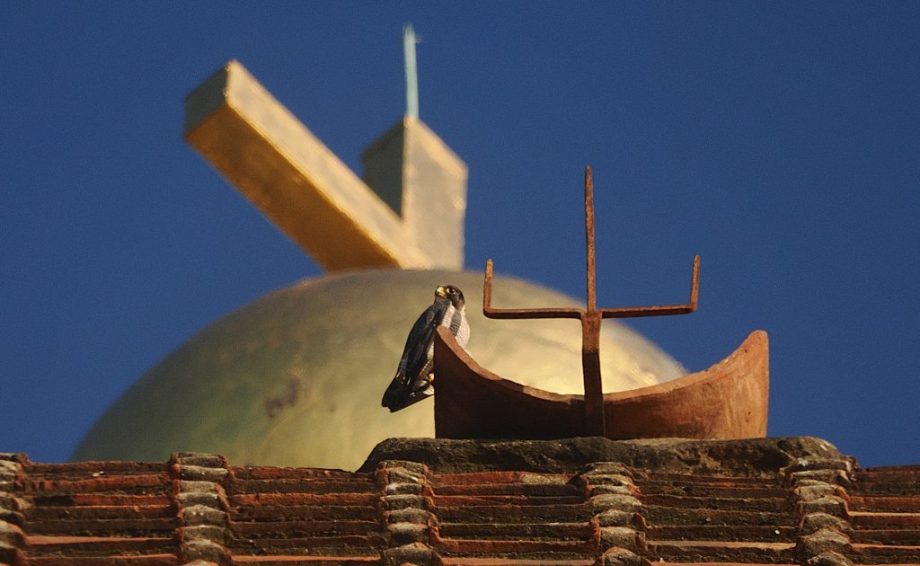
Work adapted to protect peregrine falcons
The construction schedule was also modified to protect peregrine falcons nesting on the Duomo complex.
Before and during the installation of the scaffolding, the Opera photographed and monitored the tower’s 149 putlog holes, cavities in the masonry historically used during construction. A female peregrine falcon was found incubating eggs on the western side of the tower.
Working with the Italian bird protection organisation LIPU and other specialists, the Opera rescheduled parts of the scaffolding installation to avoid disturbing the nest.
Three chicks subsequently hatched and were able to develop and leave the nest safely before work continued.
The restoration forms part of a wider programme of work by the Opera di Santa Maria del Fiore in and around Piazza del Duomo, which also includes the expansion of the Opera del Duomo Museum.
(Photos taken from the Opera di Santa Maria del Fiore website)
❤️ Support Florence Daily News
If you liked this article, please consider supporting Florence Daily News.
We are an independent news site, free from paywalls and intrusive ads, committed to providing clear and reliable reporting on Florence and Tuscany for everyone.
Your support — whether a one-time gift or a regular contribution — helps us stay independent and keep telling the stories that matter.
Donate securely via Stripe below.
Make a one-time donation
Make a monthly donation
Make a yearly donation
Choose an amount
Or enter a custom amount
Your contribution is appreciated.
Your contribution is appreciated.
Your contribution is appreciated.
Discover more from Florence Daily News
Subscribe to get the latest posts sent to your email.