
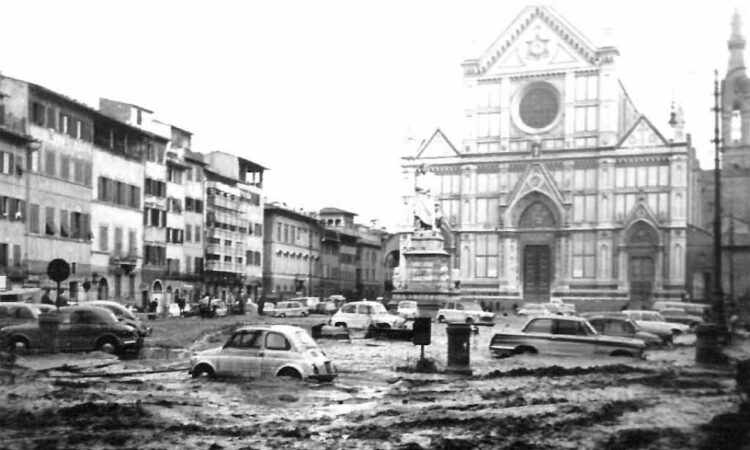
Florence is marking the 60th anniversary of the devastating flood of 4 November 1966 with a series of exhibitions across the city, bringing together historical photographs, archival records, recovered artefacts and contemporary artworks.
The exhibitions, opening throughout November 2026, explore different aspects of the disaster, from the emergency response and the work of international volunteers to the restoration of damaged cultural heritage. Several will remain open until early 2027.
On 4 November 1966, the River Arno overflowed, flooding streets, homes, shops, churches, museums and libraries. The disaster caused loss of life and widespread destruction, damaging thousands of artworks, books and historical documents.
The emergency also prompted an international mobilisation. Volunteers from Italy and abroad travelled to Florence to help remove mud and debris and recover damaged cultural treasures. Many became known as the Mud Angels, a name that remains associated with the city’s recovery.
Photographs and documents recount the disaster
One of the main exhibitions, Firenze per il mondo, il mondo per Firenze (Florence for the World, the World for Florence), is being held in the Sala d’Arme at Palazzo Vecchio, Florence’s historic town hall, from 4 to 22 November.
Organised by the City of Florence and Fondazione MUS.E, the exhibition uses archival documents, photographs, correspondence and an immersive video to reconstruct the emergency and the months that followed.
Particular attention is given to the international response and the role of Piero Bargellini, Florence’s mayor at the time, in coordinating assistance. Letters and telegrams sent from around the world illustrate how individuals, institutions and foreign governments contributed to the relief effort.
Admission is free.
Another exhibition examines the contribution of Florentine film director Franco Zeffirelli, who used cinema to draw international attention to the disaster.
Per Firenze. Omaggio di Zeffirelli alla sua città, at the Fondazione Franco Zeffirelli in Piazza San Firenze from 4 to 29 November, brings together photographs, letters, documents and press reports preserved in the director’s archive.
After the flood, Zeffirelli travelled to Florence with a television crew and made the documentary Per Firenze, with a text developed in collaboration with journalist Furio Colombo and narration by British actor Richard Burton.
Broadcast by Italian public broadcaster Rai on 23 November 1966, the documentary helped communicate the scale of the destruction to an international audience. It will be screened continuously during the exhibition.
The role of humanitarian organisations is the focus of 1966. Oltre il fango, l’Umanità (Beyond the Mud, Humanity), a photographic exhibition organised by the Italian Red Cross at Florence’s Santa Maria Novella railway station.
Located in the former ticket office area, the exhibition runs until 30 November and presents historical images and documents illustrating the relief operations carried out by the Italian Red Cross and its international counterparts.
The Red Cross will also display historical and modern emergency vehicles in Piazza Santa Maria Novella on 13 and 14 November, alongside multimedia material explaining how emergency response procedures have developed over the past six decades.
From 5 to 17 November, Palazzo Medici Riccardi will host Per le vie di Firenze, dopo l’Alluvione, an exhibition of photographs taken by photojournalist Giorgio Lotti and members of the Italian Army.
Around 50 photographs by Lotti document the city’s streets and residents in the aftermath of the flood, while a separate selection from military archives records the army’s contribution to rescue and recovery operations.
The exhibition is free and can be visited from 9 a.m. to 7 p.m., except on Wednesdays.
How Florence saved its cultural heritage
Two exhibitions in Piazza Santissima Annunziata examine the damage suffered by neighbouring institutions and the work undertaken to preserve their collections.
At the National Archaeological Museum, Salvati dal fango. Il recupero dell’archeologia a Firenze (Saved from the Mud: The Recovery of Archaeology in Florence) runs from 4 November 2026 to 7 March 2027.
The exhibition documents the extensive damage to the museum’s archaeological collections and the painstaking recovery work carried out by archaeologists, restorers and volunteers.
Historical photographs, archival documents and restored objects illustrate the difficulties of recovering fragile artefacts from mud and contaminated water.
Among the exhibits are the Mater Matuta, the Urna del Bottarone and an Etruscan funerary urn from Chianciano, all linked to the museum’s post-flood recovery work.
The disaster also led to the creation of Tuscany’s Archaeological Restoration Centre in 1966. The institution subsequently developed specialist conservation techniques and contributed to major projects, including the restoration of the Riace Bronzes, two ancient Greek statues recovered from the sea off southern Italy.
Across the square, the Museo degli Innocenti is presenting L’alluvione del 1966 in piazza Santissima Annunziata, open until 31 December.
The exhibition focuses on the impact of the flood on the historic Innocenti institution, which provided care for children and accommodated approximately 300 children at the time.
Photographs, films and documents describe how water entered the building and how staff worked to protect the children and maintain essential services.
The exhibition also includes materials relating to the neighbouring Archaeological Museum, showing how the two institutions faced the same emergency while dealing with different responsibilities.
Personal memories at the State Archives
The State Archives of Florence are approaching the anniversary through the memories of people who experienced the flood and those who learned about it from previous generations.
RI-EMERGERE 1966–2026. L’alluvione di Firenze: memoria, ricerca e futuro (Re-emerging: Memory, Research and the Future) runs until 5 February 2027.
Organised by the State Archives and Fondazione CR Firenze, the exhibition combines historical documents, photographs, multimedia installations and personal testimonies.
Its six sections examine memory, cooperation, reconstruction, conservation and the connections between past and present.
The project also involved a public appeal for personal recollections of the flood, which received almost 800 responses. The collected material helps document the experiences of residents and families, alongside official records of the emergency.
From 5 to 7 November, the archives will also host Non saprei nulla se, a performance based on witnesses’ memories, with admission by reservation.
Contemporary art examines Florence’s relationship with the Arno
The anniversary programme also includes a contemporary art exhibition that considers Florence’s relationship with the river responsible for the 1966 disaster.
ARNO – Storie di riconciliazione tra Firenze e il suo fiume (Stories of Reconciliation Between Florence and Its River), by Italian artist Roberto Ghezzi, runs from 4 November 2026 to 4 January 2027.
Beginning at MAD Murate Art District, the exhibition extends to the Museo dell’Opera del Duomo, the Cenacolo del Fuligno and the Church of San Salvatore in Ognissanti.
The project presents new works created through a process in which natural fabrics were immersed in the Arno over several months.
Water, sediment, organic matter and environmental conditions left marks on the surfaces, making the river an active part of the artistic process.
By placing these works in locations affected by the 1966 flood, the exhibition connects the historical disaster with present-day questions about the environment and the relationship between Florence and its river.
(Cover photo from Fondazione Franco Zeffirelli website)
❤️ Support Florence Daily News
If you liked this article, please consider supporting Florence Daily News.
We are an independent news site, free from paywalls and intrusive ads, committed to providing clear and reliable reporting on Florence and Tuscany for everyone.
Your support — whether a one-time gift or a regular contribution — helps us stay independent and keep telling the stories that matter.
Donate securely via Stripe below.
Make a one-time donation
Make a monthly donation
Make a yearly donation
Choose an amount
Or enter a custom amount
Your contribution is appreciated.
Your contribution is appreciated.
Your contribution is appreciated.
Discover more from Florence Daily News
Subscribe to get the latest posts sent to your email.