
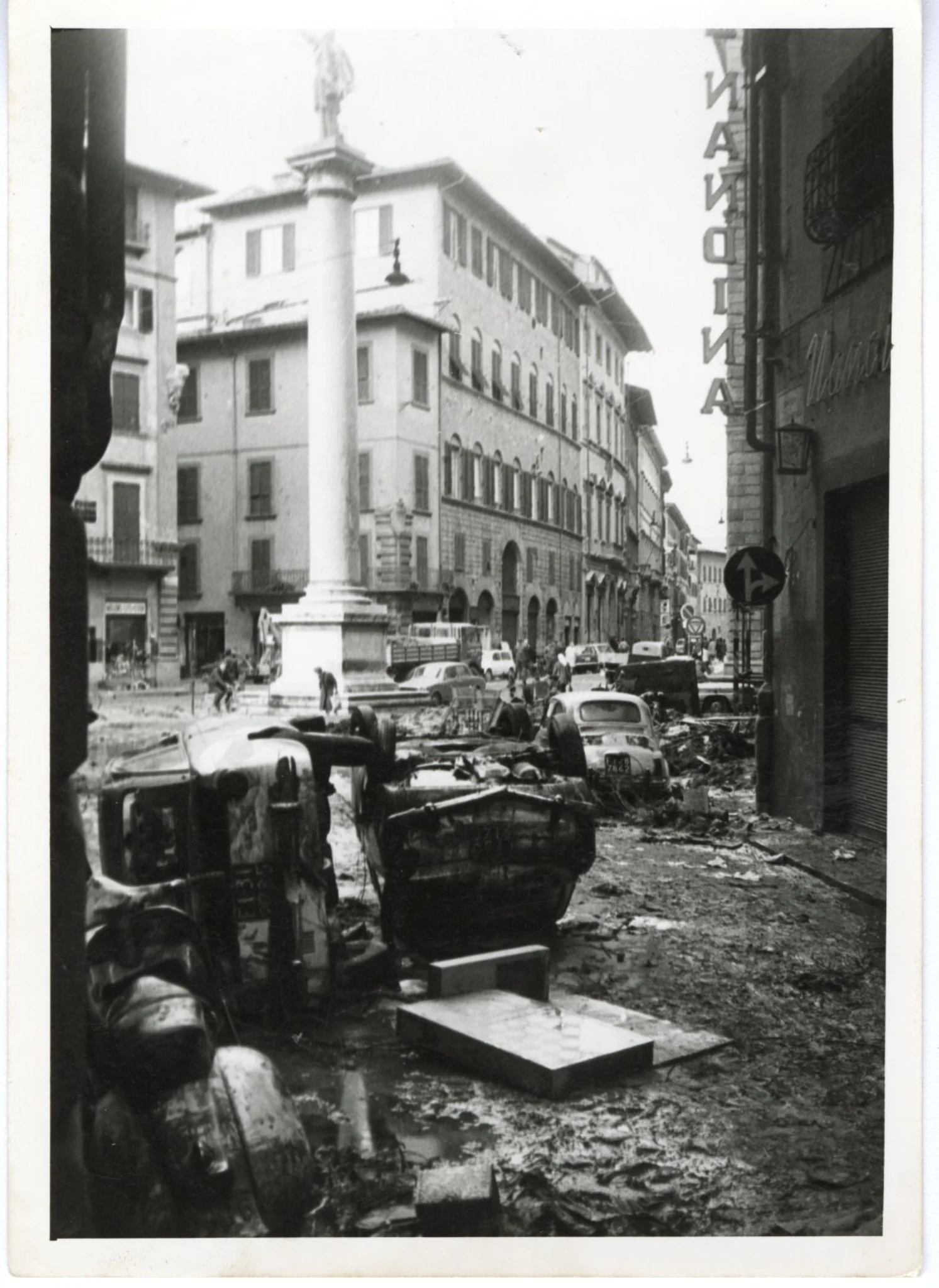
On 4 November 1966, the River Arno burst its banks, flooding Florence’s historic centre, destroying homes and businesses, and damaging thousands of books, manuscripts and works of art. The disaster became one of the defining events in the city’s modern history.
But the Florence flood also marked an important moment in the history of international cultural solidarity. Within weeks, images of streets buried in mud, damaged Renaissance masterpieces and residents struggling to save their city were being shown to audiences far beyond Italy. One of the people responsible for bringing those images to the world was Florentine film director Franco Zeffirelli, whose documentary Per Firenze, internationally known as Florence: Days of Destruction, helped transform a local catastrophe into an international campaign for assistance.
A telephone call on the morning of the flood
Zeffirelli was in Rome, working on the final stages of his film The Taming of the Shrew, when he received a telephone call from his sister Fanny in Florence early on 4 November. The information reaching him was incomplete, but the scale of the disaster was already becoming apparent. Florence was under water, communications were disrupted and entire neighbourhoods were covered in mud and debris.
According to an account preserved by the Franco Zeffirelli Foundation, the director immediately decided that he could contribute through his profession. He contacted an acquaintance at RAI, Italy’s public broadcaster, and proposed travelling to Florence with a camera crew to document the destruction.
When he reached Fiesole, the hilltop town overlooking Florence, he saw the flooded city spread across the valley below. The sight confirmed the urgency of his plan. Zeffirelli understood that images could communicate the scale of the disaster more effectively than descriptions alone. He wanted the world to see what had happened, particularly the danger facing Florence’s artistic and historical heritage.
A documentary made in just 19 days
The project developed at remarkable speed for the television technology of the 1960s.
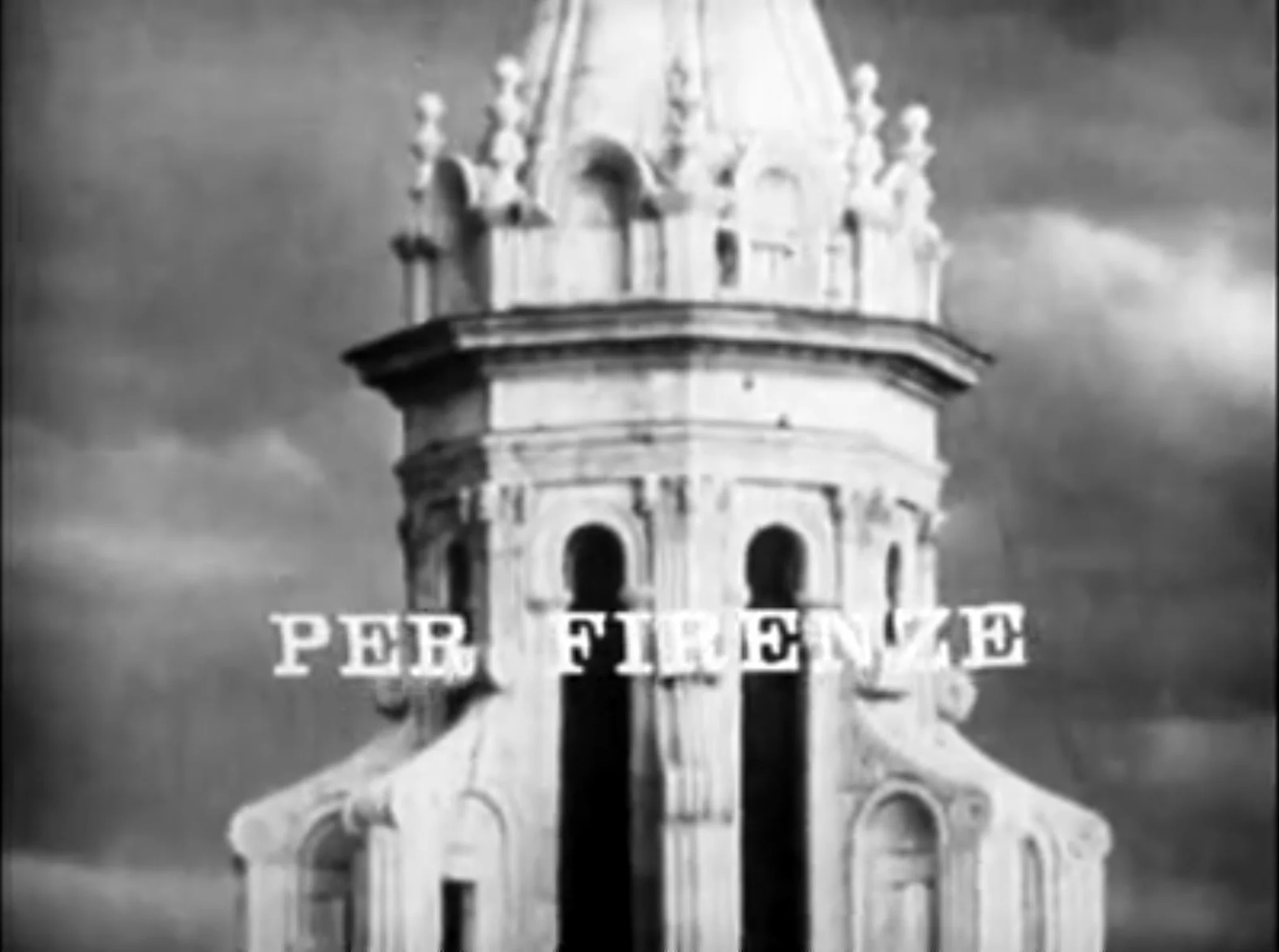
Zeffirelli enlisted the help of journalist Furio Colombo, then working for RAI in the United States, who contributed to the documentary’s text. RAI supported the production, allowing the director to record the devastation and prepare the film for broadcast. On 23 November 1966, just 19 days after the flood, Italian television broadcast Per Firenze.
The documentary showed the extent of the damage to Florence’s streets, churches and cultural institutions. Particularly significant were the images of the Santa Croce district, one of the areas worst affected by the flood.
Water and mud had entered historic buildings, damaging artworks, archives and libraries. The images also showed residents and volunteers beginning the enormous task of clearing debris and recovering what could be saved.
The film did more than document destruction. It presented the flood as a threat to a cultural inheritance that extended far beyond Florence and Italy.
Richard Burton brings the appeal to an international audience
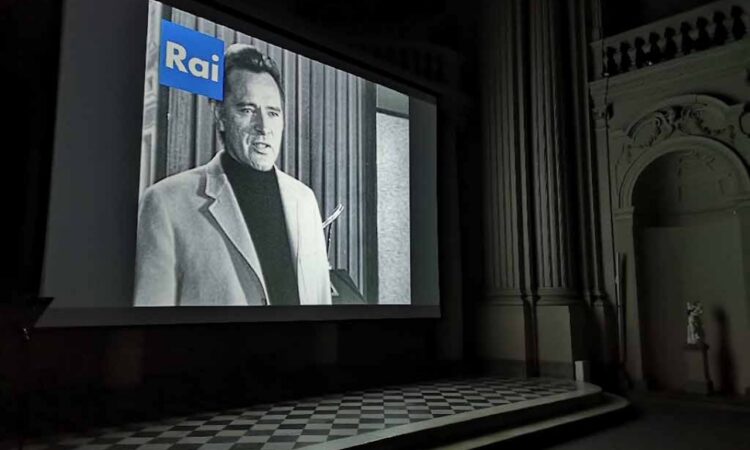
An important element of Zeffirelli’s initiative was the involvement of British actor Richard Burton, who was working with the director on The Taming of the Shrew. Burton agreed to participate in the documentary, presenting its Italian and English versions and helping communicate the appeal to international audiences.
His involvement gave the project additional visibility, particularly in Britain and the United States, where he was already a major film star.
The English-language version, Florence: Days of Destruction, began circulating internationally in December 1966.
Although the documentary was largely filmed in black and white, the section showing the damage inside the Basilica of Santa Croce included colour footage. This helped convey the condition of the church and its artworks to viewers who might never have visited Florence.
The documentary was not simply a television report. It was conceived as an appeal for financial assistance, intended to mobilise people, cultural institutions and donors outside Italy.
From television screens to international fundraising
The film became part of a wider international response to the disaster. On 29 January 1967, a screening was held at the Theatre Royal Haymarket in London, attended by members of the British royal family and figures from the entertainment world.
The event demonstrated how Zeffirelli had used his international connections to bring attention to Florence’s recovery.
According to the Franco Zeffirelli Foundation, the campaign associated with the documentary helped generate more than $20 million in assistance for the city. The figure is reported by the foundation and should be understood in the context of the wider fundraising effort rather than as independently verified proceeds from film screenings alone.
The initiative also complemented other campaigns already taking shape in Italy and abroad. Art historian Carlo Ludovico Ragghianti issued an appeal for international contributions to restore Florence’s damaged cultural heritage. On 12 November, Mayor Piero Bargellini established an international fund committee to support the recovery of museums, monuments, libraries, archives and works of art.
In the United States, Senator Edward Kennedy supported efforts to protect damaged Italian artworks. These included the Committee to Rescue Italian Art, which helped mobilise American support for conservation work. The response reflected a growing recognition that Florence’s cultural heritage was not solely a local or national concern.
The Mud Angels and the human response
While international fundraising campaigns were being organised, thousands of volunteers travelled to Florence to help with the immediate recovery. They became known as the Angeli del Fango, or Mud Angels.
Many were young people, including students from Italy and abroad, who worked alongside residents to remove mud, recover books and clean damaged buildings. Their work became one of the most enduring symbols of the 1966 flood.
The international attention generated by photographs, television coverage and documentaries such as Zeffirelli’s helped make their efforts part of a broader story of solidarity. The flood was increasingly understood not only as a natural disaster but also as a collective effort to preserve a city whose history and art held significance for people across the world.
A film that helped shape the memory of the flood
Zeffirelli’s documentary also received recognition in Florence itself. In a letter preserved in the director’s archive, Mayor Piero Bargellini thanked him for portraying both the force of the flood and the determination of Florentines confronting its aftermath.
The mayor explained that he had arranged a meeting of the municipal executive so that its members could watch the television broadcast. The film had succeeded in conveying the scale of the disaster while also showing the response of the city’s population.
Six decades later, the documentary remains an important visual record of the 1966 flood.
It also illustrates how cinema and television could be used to mobilise international support at a time when news travelled far more slowly than it does today. Zeffirelli did not create the international response to the flood on his own. Journalists, photographers, cultural institutions, governments, volunteers and donors all contributed to making Florence’s emergency a worldwide concern.
But his documentary gave that response a powerful visual narrative, combining the destruction of a historic city with an appeal to protect its future.
The exhibition
The exhibition Per Firenze. L’alluvione del ’66 secondo Zeffirelli (For Florence: The 1966 Flood Through Zeffirelli’s Eyes) will run from 4 to 29 November 2026 at the Franco Zeffirelli Foundation in Florence, marking the 60th anniversary of the devastating flood that struck the city on 4 November 1966.
Drawing on original material from the Zeffirelli Archive, the exhibition brings together photographs taken by the director in the immediate aftermath of the disaster, personal correspondence, letters from cultural figures and institutions, international press coverage and documents relating to the production of his documentary Per Firenze.
The material traces how Zeffirelli used cinema to draw international attention to the destruction and encourage support for Florence’s recovery. The exhibition is open Tuesday to Sunday, from 10 a.m. to 6 p.m., with last admission at 5 p.m. Entry is free.
(Photos taken from the Foundation Franco Zeffirelli website)
❤️ Support Florence Daily News
If you liked this article, please consider supporting Florence Daily News.
We are an independent news site, free from paywalls and intrusive ads, committed to providing clear and reliable reporting on Florence and Tuscany for everyone.
Your support — whether a one-time gift or a regular contribution — helps us stay independent and keep telling the stories that matter.
Donate securely via Stripe below.
Make a one-time donation
Make a monthly donation
Make a yearly donation
Choose an amount
Or enter a custom amount
Your contribution is appreciated.
Your contribution is appreciated.
Your contribution is appreciated.
Discover more from Florence Daily News
Subscribe to get the latest posts sent to your email.