
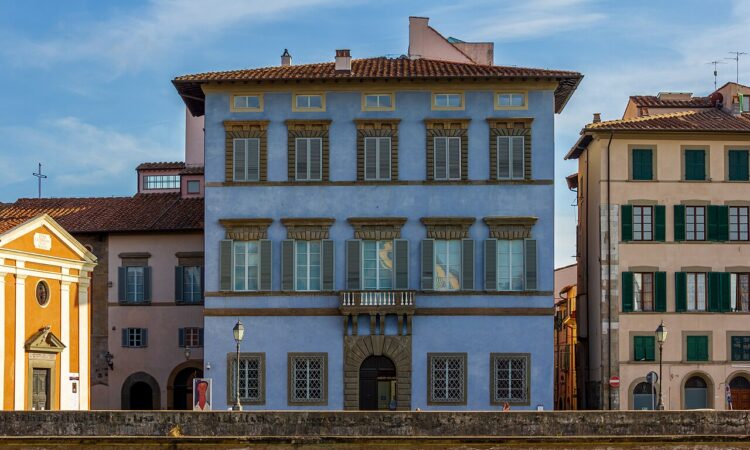
More than 150 works from the Whitney Museum of American Art trace Hopper’s career through the cities, landscapes and personal relationships that shaped his distinctive vision of modern life. An exhibition dedicated to American painter Edward Hopper opens at Palazzo Blu in Pisa on 14 October 2026, bringing together more than 150 works that examine how New York, Paris and the landscapes of New England shaped one of the most recognisable artistic visions of the twentieth century.
Entitled Edward Hopper: New York and Beyond, the exhibition runs until 7 March 2027 and draws on the collections of the Whitney Museum of American Art in New York. It includes oil paintings, watercolours, drawings, etchings, archival material and works by several of Hopper’s contemporaries.
Curated by Barbara Haskell and Caroline Webb of the Whitney Museum, the exhibition is organised in collaboration with Fondazione Palazzo Blu and MondoMostre, with support from Fondazione Pisa. Rather than presenting Hopper exclusively as the painter of lonely figures and deserted American streets, the exhibition follows the development of his artistic language across several decades. It examines his early training, his experience of European painting, his commercial illustration work and his lifelong interest in the relationship between architecture, light and human presence. The result is a broader account of an artist whose apparently simple compositions often suggest complex psychological situations without providing a clear narrative.
From art student to chronicler of modern America
Edward Hopper was born in 1882 in Nyack, a town on the Hudson River approximately 40 kilometres north of New York City. He began his artistic education at the New York School of Illustration in 1898 before moving to the New York School of Art, where he studied between 1900 and 1906. His teachers included William Merritt Chase and Robert Henri, two influential figures in American painting.
Henri’s teaching was particularly important. He encouraged students to engage directly with contemporary American life rather than imitate established academic subjects. His emphasis on individual expression and everyday experience would remain central to Hopper’s work, even as the younger artist gradually abandoned the darker colours and vigorous brushwork associated with his early training.
Hopper’s route to recognition was far from immediate. For more than a decade, he supported himself through commercial illustration, producing magazine covers, advertisements and images for articles. Although he regarded this work primarily as an economic necessity, it helped him develop an ability to communicate situations through small gestures, carefully chosen details and the arrangement of figures.
Those skills would later become essential to his paintings, in which a person’s posture or the direction of a gaze can suggest an entire story. The exhibition examines this early period through drawings and illustrations, showing how Hopper’s commercial work and his independent artistic practice developed alongside one another.
Paris and the European influence on Hopper
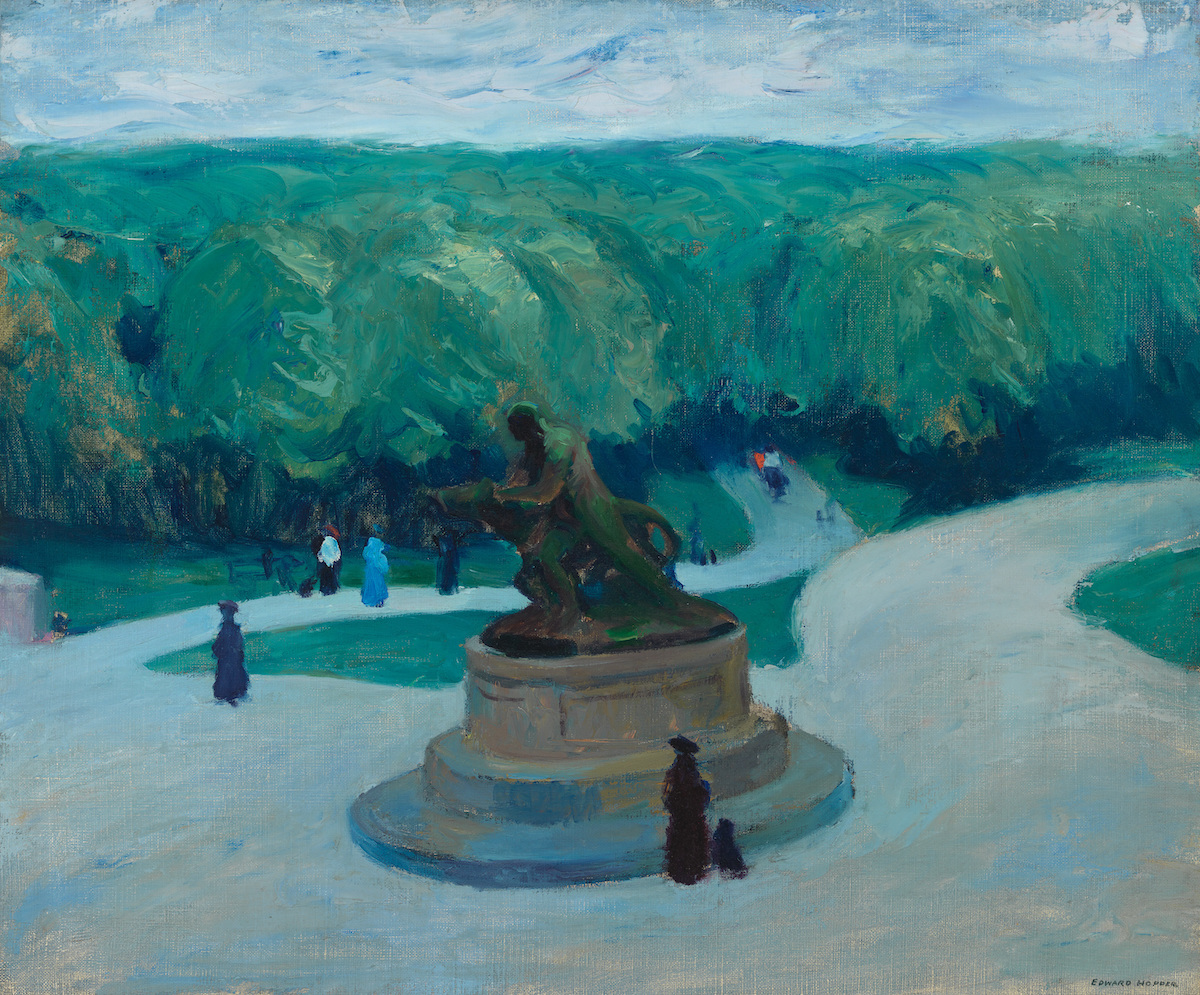
Although Hopper is closely associated with American cities and landscapes, his artistic development was significantly influenced by Europe. He travelled to Paris for the first time in October 1906, remaining abroad for approximately eleven months. He returned to Europe in 1909 and 1910, spending most of his time in the French capital while also visiting other European cities.
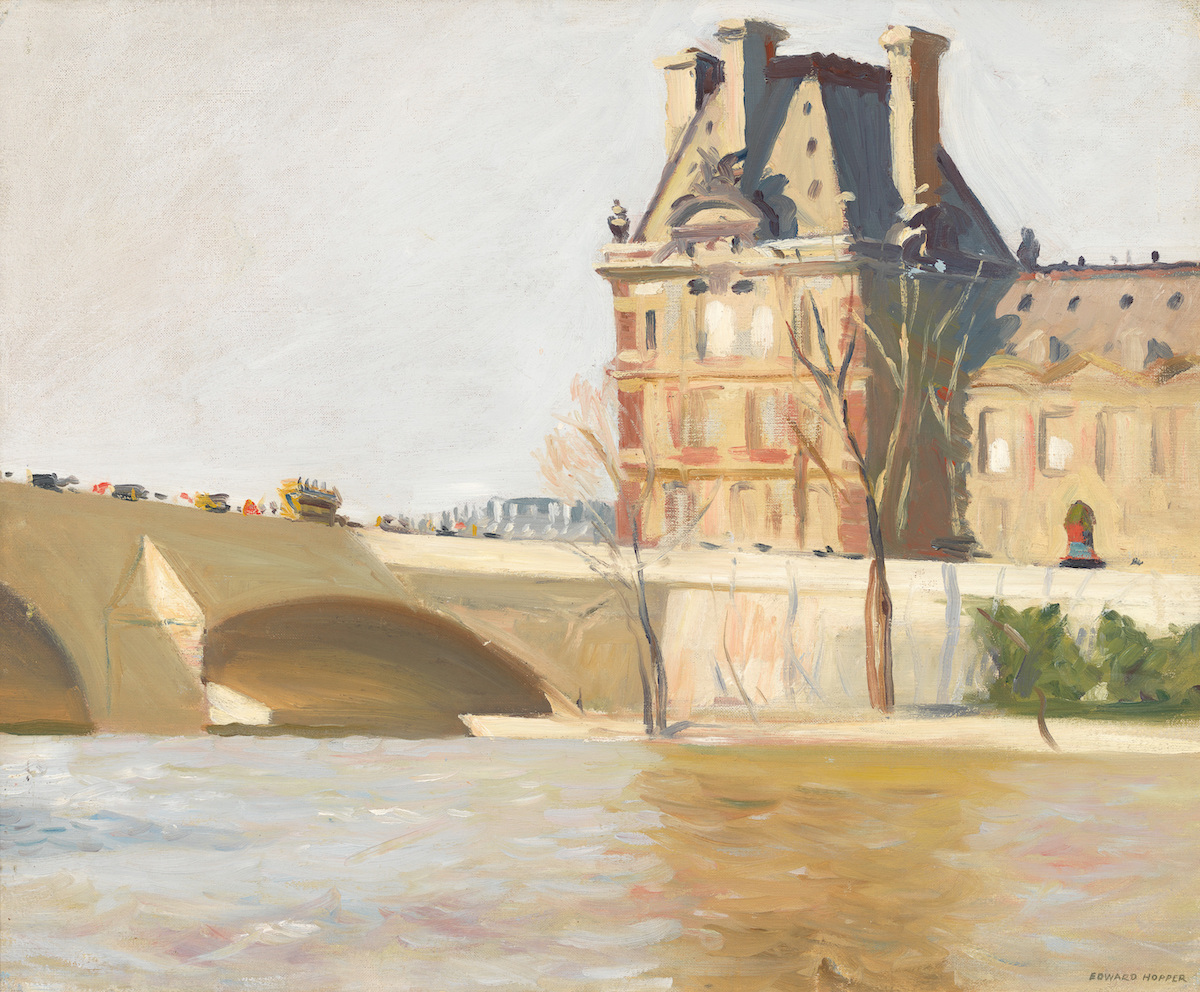
Paris introduced him to different approaches to colour, composition and natural light. His earliest paintings from the city often depict relatively quiet architectural settings, including courtyards and staircases. They retain some of the darker tonal qualities of his student work.
As he began painting outdoors in the spring of 1907, however, his palette became lighter and his compositions more expansive. He turned his attention to the River Seine, bridges and familiar Parisian landmarks, experimenting with techniques associated with Impressionism.
Yet Hopper’s response to the city was already distinctive. Rather than concentrating on crowds and movement, he frequently presented buildings and streets as quiet arrangements of geometric forms. Even when depicting a busy European capital, he seemed particularly interested in the moments when human activity was absent or temporarily suspended.
This approach anticipated the visual language that would later define his American paintings. His European experience also influenced his understanding of light, which gradually became one of the principal subjects of his work rather than simply a means of illuminating a scene. Hopper never returned to Europe after 1910, but the influence of those journeys remained visible throughout his career.
New York: the ordinary city behind the modern metropolis
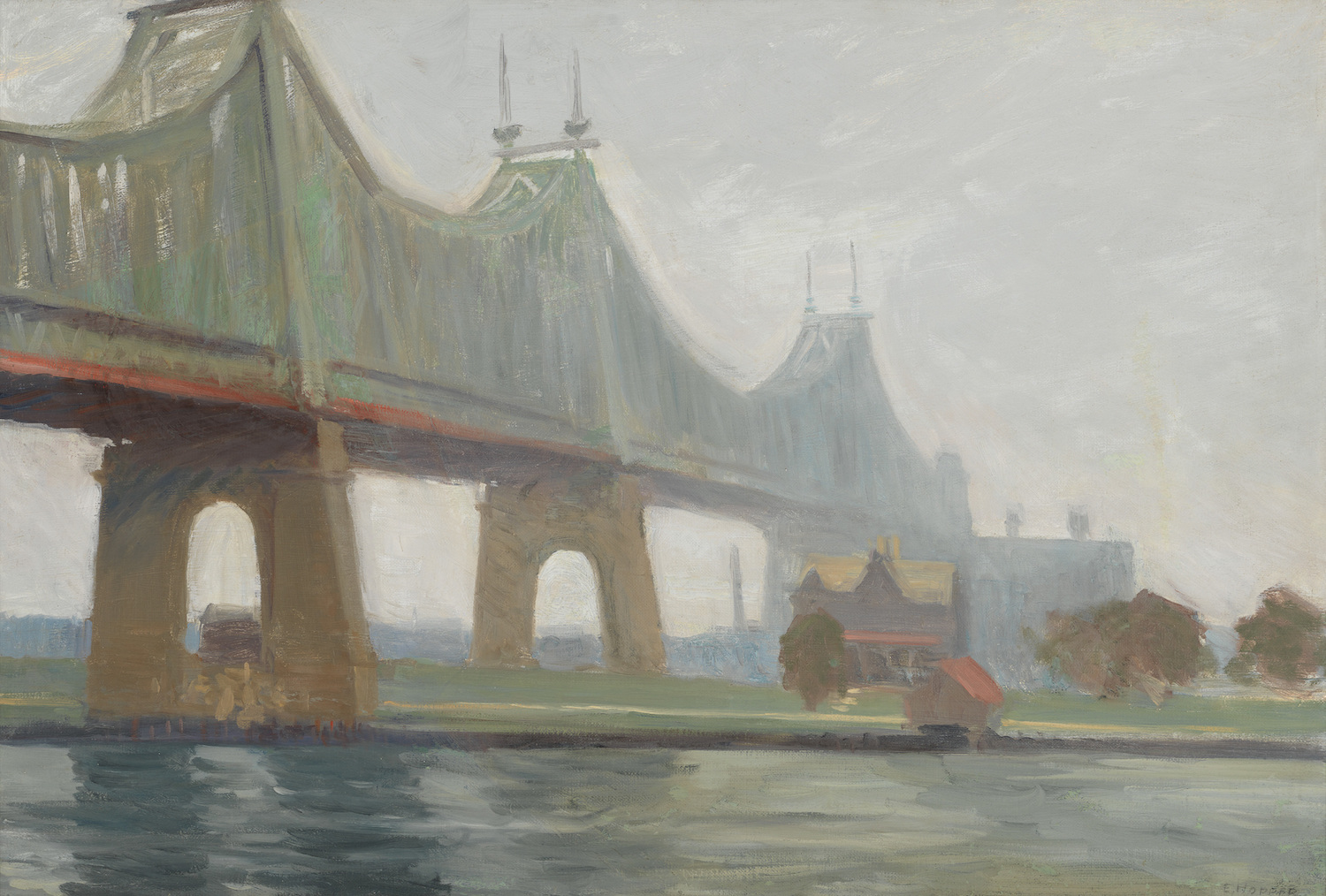
New York was the centre of Hopper’s adult life and artistic activity. He lived in the city for almost sixty years, observing its transformation into a modern metropolis. Yet his paintings rarely concentrate on the celebrated skyscrapers and monumental architecture that fascinated many of his contemporaries.
Instead, Hopper found subjects in ordinary buildings, shopfronts, bridges, offices, theatres, apartment interiors and elevated railway stations. His early familiarity with the city came from travelling between his family home in Nyack and Manhattan during his student years.
Ferries, trains and elevated railways provided changing perspectives on the urban landscape, allowing him to observe buildings from unusual angles and distances. After moving to New York, he continued exploring these everyday environments. Through careful framing and simplified architectural forms, he transformed familiar urban settings into compositions that appear strangely detached from the movement and noise of the surrounding city.
Windows, doorways and illuminated interiors became recurring elements. They frequently establish a relationship between the observer and the people depicted, creating the impression that the viewer is witnessing a private moment without knowing its circumstances.
In many works, figures appear physically close but psychologically separated. Others occupy spaces alone, absorbed in activities that remain unexplained. The paintings invite viewers to imagine what may have happened before the scene and what might happen afterwards.
This openness has contributed to Hopper’s lasting influence on photography, cinema and visual storytelling. His images often resemble fragments of narratives whose beginnings and endings remain outside the frame. The exhibition places this aspect of his work within the broader development of American urban realism, comparing his approach with those of artists who responded differently to the social and architectural changes of the early twentieth century.
New England: landscapes, lighthouses and changing light
Although Hopper is often remembered for his urban interiors, the landscapes of New England occupied an equally important place in his work. Beginning in 1912, he spent extended periods away from New York, exploring the coastal towns and rural environments of the northeastern United States.
Gloucester, Massachusetts, became particularly important during the early stages of his career. There, Hopper painted houses, harbour buildings and other architectural subjects, paying close attention to the effects of sunlight on their surfaces.
The town also played a decisive role in his personal and professional life. In 1923, Hopper renewed his acquaintance with Josephine Nivison, a fellow artist whom he had known during his student years. She encouraged him to work more extensively in watercolour, a medium that proved particularly important to his growing recognition.
The watercolours he produced during this period attracted critical and commercial attention. In 1924, the success of his first solo exhibition at a commercial gallery helped him abandon illustration and concentrate on painting. Hopper also worked extensively along the coast of Maine between 1914 and 1927, depicting rocky shorelines, lighthouses and isolated buildings. These subjects allowed him to explore the contrast between natural landscapes and human constructions.
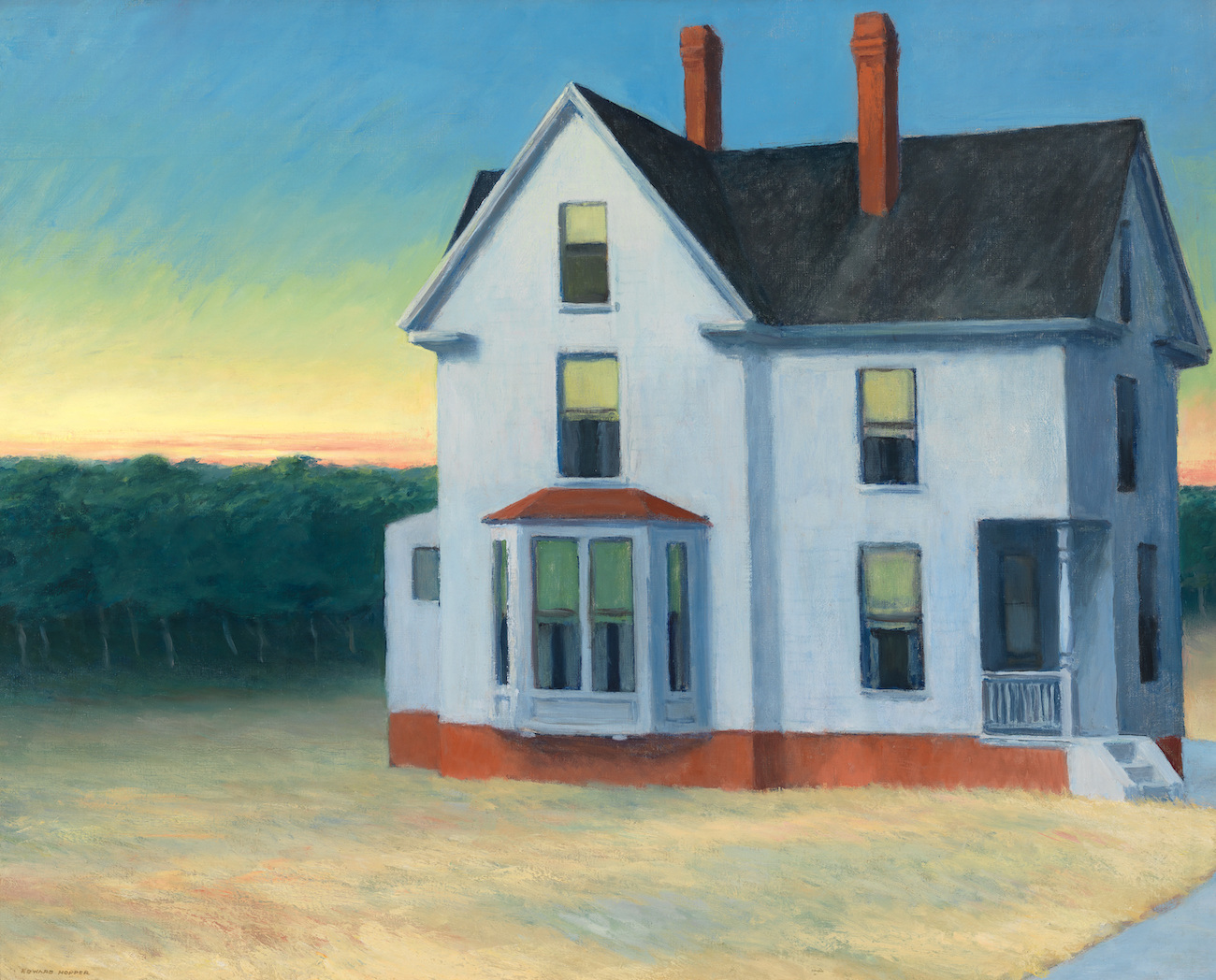
From 1930, Cape Cod became an increasingly important destination for Hopper and Jo, who had married in 1924. In 1934, they began spending their summers in a house built in South Truro, Massachusetts. The surrounding landscape, with its dunes, roads, houses and changing coastal light, remained a source of inspiration for the rest of Hopper’s life.
Unlike his urban scenes, these paintings frequently contain no human figures. Nevertheless, they explore similar questions about isolation, space and the relationship between the visible world and the emotions it can evoke.
A house standing alone in bright sunlight or a road disappearing beyond the edge of a composition can produce the same sense of uncertainty as a solitary figure sitting beside a window. The exhibition places these landscapes alongside Hopper’s city paintings, demonstrating how his artistic concerns remained consistent even as his subjects changed.
The importance of Josephine Hopper
One of the exhibition’s significant themes is the role played by Josephine Nivison Hopper in her husband’s career. Jo Hopper was an artist in her own right, having studied at the New York School of Art. She continued painting after their marriage in 1924, although her own artistic work has historically received far less attention.
Her contribution to Edward Hopper’s career extended well beyond their personal relationship. She served as the model for most of the female figures in his paintings, contributing to the development of the recurring characters that populate his interiors and urban scenes.
She also maintained detailed records of his artistic production. In notebooks, Jo documented individual works, exhibitions, prices, buyers and other information concerning her husband’s career.
These records have become an important resource for art historians seeking to reconstruct Hopper’s working methods and the history of individual paintings. They also provide evidence of the practical and organisational work that supported his artistic activity.
The exhibition draws attention to this relationship through archival materials preserved at the Whitney Museum, presenting the Hoppers’ shared life as an important part of the story behind the paintings. Their artistic partnership also helps explain the continuity of Hopper’s practice over several decades, particularly the repeated use of certain models, domestic settings and working environments.
Hopper and his American contemporaries
The exhibition does not examine Hopper in isolation. Works by other American artists active during the same period provide a wider context for understanding the changes taking place in the country’s visual culture.
Among those represented are Robert Henri, John Sloan, George Bellows, Everett Shinn, Guy Pène du Bois, Charles Burchfield, Charles Sheeler, George C. Ault, Reginald Marsh and photographer Paul Strand. Their inclusion places Hopper within a generation of artists responding to industrialisation, urban expansion and the emergence of a distinctly modern American society.
Some concentrated on the activity and social diversity of city streets. Others explored industrial architecture, rural landscapes or the possibilities of abstraction and photographic composition. Hopper shared their interest in contemporary subjects but developed a notably different approach.
Where some urban realists emphasised movement, crowds and social interaction, Hopper frequently removed unnecessary details and reduced scenes to their essential architectural and psychological elements. His paintings rarely offer explicit social commentary. Instead, they create situations in which the ordinary becomes unfamiliar.
The comparison with his contemporaries also challenges the idea that Hopper worked entirely outside the artistic debates of his time. His paintings were part of a wider search for ways to represent modern American experience, even though his individual visual language remained unusually consistent.
The Whitney Museum and the preservation of Hopper’s legacy
The exhibition in Pisa is closely connected to the history of the Whitney Museum of American Art, which holds the world’s largest collection of Hopper’s work. The relationship began before the museum itself was established.
In 1920, the Whitney Studio Club, founded as part of Gertrude Vanderbilt Whitney’s efforts to support contemporary American artists, hosted Hopper’s first solo exhibition. At the time, American artists often faced difficulties obtaining recognition from institutions that continued to favour European traditions.
Gertrude Vanderbilt Whitney sought to address that imbalance by collecting and exhibiting work produced in the United States. Her initiatives eventually led to the foundation of the Whitney Museum in 1930, which opened to the public the following year.
Hopper remained closely associated with the institution throughout his career. He participated in the museum’s first Biennial in 1932 and appeared in numerous subsequent exhibitions. The Whitney also organised major solo exhibitions of his work in 1950 and 1964.
Following Edward Hopper’s death in 1967 and Jo’s death in 1968, their artistic estate, comprising nearly 3,000 objects, was bequeathed to the Whitney. The collection includes paintings, drawings and other materials that document the development of Hopper’s career.
In 2017, the museum received a further substantial group of archival materials through the Arthayer R. Sanborn Hopper Collection Trust. Known as the Sanborn Hopper Archive, it contains nearly 4,000 items, including correspondence, photographs, notebooks, illustrations, personal documents and records maintained by Jo.
Together, these collections allow researchers to study not only Hopper’s completed paintings but also the working processes, personal relationships and professional circumstances behind them. The Pisa exhibition uses this material to offer a more detailed understanding of an artist whose paintings are frequently interpreted primarily through their atmosphere and emotional impact.
Why Hopper’s paintings remain relevant
Nearly sixty years after Hopper’s death, his work continues to occupy a distinctive position in modern visual culture. His paintings are often associated with loneliness, but their significance extends beyond that familiar interpretation.
Hopper was interested in the relationship between people and their surroundings, particularly the ways in which architecture, light and perspective can influence the emotional character of an image. His figures are rarely engaged in dramatic actions.
They sit, stand, look through windows or occupy rooms whose purpose is immediately recognisable. Yet the careful organisation of these everyday scenes creates a sense of uncertainty. The viewer sees a particular moment but receives little information about its wider circumstances.
This tension between visual clarity and narrative ambiguity is one of the defining characteristics of Hopper’s work. It also helps explain his influence on later generations of photographers, filmmakers and visual artists.
His compositions frequently employ strong contrasts between illuminated and shadowed areas, carefully framed views through windows and doors, and spatial arrangements that resemble cinematic shots. The paintings can suggest the beginning or ending of a story without revealing either.
At the same time, Hopper’s landscapes demonstrate that these effects do not depend on the presence of human figures. Buildings, roads and stretches of coastline can acquire psychological significance through the arrangement of forms and the direction of light.
By examining Hopper’s paintings alongside drawings, watercolours, prints and archival documents, the exhibition in Pisa provides an opportunity to understand how these effects were developed rather than treating them simply as expressions of an instinctive personal style.
It also demonstrates the importance of place in his artistic imagination. Paris introduced him to new approaches to colour and light. New York supplied the architecture and everyday situations that became central to his urban paintings. New England offered a different environment in which he could pursue similar questions about space, perception and mood. Together, these locations shaped an artistic language that remains recognisable across very different subjects.
Visiting the Edward Hopper exhibition in Pisa
Palazzo Blu
Lungarno Gambacorti 9, Pisa, Tuscany
14 October 2026 – 7 March 2027
Palazzo Blu is located on the southern bank of the River Arno in central Pisa, approximately 85 kilometres west of Florence.
❤️ Support Florence Daily News
If you liked this article, please consider supporting Florence Daily News.
We are an independent news site, free from paywalls and intrusive ads, committed to providing clear and reliable reporting on Florence and Tuscany for everyone.
Your support — whether a one-time gift or a regular contribution — helps us stay independent and keep telling the stories that matter.
Donate securely via Stripe below.
Make a one-time donation
Make a monthly donation
Make a yearly donation
Choose an amount
Or enter a custom amount
Your contribution is appreciated.
Your contribution is appreciated.
Your contribution is appreciated.
Discover more from Florence Daily News
Subscribe to get the latest posts sent to your email.