
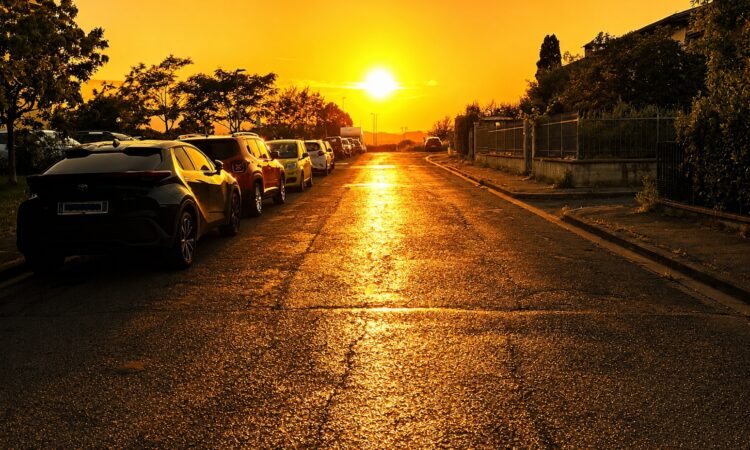
Florence is living through one of the most intense and persistent summers in its recent history, with extreme heat becoming less a succession of individual heatwaves than an almost continuous condition stretching across much of June, July and August.
The city entered its eleventh consecutive day under the highest heat-alert level this weekend, while forecasts indicate that very hot conditions are likely to remain in place through Ferragosto and into the following days.
If the pattern continues through the second half of August, Florence could end the summer having accumulated around 40 to 45 days under red heat alerts, alongside roughly two and a half months during which temperatures have remained exceptionally high with only brief interruptions.
A summer defined by duration
The most remarkable feature of summer 2026 has not necessarily been a single record temperature, but the persistence of the heat.
According to metereologists, July 2026 was the hottest July recorded in Tuscany since regional records began in 1955, and probably one of the hottest in centuries. June and July combined were the second-hottest such two-month period in the historical series, behind only the exceptional summer of 2003.
Florence has been particularly exposed. By the beginning of August, temperatures in the city had already exceeded 36°C on 27 days — roughly one day out of every two — while the city had recorded the same number of tropical nights, when temperatures never fell below 20°C.
The figures are particularly significant because high nighttime temperatures prevent buildings and the human body from cooling after sunset, extending heat stress well beyond the hottest hours of the afternoon.
Temperatures above 40°C
The latest heatwave has pushed Florence back above the 40°C threshold. On Friday, the weather station at the city’s Botanical Garden recorded 40.2°C, while Boboli Gardens reached 39.5°C and the Firenze Università station 38.2°C.
Nighttime conditions have offered little relief. Minimum temperatures have remained above 22°C at several city monitoring stations, and in recent days values around 24°C have also been recorded.
Humidity rises sharply during the evening, making temperatures feel particularly uncomfortable even after sunset. Forecasts suggest maximum temperatures will continue to hover around 36-38°C in the coming days, with very warm nights remaining one of the defining features of the current spell.
From June to August with few breaks
Florence’s first major red heat alerts arrived in the second half of June. The city was already under a Level 3 red alert on June 20 and 21, with further red-alert days following later that month and repeatedly throughout July.
The latest sequence began at the end of July and has now become one of the longest uninterrupted periods of maximum heat alert of the summer.
Taken together, the different heatwaves have left Florence with relatively few sustained periods of normal summer temperatures since the second half of June. Should the current conditions continue into the second half of August, the summer of 2026 could ultimately amount to around two and a half months dominated by unusually high temperatures.
The final figures will only be available once the season is over, but the trend is already exceptional.
The heat is increasingly a nighttime problem
The persistence of high minimum temperatures is becoming as important as the daytime peaks.
Florence’s dense historic centre, extensive paved surfaces and limited shade in many streets retain heat accumulated during the day and release it slowly after sunset. This urban heat-island effect means that the city can remain extremely warm well into the night.
For residents and visitors, this changes the practical experience of summer in Florence. The traditional strategy of avoiding the middle of the day increasingly offers only partial relief when temperatures remain high during the evening and overnight.
The city’s red alert is issued when intense heat and severe bioclimatic discomfort persist for several consecutive days. At Level 3, the conditions are considered capable of affecting the health of the entire population, not only elderly people, children or those with chronic illnesses.
Authorities continue to recommend avoiding direct sun during the hottest hours, drinking water frequently, reducing outdoor physical activity and paying particular attention to vulnerable people.
With several weeks of meteorological summer still ahead, Florence’s final 2026 heat statistics have yet to be written. But after an exceptionally hot June, a record-breaking July and another prolonged heatwave in August, this is already shaping up as one of the city’s most relentless summers.
❤️ Support Florence Daily News
If you liked this article, please consider supporting Florence Daily News.
We are an independent news site, free from paywalls and intrusive ads, committed to providing clear and reliable reporting on Florence and Tuscany for everyone.
Your support — whether a one-time gift or a regular contribution — helps us stay independent and keep telling the stories that matter.
Donate securely via Stripe below.
Make a one-time donation
Make a monthly donation
Make a yearly donation
Choose an amount
Or enter a custom amount
Your contribution is appreciated.
Your contribution is appreciated.
Your contribution is appreciated.
Discover more from Florence Daily News
Subscribe to get the latest posts sent to your email.