
The University of Pisa is contributing to NASA’s Artemis II mission, the first crewed flight of the Artemis programme, with technology designed to monitor radiation levels in deep space.
On board the Orion spacecraft are six Timepix chips, advanced sensors capable of detecting particles and radiation. The devices were developed at CERN as part of the international Medipix2 collaboration, which includes both the University of Pisa and Italy’s National Institute for Nuclear Physics (INFN).
Monitoring radiation beyond Earth’s protection
The sensors will operate throughout the mission, which is expected to last around ten days and include a flyby of the far side of the Moon.
Their role is to measure in real time the characteristics and intensity of radiation inside the spacecraft. This is considered a key aspect of the mission, as astronauts travelling beyond Earth’s geomagnetic field are exposed to significantly higher radiation levels than those experienced in low Earth orbit.
The Timepix detectors are part of NASA’s HERA (Hybrid Electronic Radiation Assessor) system. They can identify the composition, energy and intensity of incoming particles, helping assess radiation exposure for both the crew and onboard electronic systems.
Technology from particle physics to space
The sensors are derived from hybrid pixel detectors originally developed for experiments at the Large Hadron Collider at CERN. By analysing the tracks left by particles in the sensor, the devices can distinguish between different types of radiation.
According to researchers involved in the project, similar devices are also used in teaching laboratories in Pisa, particularly in medical physics programmes. The technology has evolved over several generations and is now applied not only in fundamental research but also in medical and scientific fields.
The contribution highlights the role of Italian research institutions in international space missions, particularly in areas such as radiation protection, which is essential for future long-duration human exploration beyond Earth orbit.
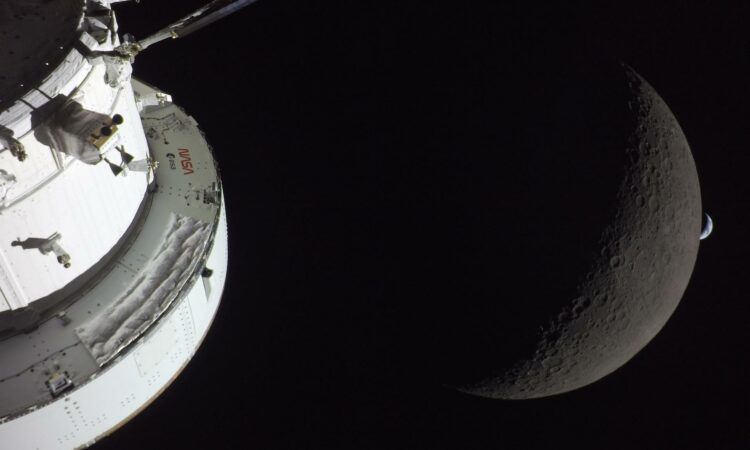
(Cover photo: NASA’s Orion spacecraft captures the Moon and the Earth in one frame during the Artemis II crew’s deep space journey at 6:42 p.m. ET on the sixth day of the mission. The right side of NASA’s Orion spacecraft is seen lit up by the Sun. A waxing crescent Moon is visible behind it. And then, a crescent Earth, tiny compared to the Moon, is about to set below the Moon’s horizon on the right. Credit: NASA)
❤️ Support Florence Daily News
If you liked this article, please consider supporting Florence Daily News.
We are an independent news site, free from paywalls and intrusive ads, committed to providing clear and reliable reporting on Florence and Tuscany for everyone.
Your support — whether a one-time gift or a regular contribution — helps us stay independent and keep telling the stories that matter.
Donate securely via Stripe below.
Make a one-time donation
Make a monthly donation
Make a yearly donation
Choose an amount
Or enter a custom amount
Your contribution is appreciated.
Your contribution is appreciated.
Your contribution is appreciated.
DonateDonate monthlyDonate yearlyDiscover more from Florence Daily News
Subscribe to get the latest posts sent to your email.