
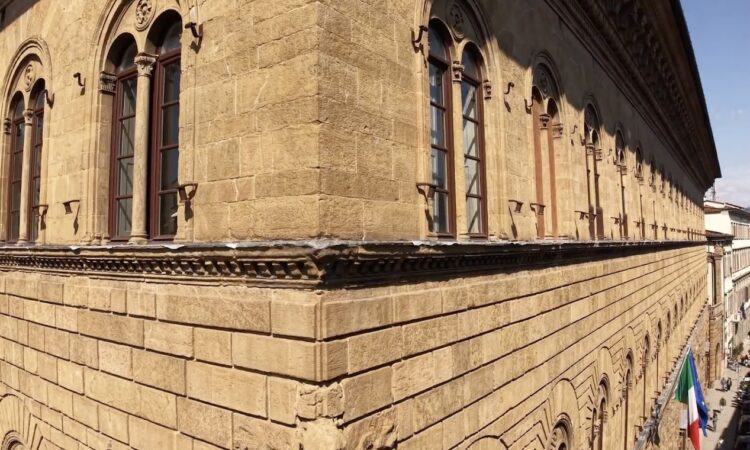
The conservation restoration of the façades of Palazzo Medici Riccardi in Florence has been completed, and institutions are now preparing a long-term maintenance and monitoring plan for the historic building. The results of the project were presented on 25 March during a conference held in the palace as part of events for the Florentine New Year.
The intervention, worth €2.1 million and entirely funded by the Metropolitan City of Florence, concerned the exterior stone surfaces of the palace in Via Cavour, one of the earliest Renaissance residences of the Medici family and now home to the metropolitan authority, a museum, and the Prefecture.
Aerial footage of the palace, filmed by Florence TV using a drone, is embedded in the article.
An experimental approach to restoration
The project was described as a “pilot construction site” due to its multidisciplinary approach, involving architects, chemists, geologists and conservation specialists. The Metropolitan City worked together with the Soprintendenza (the state body overseeing heritage protection), the University of Florence and the University of Rome Tor Vergata.
Rather than addressing immediate structural risks, the restoration focused on long-term deterioration. The façades, built in pietraforte (a traditional Florentine sandstone), had been gradually affected by ageing, pollution and environmental factors.
A wide diagnostic campaign, led by the University of Florence, combined on-site investigations with laboratory analysis. Based on the results, conservation methods were tested in advance in order to identify the most suitable treatments before drafting the final restoration project.
Timeline of the works
The experimental phase began in 2021, followed by the final design in 2022. Restoration works started in summer 2024 and were completed by the end of 2025.
The construction site allowed specialists to test different conservation techniques directly on the building, refining methods aimed at preserving the stone surfaces over time.
Towards a maintenance plan
With the restoration now finished, the next step is a structured maintenance and monitoring programme, currently being prepared. The aim is to ensure continuous care of the façades and prevent future degradation, reducing the need for major interventions.
This approach reflects a broader shift in heritage conservation in Italy, where planned maintenance is increasingly seen as essential for protecting historic buildings over the long term.
❤️ Support Florence Daily News
If you liked this article, please consider supporting Florence Daily News.
We are an independent news site, free from paywalls and intrusive ads, committed to providing clear and reliable reporting on Florence and Tuscany for everyone.
Your support — whether a one-time gift or a regular contribution — helps us stay independent and keep telling the stories that matter.
Donate securely via Stripe below.
Make a one-time donation
Make a monthly donation
Make a yearly donation
Choose an amount
Or enter a custom amount
Your contribution is appreciated.
Your contribution is appreciated.
Your contribution is appreciated.
DonateDonate monthlyDonate yearlyDiscover more from Florence Daily News
Subscribe to get the latest posts sent to your email.