
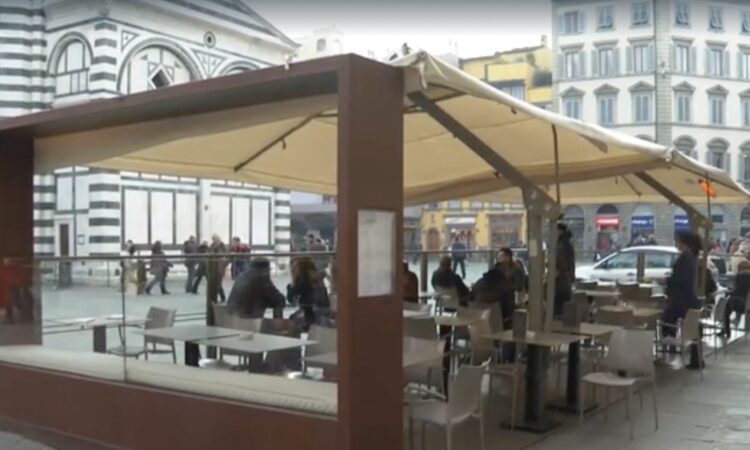
Florence’s City Council has approved a new regulation for dehors—the platforms and outdoor seating areas used by bars and restaurants—introducing stricter design rules, higher penalties and a freeze on any overall increase in authorised outdoor space in the UNESCO-listed historic centre.
The measure is paired with a protocol agreed with the national heritage authority (Soprintendenza) that sets specific restrictions street by street and adds dedicated rules for four landmark squares: Piazza della Signoria, Piazza Pitti, Piazza della Repubblica and Piazza Santa Maria Novella.
The aim, the city administration says, is to reduce visual clutter and improve pedestrian accessibility while keeping outdoor service possible under clearer and more enforceable rules.
What changes compared with current practice
A hard cap on total authorised surface in the UNESCO area
The regulation blocks any increase in the total square metres authorised for outdoor seating in the UNESCO area, effectively freezing the city-wide ceiling at the levels already in place (as referenced by the municipality to mid-November). This means new authorisations or changes should not push the overall totals higher, even if individual layouts are rearranged.
Stricter enforcement and higher penalties
The minimum administrative penalty is raised to €500. The text also strengthens consequences for repeat violations, including suspension measures and, in the most serious/repeated cases, closure of premises linked to further abusive occupation. The regulation also introduces tougher mechanisms that can lead to loss of the concession after repeated breaches within a set period.
No plastic for structural elements, and no advertising
The regulation bans the use of plastic materials for elements such as temporary closures, coverings or panels used to build the structure of a dehor. It also bans advertising messages on the elements of the installation, allowing only the venue’s name/logo.
More transparency: maps, open data and visible layouts
The municipality says every concession will be published online with geolocation and released as open data, and venues will be required to display the authorised planimetry and the maximum number of outdoor seats in a visible way.
Tighter design rules and “type” categories
The regulation consolidates five permitted types of dehors (from simple tables and chairs without platforms, to removable covered structures), and then applies those types differently depending on the street or square. This is intended to reduce ad-hoc solutions and make controls easier.
Deadlines and procedural tweaks
Applications must be filed by 30 April (including by businesses that already have outdoor seating, according to the municipality’s explanatory notes). The city also introduces an option to request a single unified concession if the same venue fronts more than one street/intersection. For street-level projects initiated by operators, plans must be signed by at least 65% of eligible businesses on that street.
The political debate
Council discussion ran long, with the majority presenting the regulation as a balancing act between residents’ concerns (accessibility, decorum, enforcement) and the interests of local businesses. Opposition councillors focused mainly on the need for consistent controls and concerns about how some provisions could be updated over time. The vote passed with the governing coalition in favour and opposition groups voting against.
The four “special squares”: separate agreement with the heritage authority
A dedicated agreement between the Comune and the Soprintendenza sets additional, square-specific rules. These four squares are not governed by the same rules as the rest of the city under the main regulation; they follow the separate framework outlined below.
Piazza della Repubblica: slimmer structures and a 200 m² reduction
In Piazza della Repubblica, the city says it will free more than 200 m² of occupied surface overall, including both reductions within the square and the complete clearance of occupied pavement space, to restore pedestrian access on both sides.
Key layout rules include:
- Symmetry between the two sides of the square.
- A uniform depth of 10.2 metres on both sides.
- A two-metre gap between individual installations.
- Wider pedestrian corridors and clearer central space.
In terms of typologies:
- On the side facing the Arcone, only Type D (removable-only solutions) is permitted.
- On the side towards Via Roma, Type B1 applies, and the heritage authority may view positively frameless glass railings without vertical supports.
Permitted materials include steel and treated/brushed metals such as sanitised/bronz-ed brass.
Piazza Santa Maria Novella: lighter solutions, limited platforms
Here the agreement allows:
- Type A: tables and chairs without platforms, with small umbrellas allowed within limits.
- Type B: platform with protective railing on three sides.
The materials guidance includes steel with darkened brass finishes and frameless extra-clear glass (including specified safety glass types).
Piazza della Signoria: Type B only
In Piazza della Signoria, only Type B installations are admitted—platform plus protective railing on three sides—reflecting the square’s exceptional heritage sensitivity.
Piazza Pitti: Type B and B1, with brown colour palette
In Piazza Pitti, Type B and Type B1 are permitted. Type B1 includes the option, in winter months, for additional transparent panels (glass/plexiglass or similar materials) within defined limits. The colour palette is restricted to brown tones.
The city also indicates that green elements can be included in some of these squares, using terracotta planters as perimeter elements where permitted.
The “city-wide map”: where dehors are banned, frozen or limited by type
Beyond the four special squares, the regulation incorporates lists agreed through the Comune–Soprintendenza protocol. For readers, the most practical way to think about it is three layers:
1) Streets with an outright ban (no dehors allowed)
The regulation lists 60 streets/areas where outdoor seating concessions for refreshment are not permitted at all, typically because of narrow widths, safety/access needs, or high heritage sensitivity.
Among the best-known locations included in this “no dehors” category are:
- Ponte Vecchio
- Via dei Calzaiuoli
- Via Roma
- Piazzale degli Uffizi
- Piazza Santa Trìnita
- Piazza de’ Frescobaldi
- Via Maggio (a key Oltrarno axis)
- Por Santa Maria and the immediate approaches to the river crossings
Several other central streets and smaller lanes in the historic core are also included, affecting both the Duomo/Uffizi area and parts of Oltrarno.
2) Streets where outdoor space cannot be expanded
A second list names 20 streets and squares where existing outdoor seating can remain but the total surface already granted cannot be increased.
This “no expansion” group includes, among others:
- Borgo San Lorenzo
- Borgo San Jacopo
- Piazza Sant’Ambrogio
- Via dei Neri
- Via dei Serragli
- Via Ginori
- Via Vecchietti
In practice, these are areas where the city wants to prevent further growth of outdoor footprint while still allowing existing concessions to be renewed within stricter design constraints.
3) Streets where only specific types are allowed (Type A/B/B1/C/D)
Finally, the regulation lists 73 streets and squares where dehors are permitted only in certain forms—for example, allowing simple tables and chairs (Type A) but not covered structures, or permitting platforms (Type B/B1) only under set conditions.
Notable examples from this type-limited group include:
- Piazza Santo Spirito (Type A only) – meaning tables and chairs without platforms, with limited umbrella options
- Piazza del Duomo (Type A only)
- Via Tornabuoni (Type A only)
- Piazza Strozzi (multiple types allowed, depending on precise siting)
- Several Lungarni (e.g., Lungarno Acciaiuoli, Corsini, Guicciardini, Torrigiani) with restricted combinations typically centred on lighter typologies
- Key squares such as Piazza San Marco, Piazza Goldoni, Piazza Beccaria, and Piazza D’Azeglio, where platforms and other elements may be allowed but only within specified typology limits
What to watch next
Two implementation details will matter for residents and businesses:
- The online map and open-data register: once published, it should make it easier to check whether a dehor is authorised, how large it can be, and what type is permitted on that street.
- The renewal window to 30 April: the months leading up to that deadline are likely to bring visible changes, as layouts are adjusted to fit the new typologies, materials and street-by-street constraints.
❤️ Support Florence Daily News
If you liked this article, please consider supporting Florence Daily News.
We are an independent news site, free from paywalls and intrusive ads, committed to providing clear and reliable reporting on Florence and Tuscany for everyone.
Your support — whether a one-time gift or a regular contribution — helps us stay independent and keep telling the stories that matter.
Donate securely via Stripe below.
Make a one-time donation
Make a monthly donation
Make a yearly donation
Choose an amount
Or enter a custom amount
Your contribution is appreciated.
Your contribution is appreciated.
Your contribution is appreciated.
DonateDonate monthlyDonate yearlyDiscover more from Florence Daily News
Subscribe to get the latest posts sent to your email.