
On September 19, 2026, during a political rally in Formello, Antonio Tajani spoke about the kind of woman he would advise his son to marry. In his example, the most serious and reliable woman was also the least conspicuous: the one wearing the longer skirt. The length of the skirt thus became a small moral metric. Shorter, more showy. Longer, more serious.
Tajani later apologized to women who had felt offended, saying that he had not intended to cause offense.
A few months earlier, in Lombardy, the question had been approached from the other end of the wardrobe. A political proposal called for considering restrictions in schools on certain Islamic garments, including the khimar, which covers the hair, neck, and shoulders while leaving the face uncovered. The proposal also linked the issue to the integration of underage female students.
On one side: cover yourself.
On the other: uncover yourself.
The contradiction is only apparent. In both cases, someone is telling someone else that her body contains a message she is not entitled to choose for herself.
Other people’s bodies, after all, interest us enormously.
Perhaps because the body is the first text we try to read. Before a person has spoken, we have already begun interpreting her. Clothing can become religion, social class, profession, sexuality, respectability. A skirt can become character. A veil can become integration.
The body is a remarkably inexpensive surface on which to produce judgments.
This is not a contemporary invention. For centuries in Europe, sumptuary laws determined which fabrics, colors, jewelry, and ornaments could be worn by different social groups. Clothing did not merely cover the body. It announced the order of the world.
Before a person had spoken, her clothes were expected to have spoken for her.
The body had to be legible.
And legible according to a precise code.
We have changed the code, but not necessarily the habit of reading. Today, we are not interested only in knowing what social class someone belongs to. We want to know whether she is respectable, emancipated, religious, modern, traditional, integrated. And we continue to look for these answers on the skin, in the hair, in the length of a skirt, in the presence or absence of a veil.
Perhaps this is the more interesting point. The problem is not simply that we try to control the body. It is that we have difficulty tolerating a body we cannot immediately translate.
Ambiguity makes us uncomfortable.
We need people to be legible because what is legible seems less unpredictable. A body we cannot interpret leaves open a possibility that politics—and perhaps everyday life—find difficult to tolerate: not knowing.
Plato imagined men chained inside a cave, watching shadows cast upon a wall and mistaking them for reality. The cave has become one of Western philosophy’s most enduring metaphors because it describes something less remote than ignorance: the ease with which a representation, repeated often enough, begins to look like a fact.
We do something similar with other people.
We see a skirt and think we see a woman’s character.
We see a veil and think we see her religion, her family, her relationship with the West.
We see a body and, almost without noticing, assign it a biography.
But we wrote that biography ourselves.
And perhaps this is where the matter becomes less reassuring. Because when we tell a woman to cover herself or uncover herself, we are not merely regulating a piece of fabric. We are asking her body to become intelligible according to our categories.
Freedom, then, might have something to do with a less spectacular form of tolerance: leaving something untranslated.
Not knowing immediately what a garment means. Not turning a skirt into a character, a veil into a destiny, a body into a political statement.
Not because every choice is innocent or beyond scrutiny. But because before interpreting someone, it might be useful to remember something rather simple: the other person is not the shadow her surface casts upon our wall.
And perhaps leaving the cave means, at least sometimes, ceasing to demand that she change her position in front of the light.
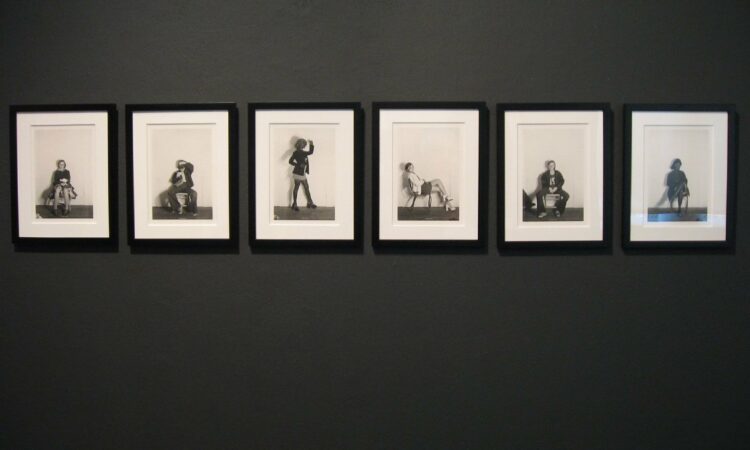
(Cover photo: Cindy Sherman, Through You, photography selections from the Martin Z. Margulies collection. By Libby Rosof via Flickr)
❤️ Support Florence Daily News
If you liked this article, please consider supporting Florence Daily News.
We are an independent news site, free from paywalls and intrusive ads, committed to providing clear and reliable reporting on Florence and Tuscany for everyone.
Your support — whether a one-time gift or a regular contribution — helps us stay independent and keep telling the stories that matter.
Donate securely via Stripe below.
Make a one-time donation
Make a monthly donation
Make a yearly donation
Choose an amount
Or enter a custom amount
Your contribution is appreciated.
Your contribution is appreciated.
Your contribution is appreciated.

Eirini Lavrentiadou is an actress and singer, born in Thessaloniki in 1992. She lives in Florence, where she trained at the city’s Theatre Academy and the Fiesole School of Music. She has performed in classical Greek and European plays, worked with international directors and companies, and appeared in concerts ranging from opera to jazz. She contributes to Florence Daily News as a writer and social media creator.
Discover more from Florence Daily News
Subscribe to get the latest posts sent to your email.