
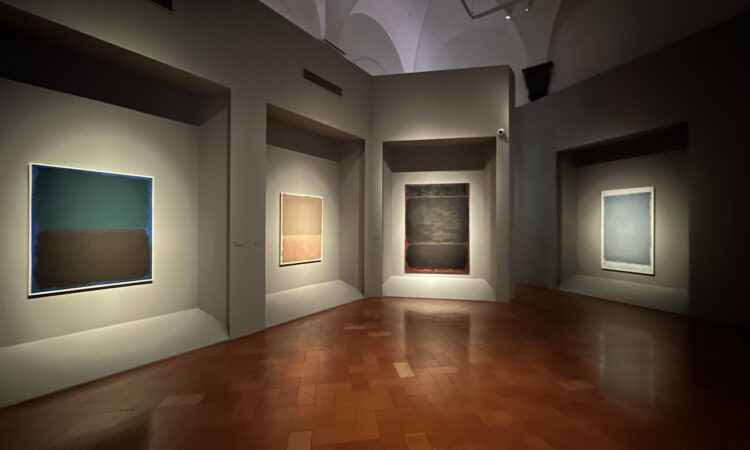
Rothko in Florence closed on Sunday, August 23, after becoming the most visited exhibition in the 20-year history of Fondazione Palazzo Strozzi. Over its 162 days, the show attracted 301,730 visitors to Palazzo Strozzi, confirming the strong public response to a project created specifically for Florence.
Curated by Christopher Rothko and Elena Geuna, the exhibition explored Mark Rothko’s relationship with the city through works borrowed from major international museums and private collections, including the Museum of Modern Art and the Metropolitan Museum of Art in New York, Tate in London and the National Gallery of Art in Washington.
The project extended beyond Palazzo Strozzi to two historic Florentine institutions. During the same period, the Museo di San Marco recorded 96,665 visitors, while the Biblioteca Medicea Laurenziana received 32,140. At San Marco, Rothko’s paintings were placed in dialogue with the spiritual and meditative environment associated with Fra Angelico, while at the Laurenziana the exhibition introduced contemporary works into Michelangelo’s celebrated architectural setting.
The organisers also highlighted the exhibition’s ability to draw visitors specifically to Florence. According to Fondazione Palazzo Strozzi, around 60 per cent of the audience — approximately 200,000 people — came from outside the Florence metropolitan area and travelled to the city with the exhibition among the main reasons for their visit. It was the highest proportion ever recorded by the foundation.
The show also generated considerable international attention and strong digital engagement. Palazzo Strozzi said its social media content connected with more than 6.1 million people, generating over 470,000 interactions, while the institution’s website recorded more than 538,000 users and 1.9 million page views during the exhibition period.
Next at Palazzo Strozzi: Broken
The next major exhibition at Palazzo Strozzi will open on September 25. Broken. Il potere del frammento — Broken. The Power of the Fragment — will examine how damaged, incomplete or deliberately fragmented sculptures have acquired new meanings across centuries.
Organised with the National Gallery of Art in Washington, the exhibition will bring together more than 80 works from international collections, ranging from ancient Egypt and classical Greece to Cambodia, Mexico and contemporary art.
The exhibition will look not only at fragments as archaeological remains, but also at the historical forces that created them: war, religious iconoclasm, political upheaval, vandalism, natural disasters and deliberate artistic choices. Among the events explored will be the French Revolution, the world wars and the 1966 Florence flood.
Works by Giovanni Pisano, Michelangelo, Antonio Canova and Auguste Rodin will appear alongside contemporary artists including Louise Bourgeois, Huma Bhabha, Robert Gober, Francesco Vezzoli and Danh Vo. Dutch artist Mark Manders will also create a new installation for Palazzo Strozzi’s Renaissance courtyard.
The exhibition will run until January 24, 2027.
California and Basquiat in 2027
Palazzo Strozzi has also announced the two main exhibitions scheduled for its Piano Nobile in 2027.
From March 20 to July 18, 2027, California Dreaming will explore California as both a real place and a global cultural idea, examining the tensions between optimism and disillusionment, popular culture and political activism, technology and nature.
Curated by Arturo Galansino and co-organised with the Manetti Shrem Museum of Art in Davis, California, the exhibition will bring together artists associated with the state from the 1960s to the present. David Hockney, James Turrell, Judy Chicago, John Baldessari, Ed Ruscha, Mike Kelley and Catherine Opie will be shown alongside contemporary figures including Sadie Barnette, Alex Israel, Patrick Martinez, Lauren Halsey and Refik Anadol.
The programme will then turn to Jean-Michel Basquiat.
Basquiat. In Italian, running from September 25, 2027 to January 23, 2028, will present more than 60 works and focus on the artist’s relationship with Italy and with the country’s artistic and cultural heritage.
Curated by Dieter Buchhart and Anna Karina Hofbauer, the exhibition will examine how Basquiat absorbed references ranging from ancient Rome and Egypt to Leonardo da Vinci and Galileo Galilei, combining them with the distinctive visual vocabulary through which he addressed race, identity, inequality and capitalism.
The exhibition will also explore Basquiat’s direct relationship with Italy, which he visited several times during his life, offering a specifically Italian perspective on one of the most influential artists of the late 20th century.
❤️ Support Florence Daily News
If you liked this article, please consider supporting Florence Daily News.
We are an independent news site, free from paywalls and intrusive ads, committed to providing clear and reliable reporting on Florence and Tuscany for everyone.
Your support — whether a one-time gift or a regular contribution — helps us stay independent and keep telling the stories that matter.
Donate securely via Stripe below.
Make a one-time donation
Make a monthly donation
Make a yearly donation
Choose an amount
Or enter a custom amount
Your contribution is appreciated.
Your contribution is appreciated.
Your contribution is appreciated.
Discover more from Florence Daily News
Subscribe to get the latest posts sent to your email.