


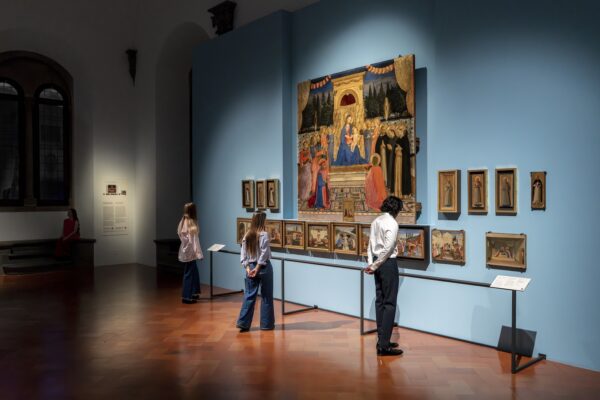
The Fra Angelico exhibition at Palazzo Strozzi did more than succeed. It broke records. With over a quarter of a million visitors in just four months, it became the most visited exhibition in the institution’s history. The figures are striking, but they are also revealing. They point to something larger than attendance alone: a shift in where, and how, people seek experiences of meaning.
Fra Angelico was a friar before he was a painter. His works were conceived for convents, cells, and altars—for spaces shaped by silence, repetition, and devotion. And yet today, in the heart of Florence, his paintings have drawn vast crowds of largely secular, international visitors, many of whom travelled to the city specifically to see them. The religious framework has changed, but the attention has not. If anything, it has intensified.
In recent years, critics and historians have noted how museums have quietly assumed a role once occupied by churches. Not because they offer faith, but because they provide something increasingly rare: carefully constructed spaces for contemplation. Many contemporary churches, shaped by functional demands or conceptual architectural gestures, struggle to create a sense of symbolic gravity. They often fail to guide the body and the gaze toward something larger than itself.
Museums, by contrast, have perfected a secular ritual. The threshold at the entrance, the calibrated light, the slow unfolding of rooms, the shared silence. Time is deliberately stretched. Distraction is discouraged. Visitors are invited—almost instructed—to look closely. To linger. To suspend themselves.
The Fra Angelico exhibition made this transformation especially visible. Altarpieces once embedded in liturgical settings found a new, convincing home within the museum. No longer objects of worship, they became objects of total attention. The crowds moved through the galleries with the focus of a contemporary pilgrimage: lines, audio guides, carefully plotted routes, long pauses in front of images painted six centuries ago.
What draws people in is not doctrine, but atmosphere. The museum offers order, care, and a sense of orientation—qualities once associated with sacred architecture. It does not promise salvation, but it does offer something quietly powerful: a shared experience of stillness and concentration.
That a painter devoted to eternity should become the center of the most visited exhibition in Palazzo Strozzi’s history is not a paradox. It is a sign. The sacred has not disappeared. It has simply found a new address.
❤️ Support Florence Daily News
If you liked this article, please consider supporting Florence Daily News.
We are an independent news site, free from paywalls and intrusive ads, committed to providing clear and reliable reporting on Florence and Tuscany for everyone.
Your support — whether a one-time gift or a regular contribution — helps us stay independent and keep telling the stories that matter.
Donate securely via Stripe below.
Make a one-time donation
Make a monthly donation
Make a yearly donation
Choose an amount
Or enter a custom amount
Your contribution is appreciated.
Your contribution is appreciated.
Your contribution is appreciated.
DonateDonate monthlyDonate yearly

Eirini Lavrentiadou is an actress and singer, born in Thessaloniki in 1992. She lives in Florence, where she trained at the city’s Theatre Academy and the Fiesole School of Music. She has performed in classical Greek and European plays, worked with international directors and companies, and appeared in concerts ranging from opera to jazz. She contributes to Florence Daily News as a writer.