


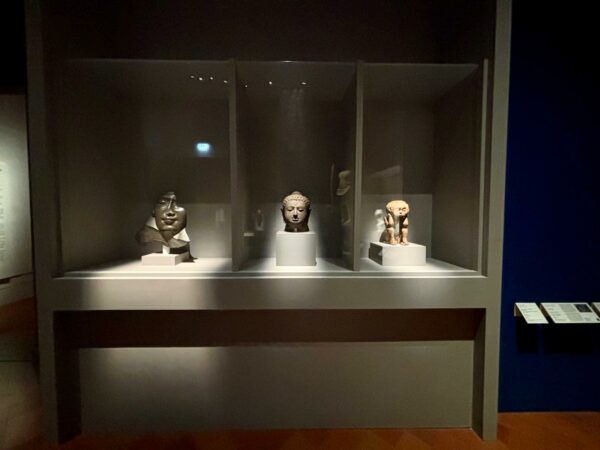
To enter Broken, at Palazzo Strozzi, is to enter a place where almost nothing is whole.
There are mutilated bodies, broken statues, fragments that have survived wars, iconoclasm, earthquakes, floods. But after a few rooms, you almost stop looking at what is missing. You begin to look at what has been placed beside it.
The exhibition, organized with the National Gallery of Art in Washington, moves across distant times and geographies: from ancient Egypt and Greece to Etruria, the cultures of Mexico, Mali, Peru and Cambodia, and then to Michelangelo, Rodin, and contemporary artists such as Louise Bourgeois, Francesco Vezzoli and Danh Vo. More than eighty works that do not belong to the same world and that, for precisely this reason, suddenly seem to have something to say to one another.
The fragment, here, is not simply what remains after a loss. It is something that acquires another life when it is placed in relation to something else.
One face beside another.
One culture beside another.
One way of seeing the body beside a completely different one.
Difference is not erased. It is made visible.
I found myself thinking about this again when I read, these days, about the Italian government’s proposal to introduce a limit on the presence in classrooms of newly arrived students who do not yet have sufficient Italian-language skills. A story about schools, seemingly far removed from a sculpture exhibition. And yet I could no longer think about it simply as a question of numbers or administration.
Because a classroom is, in a way, a room in which we place different things beside one another.
Different languages.
Different histories.
Different families.
Memories that did not begin in the same place.
Of course, not knowing the language of instruction can make learning difficult. There is nothing poetic about that: it is a concrete problem, requiring concrete tools.
But there is also something that happens only when difference enters the same room.
At Palazzo Strozzi, the fragment is not reconstructed so that it can return to its original form. It is left beside other fragments. And it is precisely this proximity that produces something new.
Perhaps that is what stayed with me after the exhibition.
Not the idea that every difference must be harmonized. Rather, the simpler—and more difficult—idea that some things become visible only when they are placed beside one another.
A classroom is a much smaller room than the world.
But it is one of the first rooms in which we learn that the world does not necessarily resemble us.
And perhaps it shouldn’t.
(Cover photo taken from the exhibition Broken in Palazzo Strozzi, Florence)
❤️ Support Florence Daily News
If you liked this article, please consider supporting Florence Daily News.
We are an independent news site, free from paywalls and intrusive ads, committed to providing clear and reliable reporting on Florence and Tuscany for everyone.
Your support — whether a one-time gift or a regular contribution — helps us stay independent and keep telling the stories that matter.
Donate securely via Stripe below.
Make a one-time donation
Make a monthly donation
Make a yearly donation
Choose an amount
Or enter a custom amount
Your contribution is appreciated.
Your contribution is appreciated.
Your contribution is appreciated.


Eirini Lavrentiadou is an actress and singer, born in Thessaloniki in 1992. She lives in Florence, where she trained at the city’s Theatre Academy and the Fiesole School of Music. She has performed in classical Greek and European plays, worked with international directors and companies, and appeared in concerts ranging from opera to jazz. She contributes to Florence Daily News as a writer.