


There is a moment in military footage when the world seems to lose its usual grammar.
The screen is small, almost insignificant compared to what it is supposed to contain: a point of light moving without apparent inertia, as if physics itself had briefly become a negotiable convention. No one in the room reacts with theatrical astonishment. Only a form of restrained attention, technical, almost bureaucratic. And yet it is difficult not to feel that, for an instant, the question is not what is being seen, but what it means to “see” when the object no longer belongs to any available category.
In the recent vocabulary of American politics, UFOs have re-emerged under a new acronym, UAP — Unidentified Anomalous Phenomena — as if the change of name could soften the old vertigo that surrounds them. Military videos, public hearings, testimonies from former officials: material sufficient to reopen a question that has never quite found rest.
It is not the question of whether we are alone.
It is another, quieter one: what we are willing to imagine when we do not understand.
Every era seems to answer differently, yet according to a surprisingly stable grammar. During the Cold War, unidentified objects in the sky tended to resemble enemy technologies. The unknown was translated into the language of conflict. It was not necessary that “aliens” exist; it was enough that the world was already organized around the idea of an invisible adversary.
Today the scene is different, yet the emotional structure remains recognizable. In a political landscape shaped by technological surveillance, strategic competition, and diffuse instability, the unidentified is again absorbed into the vocabulary of security. What is not understood becomes, almost automatically, what might be a threat.
And yet, in another domain of thought — that of physics — there exists an observation that introduces a different kind of distance.
We never see the present.
Every beam of light takes time to reach us. To look at the sky is to receive delayed news: not events themselves, but their earlier versions. The universe never presents itself as simultaneity, but as an archive in constant revision. Even what we call “now” is, in truth, a mediation.
At this point there is a temptation to extend the analogy. If the cosmos always appears in delay, then perhaps the human future is not what lies ahead of us, but what the past projects beyond its own limit.
Societies do not seem to build the future from nothing. They build it from what they already know: conflicts, hopes, sedimented fears. Even the most radical breaks — technologies that appear to interrupt historical continuity — often arrive accompanied by older imaginaries than we admit. Flight inherits the myth of flight. The internet inherits the idea of an invisible network connecting everything. Artificial intelligence inherits the dream, or the fear, of a non-human intelligence that observes or replaces us.
At this point the question changes form. It is no longer whether the future is new.
It is whether we are able to think it without dragging it backward.
There is an unavoidable objection, almost obvious: history is full of real discontinuities. Nothing we call modernity can be reduced to repetition. But perhaps continuity does not lie in events. It lies in how we feel them.
Technologies change faster than our ability to comprehend them. Emotions do not. Fear, the desire for control, curiosity, ambition: these remain remarkably stable, as if they belong to a duration longer than history itself.
Perhaps this is where the true symmetry hides. Not between past and future, but between what we are and what we are willing to transform into what we feel.
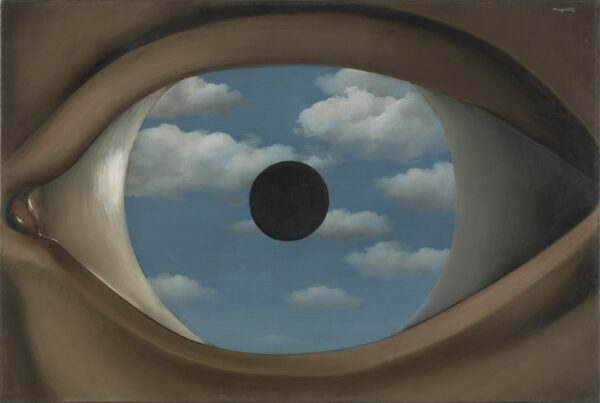
(Cover photo: René Magritte’s The False Mirror / Le faux miroir, 1929, public domain)
❤️ Support Florence Daily News
If you liked this article, please consider supporting Florence Daily News.
We are an independent news site, free from paywalls and intrusive ads, committed to providing clear and reliable reporting on Florence and Tuscany for everyone.
Your support — whether a one-time gift or a regular contribution — helps us stay independent and keep telling the stories that matter.
Donate securely via Stripe below.
Make a one-time donation
Make a monthly donation
Make a yearly donation
Choose an amount
Or enter a custom amount
Your contribution is appreciated.
Your contribution is appreciated.
Your contribution is appreciated.


Eirini Lavrentiadou is an actress and singer, born in Thessaloniki in 1992. She lives in Florence, where she trained at the city’s Theatre Academy and the Fiesole School of Music. She has performed in classical Greek and European plays, worked with international directors and companies, and appeared in concerts ranging from opera to jazz. She contributes to Florence Daily News as a writer.