


Not long ago, interviews with artists had a fairly clear perimeter: a work, a creative process, a few personal detours—just enough to add depth without crossing fully into intimacy. That perimeter has since dissolved. Listening to recent conversations, such as the interview with Richard Gadd on The Interview from The New York Times, one gets the sense that the interview is no longer a space for narration, but a space for access—direct, accelerated, almost clinical.
Questions no longer circle around the work in order to reach the person. They begin with the person—or rather, with a version of the person already interpreted. “What does this trauma mean to you?” “How do you define your identity?” “What is your relationship to that part of yourself?” The vocabulary is that of therapy, but the setting is something else entirely: public, compressed, lacking the conditions that make therapy what it is—time, trust, responsibility.

This shift reflects a broader cultural movement. In recent years, psychology has ceased to be a specialized language and has become a kind of everyday grammar. Terms like trauma, processing, narcissism no longer belong solely to therapists’ offices; they circulate freely in conversations, on social media, within relationships. We have learned to read ourselves through these categories. More recently, we have begun to use them to read others.
Perhaps, within this tendency, there is also another, less explicit impulse. In a social landscape marked by instability—fragile relationships, shifting identities, fewer shared codes—analysis offers a form of orientation. To name what another person is, or appears to be, is to reduce uncertainty. Interpretation becomes a way of containing anxiety, of turning unpredictability into something legible.
The result is a new kind of proximity, one that does not pass through knowledge but through interpretation. It is no longer necessary to build a conversation slowly in order to arrive at something personal; one can begin there, as if intimacy were a universally available starting point. The interviewer thus takes on an ambiguous role: no longer simply an observer or interlocutor, but a figure who, in tone and language, resembles a therapist—without sharing the therapist’s limits or responsibilities.
In this context, the artist’s position also shifts. Where once they could choose how and how much to reveal, they now often find themselves within a format that presumes exposure. This is not necessarily coercion; more often, it is a form of cultural alignment. If the work itself—as in the case of Gadd—originates in an act of self-revelation, the interview seems authorized to continue along that line, pushing it further. Yet the transition is not neutral: between choosing to tell and being asked to account for what one has told lies a subtle but decisive difference.
The risk is not simply that of invading the personal sphere. It is something harder to detect: a gradual reduction of complexity. When everything is translated into psychological terms, every experience tends to be read as a symptom, every contradiction as something to be explained, every silence as a gap to be filled. Analysis becomes a narrative shortcut, a way of making immediately intelligible what may not, in fact, be so.
In this sense, intimacy ceases to be a discovery and becomes a format. And like all formats, it risks repetition, standardization, and the loss of what makes it meaningful in the first place: unpredictability, resistance, the possibility of remaining only partially articulated.
What remains, then, is a question less obvious than it might seem: in this new regime of transparency, are we truly coming to understand artists more deeply—or are we simply learning to recognize, in their stories, the vocabulary we have come to use for ourselves?
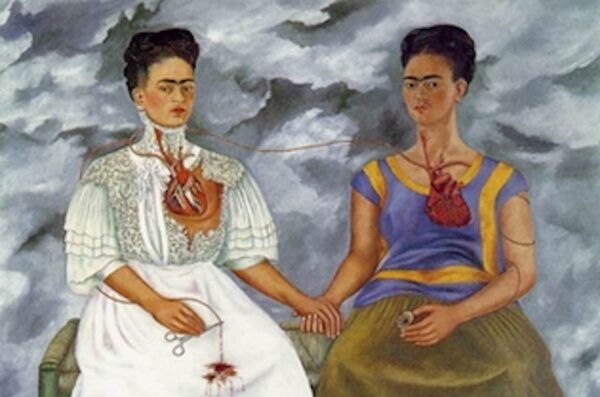
(Cover photo: The painting The Two Fridas, Frida Kahlo, public domain)
❤️ Support Florence Daily News
If you liked this article, please consider supporting Florence Daily News.
We are an independent news site, free from paywalls and intrusive ads, committed to providing clear and reliable reporting on Florence and Tuscany for everyone.
Your support — whether a one-time gift or a regular contribution — helps us stay independent and keep telling the stories that matter.
Donate securely via Stripe below.
Make a one-time donation
Make a monthly donation
Make a yearly donation
Choose an amount
Or enter a custom amount
Your contribution is appreciated.
Your contribution is appreciated.
Your contribution is appreciated.
DonateDonate monthlyDonate yearly

Eirini Lavrentiadou is an actress and singer, born in Thessaloniki in 1992. She lives in Florence, where she trained at the city’s Theatre Academy and the Fiesole School of Music. She has performed in classical Greek and European plays, worked with international directors and companies, and appeared in concerts ranging from opera to jazz. She contributes to Florence Daily News as a writer.