


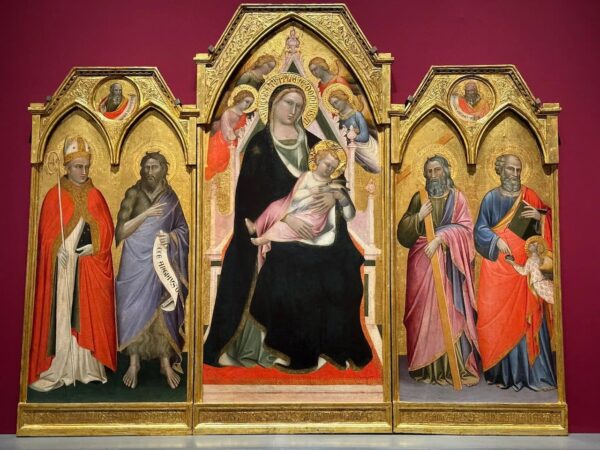
A late medieval altarpiece by Spinello Aretino has returned to public view in Florence following a major restoration, with a dedicated display now open at the Galleria dell’Accademia.
The triptych, dated 1391, has been on show since 24 February in the museum’s rooms devoted to late 14th-century Florentine painting. The display runs until 11 May 2026 and includes videos, images and explanatory material illustrating the different phases of the conservation work.
A key work of late medieval Tuscan painting
The painted wooden triptych depicts the Madonna and Child enthroned with four angels, alongside Saints Paolino, John the Baptist, Andrew and Matthew. In the upper roundels, the prophets Jeremiah and Moses are represented.
The work was commissioned by a merchant from Lucca for the oratory of Sant’Andrea in that city. The choice of saints reflects both the dedication of the church and the names of the patron and his family.
Art historians consider the panel an important reference point in reconstructing the career of Spinello Aretino, an artist active between Florence, Pisa and Lucca. It also illustrates the transition in Tuscan painting between the late 14th and early 15th centuries.
The artwork narrowly avoided leaving Italy in the mid-19th century, when an attempted illicit sale was blocked by the authorities of the Grand Duchy of Tuscany, leading to its permanent inclusion in Florentine collections.

The restoration: recovering original details
The restoration, completed in early 2026 after starting in November 2024, followed a full diagnostic campaign that analysed the structure, materials and pigments of the painting.
Before the intervention, the triptych’s appearance had been significantly altered by centuries of wear and previous restorations. Surface deposits, oxidised varnishes, overpainting and structural issues in the wooden support all affected its readability.
Scientific analysis allowed conservators to distinguish original elements from later additions and to identify the preparatory drawing beneath the painted surface.
The work focused on recovering the original paint layers and restoring visual coherence, while respecting standard conservation principles such as reversibility and recognisability of the intervention.
As a result, the colours have regained brightness and clarity. Subtle modelling in the figures, the rhythm of the drapery and the delicate treatment of skin tones are now more legible, offering a clearer view of the artist’s technique.

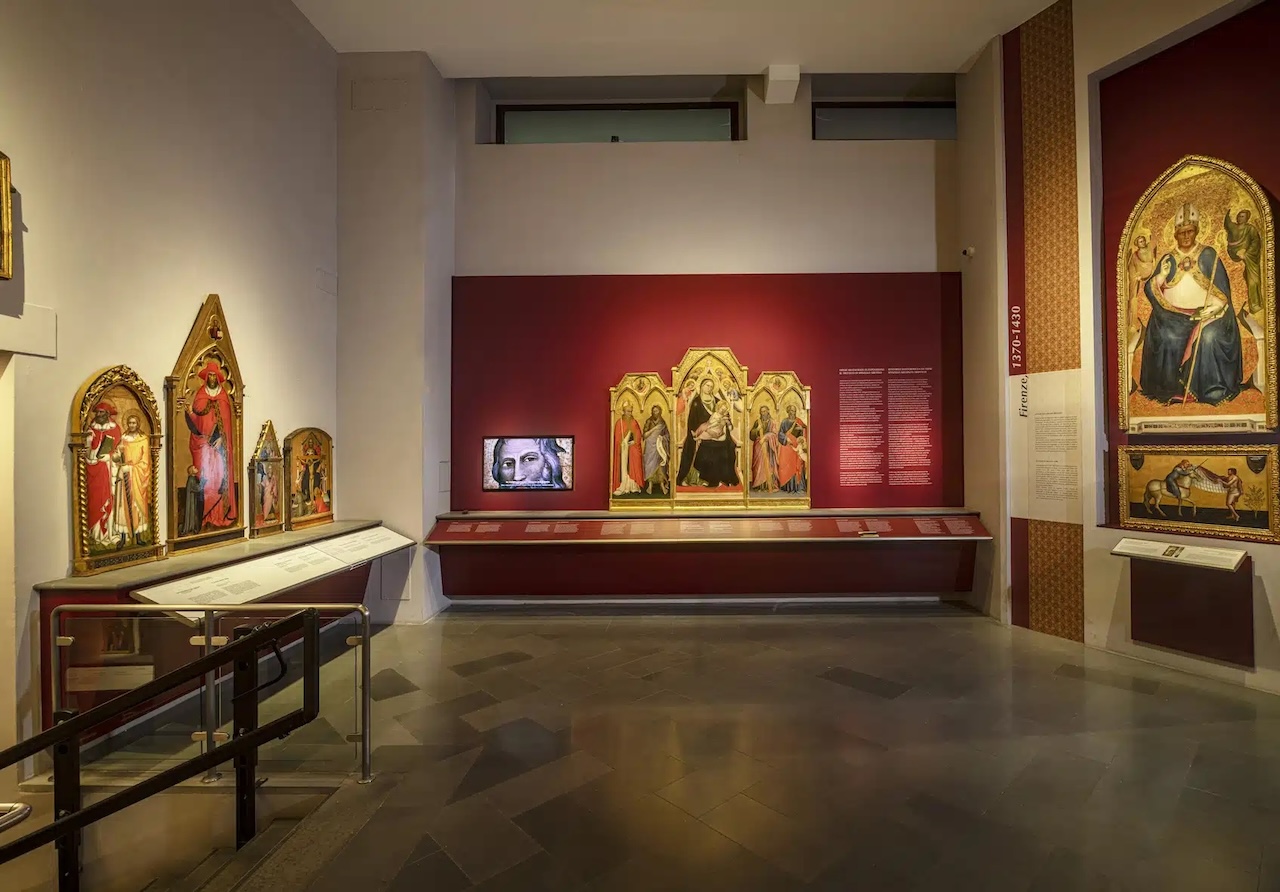
A display focused on “invisible” museum work
Alongside the restored artwork, the exhibition highlights the technical and often unseen processes involved in conserving cultural heritage.
The museum has structured the display to explain how restorers operate, from diagnostic analysis to cleaning and reintegration, giving visitors a better understanding of the work that takes place behind the scenes in major collections.
Practical information
- Location: Galleria dell’Accademia, Florence
- Dates: until 11 May 2026
- Exhibition focus: the restored Spinello Aretino triptych and its conservation process
The display is included in the museum’s standard visit route, according to information provided by the institution.
❤️ Support Florence Daily News
If you liked this article, please consider supporting Florence Daily News.
We are an independent news site, free from paywalls and intrusive ads, committed to providing clear and reliable reporting on Florence and Tuscany for everyone.
Your support — whether a one-time gift or a regular contribution — helps us stay independent and keep telling the stories that matter.
Donate securely via Stripe below.
Make a one-time donation
Make a monthly donation
Make a yearly donation
Choose an amount
Or enter a custom amount
Your contribution is appreciated.
Your contribution is appreciated.
Your contribution is appreciated.
DonateDonate monthlyDonate yearly