


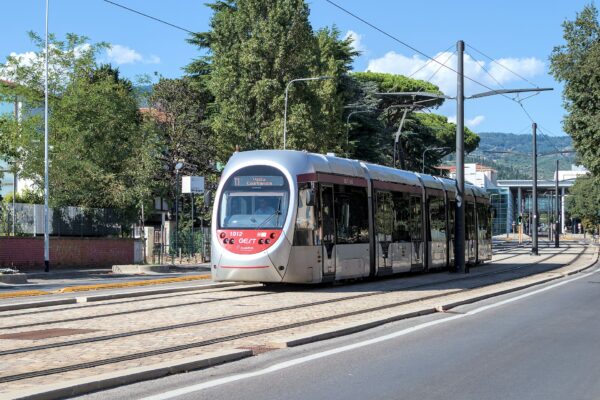
The Tramvia di Firenze recorded continued growth in passenger numbers in 2025, with just over 45 million trips made across the network, up from 39.1 million the previous year. Data released by the Comune di Firenze show an increase of around 15%, equivalent to more than six million additional journeys.
Much of this growth is linked to changes in the network rather than to a general surge in demand. In particular, the extension of line T2 from the airport into the historic centre has reshaped travel patterns, offering a direct connection to areas previously served only by buses or on foot.
The effect of the San Marco extension
Line T2, which connects Florence Airport with the city centre, was extended in 2025 through the Variante al Centro Storico (VACS) to Piazza San Marco. The extension resulted in a marked increase in usage, with 18.3 million passengers recorded on the line over the year, about 36% more than in 2024.
Line T1, running between Villa Costanza park-and-ride and Careggi hospital, also saw a smaller rise to 28.9 million passengers, despite summer works that required part of the route to be replaced temporarily by shuttle buses.
Monthly figures highlight how the new San Marco terminus changed demand on line T2, with passenger numbers rising steadily after its opening and reaching their highest levels in the autumn.
Archaeological discoveries complicate construction works
At the same time, tram construction continues to face constraints linked to Florence’s archaeological heritage. During utility works near Piazza Beccaria, close to Porta alla Croce, archaeologists uncovered a small Roman-era burial containing the remains of a young girl who died around 2,050 years ago. The find was initially thought to date to the Middle Ages before further analysis confirmed its Roman origin.
The burial emerged alongside earlier discoveries of 14th-century city walls, already identified during works linked to the future tram stop for line 3.2.1. While surface-level works in the square are continuing, the presence of significant remains below ground is increasing the risk of delays.
The Soprintendenza Archeologia Belle Arti e Paesaggio has asked for further technical documentation on how major underground pipelines, including water and gas infrastructure, could be rerouted or protected. A final decision on how works may proceed is expected only after this assessment, leaving timelines uncertain.
Expansion plans and open questions
Florence is pressing ahead with plans to extend the tram network further, including the new line towards Bagno a Ripoli, where construction is already well advanced, and future branches to Rovezzano and Le Piagge.
City officials describe the tram as a central tool for reducing car traffic and improving air quality, supported by discounted season tickets and plans for an integrated metropolitan fare system. However, as recent discoveries show, the pace of expansion remains closely tied to the city’s complex underground layers, where infrastructure projects must constantly adapt to archaeological constraints.
In this context, 2025 confirmed both the growing role of the tram in daily mobility and the practical limits imposed by building new transport infrastructure in a city with more than two millennia of history beneath its streets.
❤️ Support Florence Daily News
If you liked this article, please consider supporting Florence Daily News.
We are an independent news site, free from paywalls and intrusive ads, committed to providing clear and reliable reporting on Florence and Tuscany for everyone.
Your support — whether a one-time gift or a regular contribution — helps us stay independent and keep telling the stories that matter.
Donate securely via Stripe below.
Make a one-time donation
Make a monthly donation
Make a yearly donation
Choose an amount
Or enter a custom amount
Your contribution is appreciated.
Your contribution is appreciated.
Your contribution is appreciated.
DonateDonate monthlyDonate yearly