


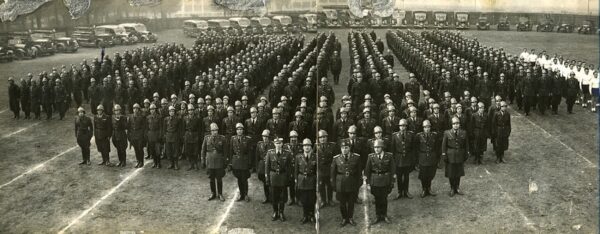
The chart is orderly, almost neutral. The question it asks—What would you do if war broke out tomorrow?—is anything but. According to a CENSIS survey, among Italians aged eighteen to forty-five, only sixteen percent say they would be ready to fight. The rest divide themselves among pacifism, refusal of conscription, and flight. It is not an emotional response, but a pragmatic one. And it is precisely this detachment that makes it meaningful.

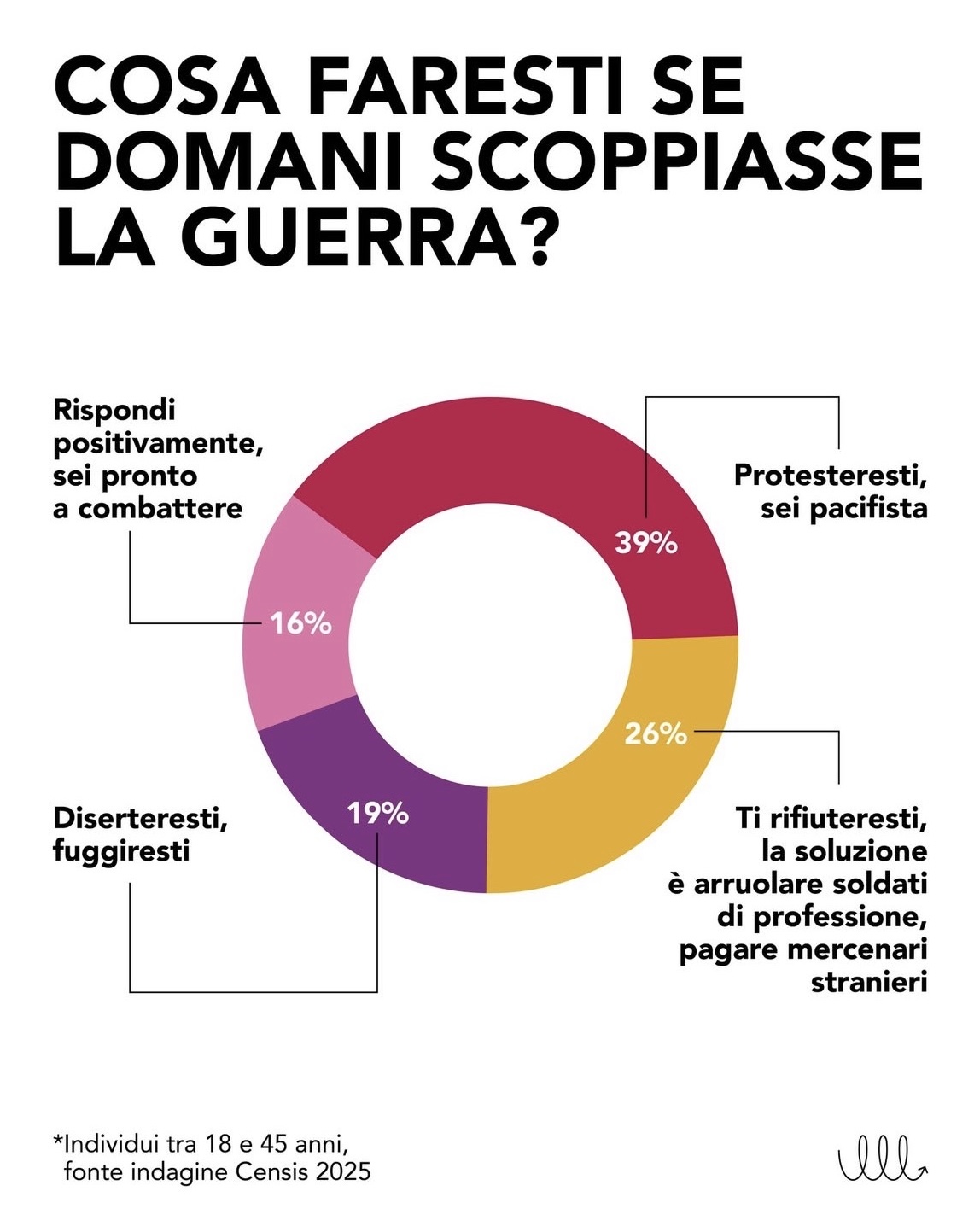
In post–World War I Italy, war was not a remote possibility but a recent and shared experience. Violence had left behind a habit—of confrontation, discipline, and the belief that the state could legitimately demand extreme sacrifice. In that context, fascism did not need to persuade Italians to accept war; it merely had to organize it symbolically, turning it into order, mission, and national destiny.
Today, the chart tells a different story. The thirty-nine percent who identify as pacifist and the twenty-six percent who reject compulsory military service point to a quiet rupture: the state is no longer perceived as something for which one’s life should automatically be risked. War, if it comes, is seen as a failure of politics, not its fulfillment.
The figure regarding desertion is equally revealing. Saying one would flee implies neither heroism nor shame; it is a socially permissible answer. Under fascism, such a statement would have been unthinkable, because the regime was built on the assumption that the individual existed only in service of the nation.
Fascism emerged in a society willing to subordinate the individual to the collective and to attribute a regenerative value to war. The current data, by contrast, depict a disenchanted, individualistic Italy, one with little inclination toward total mobilization and little faith that violence can produce greatness.
It is in this distance—cultural more than political—that we can understand why a consensus like the one that sustained fascism would be unlikely to reappear today in the same form.
🎄 Support Florence Daily News this holiday season
If you value our work, please consider supporting Florence Daily News this Christmas.
We’re an independent news site — free from paywalls and intrusive ads — committed to offering clear and reliable reporting on Florence and Tuscany for everyone.
Your contribution helps us remain independent and continue telling the stories that matter.
As a small thank-you, supporters this holiday season will receive an original photograph of Florence — a simple, meaningful gift to celebrate the city we all love.
🎁 Donate securely via Stripe below and make your gift count for good journalism in Tuscany.
Make a one-time donation
Make a monthly donation
Make a yearly donation
Choose an amount
Or enter a custom amount
Your contribution is appreciated.
Your contribution is appreciated.
Your contribution is appreciated.
DonateDonate monthlyDonate yearly

Eirini Lavrentiadou is an actress and singer, born in Thessaloniki in 1992. She lives in Florence, where she trained at the city’s Theatre Academy and the Fiesole School of Music. She has performed in classical Greek and European plays, worked with international directors and companies, and appeared in concerts ranging from opera to jazz. She contributes to Florence Daily News as a writer.