


A fragment can be evidence of destruction, the accidental result of centuries of survival or an artistic choice in its own right. A new exhibition at Palazzo Strozzi uses this idea to reconsider the history of sculpture, bringing objects separated by thousands of years and very different cultures into the same narrative.
Broken. The Power of the Fragment, opening on September 25 and running until January 24, 2027, presents more than 80 works from archaeological collections and international museums. Its scope extends from ancient Egypt, Mesoamerica, Etruria, Greece and Rome to medieval and modern Europe and contemporary art.
The exhibition is organised by Fondazione Palazzo Strozzi with the National Gallery of Art in Washington, where it will subsequently be shown from March 3 to June 27, 2027. It is curated by C.D. Dickerson III and Andrew Sears of the National Gallery, in collaboration with Palazzo Strozzi director general Arturo Galansino.
Rather than treating damaged sculptures simply as incomplete versions of an original work, the exhibition examines what happens after an object is broken. Some fragments survived because of chance; others bear the marks of religious or political violence, war, colonialism or natural disasters. In other cases, artists deliberately embraced fragmentation as an expressive language.


A history told through what survives
The exhibition begins with the evocative power that fragments can acquire once separated from their original context.
Among its opening works are surviving elements of Giovanni Pisano’s funerary monument for Margaret of Brabant, created between 1312 and 1314. They are followed by a sequence of fragmentary faces from different periods and cultures, illustrating how even a small surviving portion of a sculpture can retain a strong sense of identity and presence.
One of the earliest is a fragment depicting the nose and lips of the Egyptian pharaoh Akhenaten, dating to around 1350 BC and on loan from the Metropolitan Museum of Art in New York. It appears alongside an Etruscan protome from the sixth century BC, a second-century BC head of Aphrodite from Athens and a rare eighth-century Buddhist bronze fragment from Vietnam, normally held by the Musée Guimet in Paris.
The geographical range is deliberately broad. Objects come not only from the Mediterranean and Europe but also from the territories of present-day Mexico, Mali, Peru, Cambodia and Vietnam. Major lenders include the Louvre, British Museum, National Archaeological Museum of Athens, National Roman Museum, National Archaeological Museum of Florence and Mexico City’s Museo Nacional de Antropología.
The display then considers what societies have done with fragmented bodies: exhibiting them, collecting them, reconstructing them or sometimes concealing them. Among the examples are one of Sardinia’s Giants of Mont’e Prama, dating from approximately 900–700 BC, and the Torso of Livorno, a Roman work from the first century BC held by Florence’s National Archaeological Museum.


Breaking statues as a political act
Some of the exhibition’s most historically charged objects were not damaged accidentally.
One section examines iconoclasm and damnatio memoriae — the destruction or alteration of images associated with political power, religion or particular individuals. The exhibition presents fragments of one of the earliest known bronze equestrian monuments, erected in the Agora of Athens around 320–270 BC and pulled down around 200 BC.
The same theme reappears more than two millennia later in fragments of French royal monuments destroyed during the French Revolution. A surviving foot from an equestrian statue of Louis XIV and the right hand from a monument to Louis XV, both on loan from the Louvre, show how attacks on political systems have often involved attacks on their public images.
The exhibition also reaches into 20th-century Italian history through Adolfo Wildt’s 1923 bust of Benito Mussolini. The sculpture is perforated by damage inflicted by partisans after the Liberation, turning the physical condition of the object itself into evidence of the political rupture that followed the collapse of Fascism.
Beyond Europe, a fragment from a once monumental representation of the Aztec goddess Coatlicue, now in Mexico City’s National Museum of Anthropology, is thought to have formed part of a sculpture destroyed following the Spanish conquest in the 16th century.
Together, these objects illustrate one of the exhibition’s central themes: breaking a sculpture can itself be a historical action. What remains can therefore document not only the culture that produced the original object, but also the people and events responsible for its destruction.

War, colonialism and damaged heritage
Conflict forms another part of the exhibition’s chronology.
Two works from Berlin museums show the damage inflicted on collections during the Second World War: a Neo-Hittite female figure from Tell Halaf in present-day Syria and the so-called Prague Pietà, dating to around 1380, of which only the heads of Christ and the Virgin survive.
Two plaster heads by Antonio Canova tell a similar story from the First World War. The works, from the Gypsotheca in Possagno in the Veneto region, were damaged during wartime bombardment.
The exhibition also connects fragmentation with the movement of cultural objects under colonial rule. A head of Buddha taken by the British in 1814 from the Borobudur temple complex on the Indonesian island of Java is used to examine how Western colonial powers removed parts of monuments and archaeological sites, separating objects from both their physical and cultural settings.

The 1966 flood enters the story
Not all destruction is intentional. Natural forces can alter an object slowly over centuries or transform it in a matter of hours.
A Crouching Boy recovered from the Antikythera shipwreck provides an unusually visible example of long-term deterioration. The part protected by sand survived relatively well, while the section exposed to seawater was corroded over approximately two millennia.
For Florence, however, the most immediately recognisable example is the flood of November 4, 1966, which devastated large areas of the city and damaged an enormous quantity of artistic heritage.
The exhibition includes a sculpture of Christ carrying the Cross, made by a Tuscan sculptor between the 14th and 15th centuries and held by the Museo di San Marco. Although subsequently restored, the work still bears traces of the flood. Its inclusion connects the exhibition’s broad historical argument with an event that remains central to Florence’s modern cultural memory.

Rebuilding the ancient world
The exhibition also asks what happens when later generations decide not simply to preserve a fragment but to complete or transform it.
The African Girl from Florence’s National Archaeological Museum is one example. During the Renaissance, an ancient Hellenistic bronze head was combined with a newly created 16th-century body. Rather than attempting a modern archaeological reconstruction, the intervention effectively created a new artwork around an ancient fragment.
The practice has contemporary parallels. Francesco Vezzoli’s The Swan, from 2023, combines a Roman portrait head dating from the second century AD with a late Renaissance bust, deliberately bringing different historical periods together within a single object.
Another major ancient fragment comes from Rome: the monumental right hand traditionally associated with the Colossus of Constantine and normally held by the Capitoline Museums. Its enormous scale demonstrates how a fragment can become familiar as an independent object, even when most of the sculpture to which it belonged has disappeared.

From Michelangelo to contemporary art
The final part of the exhibition shifts the emphasis from fragmentation caused by history to fragmentation adopted by artists themselves.
Michelangelo marks an important point in this transition. The exhibition then looks at Auguste Rodin and Medardo Rosso, for whom the partial human figure could function as a finished artistic statement rather than simply as a damaged body.
That approach developed further during the 20th century. Artists including Alberto Giacometti and Alina Szapocznikow used fragmented representations of the body to explore formal questions as well as the political and historical upheavals of their period.
The exhibition carries that discussion into contemporary art through Louise Bourgeois, Huma Bhabha, Robert Gober, Paul Pfeiffer, Adrián Villar Rojas and Danh Vo, among others. Their works show how the fragment has moved from being something that happened to sculpture to becoming a deliberate artistic strategy.
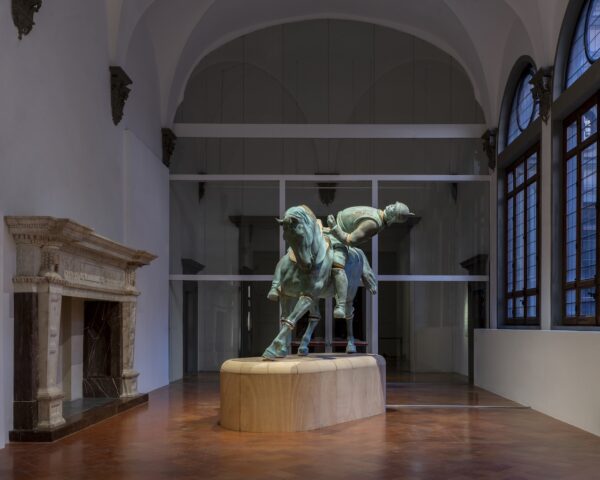
A new installation by Dutch artist Mark Manders, conceived specifically for Palazzo Strozzi’s Renaissance courtyard, extends the theme beyond the exhibition rooms.

An exhibition built around different kinds of loss
Taken together, the objects complicate the familiar idea that a broken artwork is necessarily a diminished one. The exhibition distinguishes between very different processes — erosion, accident, iconoclasm, warfare, political change, colonial removal, restoration and intentional artistic fragmentation — while examining how each can alter the meaning of an object.
A fragment may provide archaeological evidence of a vanished whole, preserve physical evidence of violence or acquire a second history independent of the work from which it came. The exhibition’s chronology also shows how attitudes towards incomplete sculpture have changed: objects once valued primarily as remnants of antiquity have themselves influenced the way later artists represent the human body.
In Florence, where ancient fragments, Renaissance restoration and the physical legacy of the 1966 flood form part of the city’s own relationship with cultural heritage, that question has a particularly local dimension.
Practical information
Broken. The Power of the Fragment runs at Palazzo Strozzi from September 25, 2026 to January 24, 2027. It then moves to the National Gallery of Art in Washington, where it is scheduled from March 3 to June 27, 2027.
The Florence exhibition is open daily from 10 a.m. to 8 p.m., with Thursday opening extended until 11 p.m.
Further information on tickets, accessibility and visits is available from Palazzo Strozzi’s official website.
(Photos by Photo Ela Bialkowska, OKNO Studio)
❤️ Support Florence Daily News
If you liked this article, please consider supporting Florence Daily News.
We are an independent news site, free from paywalls and intrusive ads, committed to providing clear and reliable reporting on Florence and Tuscany for everyone.
Your support — whether a one-time gift or a regular contribution — helps us stay independent and keep telling the stories that matter.
Donate securely via Stripe below.
Make a one-time donation
Make a monthly donation
Make a yearly donation
Choose an amount
Or enter a custom amount
Your contribution is appreciated.
Your contribution is appreciated.
Your contribution is appreciated.