


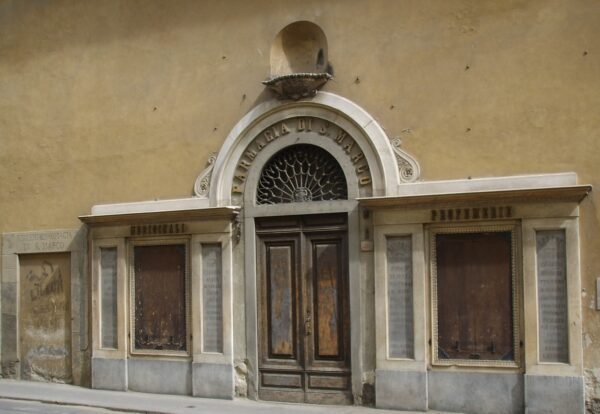
An old advertisement found in the archives of the Dominican convent of San Marco in Florence has revealed the recipe for a restorative drink once produced by the friars using coca leaves and kola nuts.
The discovery was first reported by the Tuscan Catholic weekly Toscana Oggi, which collected the account of the Dominican community at San Marco. The document emerged during work to reorganise the archives of the convent’s historic pharmacy in Via Cavour.
The yellowed advertising leaflet, dating from the 19th century, describes an Elixir vinoso ricostituente, or restorative wine-based elixir. It was promoted at the time as a tonic for physical and mental fatigue, headaches and weakness associated with age or particularly strenuous activity.
Its recipe is what has attracted attention: 30 grams of kola nut and 10 grams of Bolivian coca leaves infused in one litre of an alcoholic mixture. According to the account reported by Toscana Oggi, the ingredients may have reached Tuscany through missionaries returning from Latin America and Africa.
A resemblance, not a historical link
The combination inevitably recalls the early history of Coca-Cola. But there is no evidence that the Florence elixir influenced Coca-Cola, and the Dominican friars themselves are not claiming that it did.
The comparison is based on the similarity of some ingredients and on the period in which the drinks were developed. The surviving Florentine document does not establish any connection between the San Marco pharmacy and John Stith Pemberton, the Atlanta pharmacist credited with creating Coca-Cola.
The Coca-Cola Company dates the birth of its drink to May 8, 1886, when Pemberton brought his syrup to Jacobs’ Pharmacy in Atlanta, Georgia. There it was mixed with carbonated water and sold as a soda-fountain drink.
The San Marco discovery therefore offers an intriguing example of how coca and kola were being used in 19th-century pharmaceutical preparations on both sides of the Atlantic, rather than evidence for a Florentine origin of Coca-Cola.
A popular product at San Marco
The document was found by Father Manuel Russo, rector of the San Marco convent, while he was examining material preserved in the pharmacy archives.
According to his account reported by Toscana Oggi, further research showed that the elixir had once been among the pharmacy’s most popular preparations. The recipe itself may have older origins, possibly dating back to the 18th century, although the drink became particularly widespread between the late 19th and early 20th centuries.
There is also a local Florence story attached to the drink. During the period when Florence was capital of the newly unified Kingdom of Italy, from 1865 to 1871, government ministry employees are said to have stopped at the pharmacy in Via Cavour during their breaks to drink the restorative preparation.
Production continued until around the 1930s. Original labels and several empty bottles have survived in the convent’s collection.
The find sheds light on a less familiar part of San Marco’s history. Better known internationally for its Renaissance art and its association with the Dominican friar and painter Fra Angelico, the convent also had a long pharmaceutical tradition in which friars prepared and sold remedies using ingredients arriving in Florence from different parts of the world.
Whether the San Marco elixir and Coca-Cola belong to anything more than parallel chapters of 19th-century pharmaceutical history remains unproven. For now, the archival discovery documented by Toscana Oggi provides a curious Florentine counterpart to the story of a drink that would later become one of the most recognisable brands in the world.
❤️ Support Florence Daily News
If you liked this article, please consider supporting Florence Daily News.
We are an independent news site, free from paywalls and intrusive ads, committed to providing clear and reliable reporting on Florence and Tuscany for everyone.
Your support — whether a one-time gift or a regular contribution — helps us stay independent and keep telling the stories that matter.
Donate securely via Stripe below.
Make a one-time donation
Make a monthly donation
Make a yearly donation
Choose an amount
Or enter a custom amount
Your contribution is appreciated.
Your contribution is appreciated.
Your contribution is appreciated.