


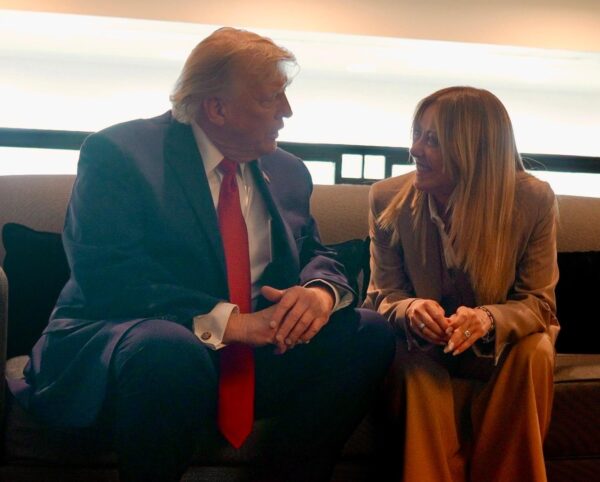
The news of the day was, in essence, simple: a brief exchange of public barbs between Donald Trump and Giorgia Meloni on social media. Nothing unusual in Trump’s case, where provocation has long since become a stable form of political communication. More interesting, instead, was Meloni’s response: not institutional silence, but a reply delivered in the same space, at the same speed, in the same language.
It is at this point that the episode stops being an isolated incident and becomes a signal. Increasingly, political leaders do not respond only as heads of government, but as public profiles exposed to a constant stream of judgment, attack, and interpretation. The defense is not limited to a political position; it extends to one’s immediate reputation.
In this sense, politics is moving closer to a form of permanent image management. And the reputation of the leader increasingly overlaps with that of the institution they represent: defending oneself becomes indistinguishable from defending the government—or at least it is perceived that way.
It is the same mechanism that makes it natural, in many contexts, to refer to the Israeli prime minister as “Bibi.” The nickname compresses institutional distance and turns a constitutional role into a personal presence—recognizable, almost narrative. One is no longer speaking solely about an office, but about a character.
Donald, Giorgia, “Bibi”: names that function less and less as titles and more as brands. And when politics becomes a system of competing personal reputations, every public exchange—even the briefest, even the most routine—takes on the weight of image defense.
In the end, this is not only about communication. It reflects a deeper shift: politics as the continuous management of visibility, in which governing and “staying credible” online begin to feel like the same task.
The danger, however, is that this overlap between institution and character produces a nearly imperceptible side effect: it renders everything that is not the leader invisible. The complexity of administration, the plurality of political and technical actors, the slow work of institutions recede into the background, as if they were merely scenery.
And the more politics concentrates on a single face, the more that face accumulates not only attention, but symbolic power. A power that does not necessarily stem from greater formal authority, but from the ability to occupy the entire space of public representation.
In this shift, the risk is not simply that politics becomes more personalized. It is that it becomes harder to distinguish between those who make decisions and the collective system that makes them possible.
(Cover photo via Italian government website)
❤️ Support Florence Daily News
If you liked this article, please consider supporting Florence Daily News.
We are an independent news site, free from paywalls and intrusive ads, committed to providing clear and reliable reporting on Florence and Tuscany for everyone.
Your support — whether a one-time gift or a regular contribution — helps us stay independent and keep telling the stories that matter.
Donate securely via Stripe below.
Make a one-time donation
Make a monthly donation
Make a yearly donation
Choose an amount
Or enter a custom amount
Your contribution is appreciated.
Your contribution is appreciated.
Your contribution is appreciated.


Eirini Lavrentiadou is an actress and singer, born in Thessaloniki in 1992. She lives in Florence, where she trained at the city’s Theatre Academy and the Fiesole School of Music. She has performed in classical Greek and European plays, worked with international directors and companies, and appeared in concerts ranging from opera to jazz. She contributes to Florence Daily News as a writer.