


Calls for a stronger European defence system, warnings about geopolitical instability and appeals for greater technological independence dominated the opening day of celebrations marking the 50th anniversary of the European University Institute (EUI) in Florence.
European political leaders, institutional representatives and academics gathered at the Teatro del Maggio Musicale Fiorentino on Thursday May 7, 2026, for the start of a three-day programme dedicated to the institute’s role in European research and integration. But the event quickly became a wider discussion about the future of the European Union in a period marked by war, energy insecurity, global competition and democratic pressure.
“Europe must free itself from the tyranny of global crises,” European Commission president Ursula von der Leyen said in a video message sent to the conference. She argued that Europe must become capable of guaranteeing its own defence, securing technology and energy supplies and protecting democratic institutions through “massive investments” and “unwavering political commitment”.

Defence and security dominate the debate
One of the strongest themes throughout the day was the idea that Europe can no longer rely entirely on the United States for its security.
Portuguese president António José Martins Seguro said Russia’s invasion of Ukraine had fundamentally changed Europe’s strategic outlook.
“Europe has understood that Russia represents a real threat and that it cannot continue to depend on the United States to guarantee its security and defence,” Seguro said. “It needs an autonomous and credible defence capacity.”
At the same time, Seguro insisted that strengthening European defence should not be interpreted as anti-American or anti-NATO. “We must maintain NATO,” he said, “but within a relationship of alliance between countries that cooperate on equal terms and respect each other.”
European Council president António Costa echoed the same message, saying the past year had shown that “peace without defence is simply an illusion”.
Costa explained that EU institutions have already begun identifying common defence priorities and creating financial instruments to support greater investment among member states. According to him, the process is intended to complement NATO rather than replace it.
Roberta Metsola, president of the European Parliament, also backed the idea of a European defence union, openly supporting recent remarks by Italian president Sergio Mattarella.
“President Mattarella is right when he says Europe needs a defence union,” Metsola said. “Working together absolutely makes sense.”
She questioned why EU countries continue investing separately in defence despite spending more overall than during the Cold War years.
Ukraine and enlargement remain central
The war in Ukraine repeatedly emerged as both a security issue and a symbol of Europe’s future political direction.
Seguro described peace as “fragile” and warned that democracy across Europe faces pressure from disinformation, declining trust in institutions and political extremism.
Costa said any future peace agreement would eventually require dialogue not only between Kyiv and Moscow but also between Europe and Russia regarding the continent’s future security architecture.
“We are in Europe, we are neighbours of Russia,” Costa said. “So we will also have to speak with them about security and the architecture of future peace.”
At the same time, European leaders stressed that support for European integration remains strong internationally.
Metsola noted that 12 countries are currently seeking membership in the European Union. She also pointed to signs of renewed British interest in closer relations with Europe a decade after Brexit.
“We now have a government in the United Kingdom that understands that it needs to move closer to Europe,” Metsola said, adding that this is particularly important for younger generations in Britain.
Costa also expressed optimism about future enlargement, saying Montenegro could realistically become an EU member by 2028. He suggested that political changes in Hungary could eventually remove current obstacles to Ukraine’s accession process.
Technology and digital sovereignty move to the centre
Alongside defence, another major theme was Europe’s growing concern about technological dependence on non-European platforms and infrastructures.
EUI president Patrizia Nanz argued that Europe faces enormous investment needs if it wants to remain competitive and strategically autonomous.
“It is estimated that by 2030 the investment deficit will amount to €750-800 billion per year,” Nanz said. “If Europe wants to become self-sufficient, it must be able to mobilise its own resources.”
She described digital infrastructure as “our coal and steel”, comparing today’s technological systems to the industries that formed the basis of European integration after the Second World War.
Nanz warned that much of Europe’s knowledge, data and security-related information is currently stored and managed by large non-European platforms.
“The question is whether Europe will be able to govern itself on its own terms,” she said, “or whether it will leave the fundamental infrastructure where citizens deliberate and young generations interact under the control of others.”
She also revealed that the EUI is working on the idea of creating what she described as “the first truly European social media platform”.
Florence and Tuscany reaffirm their European identity
The anniversary celebrations also highlighted the historical connection between Florence, Tuscany and the European project.
EUI secretary general Armando Barucco said the institute had spent the last 50 years helping to build a European identity through research, universities and culture.
“In these 50 years we have formulated bold ideas to create a united Europe,” Barucco said, recalling the contribution of former Italian prime minister Aldo Moro and former Florence mayor Giorgio La Pira to the institute’s creation.
Florence mayor Sara Funaro described the anniversary as “a new starting point” and said Europe must renew the spirit of cohesion that shaped its history.
Fiesole mayor Cristina Scaletti recalled that Moro personally selected the Badia Fiesolana as the institute’s headquarters because he believed Europe could not be built solely on bureaucracy or monetary union, but on shared values and culture.
Tuscany president Eugenio Giani said the European spirit is “part of the DNA” of the region’s identity and expressed support for a more integrated and enlarged European Union.
A European institution rooted in Florence
Founded in 1972 by the member states of the European Communities, the European University Institute officially opened in Florence in 1976. Its main campus is located at the Badia Fiesolana in Fiesole, while additional departments and research centres are spread across several historic buildings in Florence and the surrounding area.
Over the decades, the EUI has become one of Europe’s leading postgraduate and research institutions, specialising in law, economics, history, political and social sciences and public policy.
The institute hosts doctoral researchers, fellows and visiting scholars from across Europe and beyond, contributing significantly to Florence’s international academic profile.
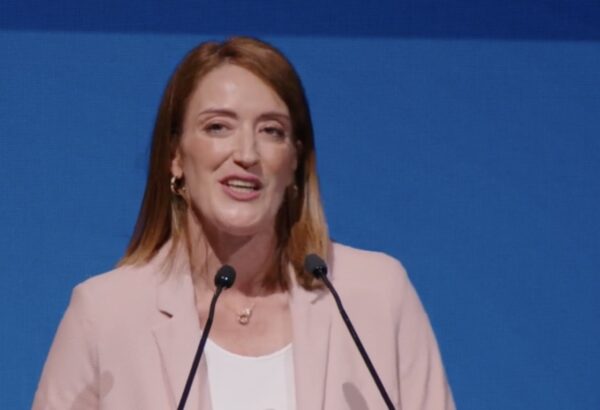
(Cover photo: Roberta Metsola, president of the European Parliament)
❤️ Support Florence Daily News
If you liked this article, please consider supporting Florence Daily News.
We are an independent news site, free from paywalls and intrusive ads, committed to providing clear and reliable reporting on Florence and Tuscany for everyone.
Your support — whether a one-time gift or a regular contribution — helps us stay independent and keep telling the stories that matter.
Donate securely via Stripe below.
Make a one-time donation
Make a monthly donation
Make a yearly donation
Choose an amount
Or enter a custom amount
Your contribution is appreciated.
Your contribution is appreciated.
Your contribution is appreciated.