


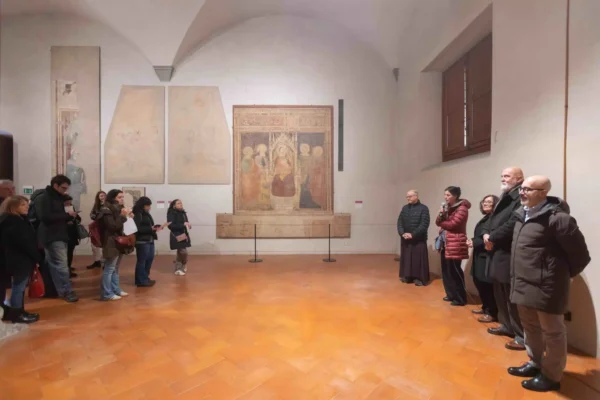
From Sunday February 1, 2026, visitors to the complex of Santa Maria del Carmine in Florence will be able to enter a new permanent museum space: the Sala della Colonna. Until now, the room had only been opened on an occasional basis.
The opening extends the visit itinerary of one of Florence’s most important religious complexes, internationally known for the Cappella Brancacci, frescoed in the 15th century by Masolino da Panicale, Masaccio and Filippino Lippi, and for the Baroque Cappella Corsini, restored in recent years.
According to the city administration, the Sala della Colonna becomes an integral part of the route managed by Florence’s Civic Museums, following an agreement with the Carmelite friars and operational support from Fondazione MUS.E. The new room is intended to offer a broader reading of the artistic and historical development of the Carmine complex, from the late Middle Ages to the early Renaissance.
A room shaped by restorations and rediscoveries
The Sala della Colonna is located in the first cloister of the former convent, between the old and the new refectory, and takes its name from a large 14th-century column placed at its centre. The space brings together detached frescoes and sinopie recovered from the church and the cloister during research and restoration campaigns carried out between the 19th and 20th centuries.
Among the earliest works on display is a fresco by Pietro Nelli, depicting the Madonna and Child enthroned with saints and donors, dated to the 1380s. The painting was uncovered during 19th-century investigations linked to the search for Masaccio’s lost Sagra fresco.
Also dating to those discoveries is a large fresco attributed to the young Filippo Lippi, who at the time was a friar living in the Carmine convent.
Fragments from the fresco decoration of the chapel of San Girolamo, painted between 1402 and 1404 by Gherardo Starnina, are displayed along the walls. Starnina was a leading figure of late Gothic painting in Florence and was later praised by Giorgio Vasari.
The Brancacci sinopie and later additions
The room also houses two sinopie by Masolino from the Cappella Brancacci, representing the Repentance of Saint Peterand Pasce oves meas. These preparatory drawings are the only surviving evidence of the original fresco decoration of the upper register of the chapel, which was destroyed in the 18th century.
The display is completed by a fresco of the Crucifixion attributed to Paolo Schiavo, dated to around 1425. The work was discovered beneath later plaster layers inside the Sala della Colonna during restoration works carried out after the 1966 flood.
With the opening of this new space, the visit to Santa Maria del Carmine gains an additional layer of historical depth, helping visitors understand how the artistic experiments of early Renaissance Florence emerged from a long and complex visual tradition.
❤️ Support Florence Daily News
If you liked this article, please consider supporting Florence Daily News.
We are an independent news site, free from paywalls and intrusive ads, committed to providing clear and reliable reporting on Florence and Tuscany for everyone.
Your support — whether a one-time gift or a regular contribution — helps us stay independent and keep telling the stories that matter.
Donate securely via Stripe below.
Make a one-time donation
Make a monthly donation
Make a yearly donation
Choose an amount
Or enter a custom amount
Your contribution is appreciated.
Your contribution is appreciated.
Your contribution is appreciated.
DonateDonate monthlyDonate yearly