


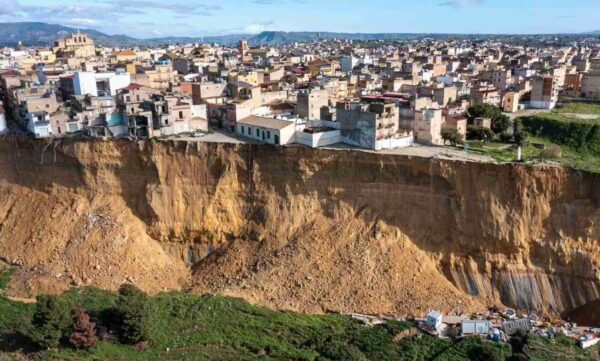
A team from the University of Florence is operating in Niscemi, in southern Sicily, following a large landslide that worsened overnight between Sunday 25 and Monday 26 January. The collapse has created a long scarp below the built-up area and has involved several residential buildings.
The intervention is being coordinated by the university’s Centre for Civil Protection, which has been a national competence centre for landslides and volcanic risk since 2005, providing technical and scientific support to Italy’s Department of Civil Protection.
Surveys and monitoring underway
According to Nicola Casagli, president of the University of Florence’s Civil Protection Centre, the team was activated urgently after the Sicily Region requested specialist support for a landslide that had started in mid-January but then rapidly intensified.
Casagli travelled to Sicily together with applied geology professor Giovanni Gigli and technologist Tommaso Beni. Once on site, the group carried out helicopter overflights, ground inspections and high-precision surveys using drones to assess the scale and dynamics of the movement.
Preliminary estimates indicate that tens, and possibly hundreds, of millions of cubic metres of material are involved. The landslide has created a steep scarp immediately below the town, posing a serious threat to the first rows of houses along the edge of the built-up area.
A large but not unprecedented event
Casagli explained that, despite its exceptional size, the Niscemi landslide does not necessarily indicate a general increase in vulnerability. Similar events, although sometimes smaller, have occurred in the same area in the past, notably in 1790 and 1997, pointing to the cyclical nature of this type of instability.
However, the recent collapse showed no clear precursory signals, making forecasting extremely difficult. Italy’s official hazard maps identify around 650,000 areas exposed to landslides and floods nationwide, underlining the structural nature of hydrogeological risk in many parts of the country.
Future scenarios and mitigation
Looking ahead, the scarp below Niscemi is expected to retreat further. Once this phase stabilises, technical interventions will be needed to drain water from the underlying clay layers, as water is a key factor driving the movement of large masses of soil.
For now, the priority remains continuous monitoring to detect any new signs of movement and to reduce risk where possible. After completing field activities, Casagli briefed Italy’s prime minister Giorgia Meloni on the situation and the initial findings from the surveys.
❤️ Support Florence Daily News
If you liked this article, please consider supporting Florence Daily News.
We are an independent news site, free from paywalls and intrusive ads, committed to providing clear and reliable reporting on Florence and Tuscany for everyone.
Your support — whether a one-time gift or a regular contribution — helps us stay independent and keep telling the stories that matter.
Donate securely via Stripe below.
Make a one-time donation
Make a monthly donation
Make a yearly donation
Choose an amount
Or enter a custom amount
Your contribution is appreciated.
Your contribution is appreciated.
Your contribution is appreciated.
DonateDonate monthlyDonate yearly